Results by title
5 books match the query 'Boethius'
An Exposition of the On the Hebdomads of Boethius (Thomas Aquinas in Translation)
Saint Thomas Aquinas
Catholic University of America Press, 2001
The English translation itself, in facing-page format with the 1992 Leonine critical edition of Aquinas's Latin text, remains faithful to the text and at the same time clear and readable.
[more]
Boethius and Aquinas
Ralph McInerny
Catholic University of America Press, 2012
In this study of the relationship between Boethius and Thomas Aquinas, Ralph McInerny dispels the notion that Aquinas misunderstood the early philosopher and argues instead that he learned from Boethius, assimilated his ideas, and proved to be a reliable interpreter of his thought.
[more]
Practicing Literary Theory in the Middle Ages
Ethics and the Mixed Form in Chaucer, Gower, Usk, and HoccleveEleanor Johnson
University of Chicago Press, 2013
Literary scholars often avoid the category of the aesthetic in discussions of ethics, believing that purely aesthetic judgments can vitiate analyses of a literary work’s sociopolitical heft and meaning. In Practicing Literary Theory in the Middle Ages, Eleanor Johnson reveals that aesthetics—the formal aspects of literary language that make it sense-perceptible—are indeed inextricable from ethics in the writing of medieval literature.
Johnson brings a keen formalist eye to bear on the prosimetric form: the mixing of prose with lyrical poetry. This form descends from the writings of the sixth-century Christian philosopher Boethius—specifically his famous prison text, Consolation of Philosophy—to the late medieval English tradition. Johnson argues that Boethius’s text had a broad influence not simply on the thematic and philosophical content of subsequent literary writing, but also on the specific aesthetic construction of several vernacular traditions. She demonstrates the underlying prosimetric structures in a variety of Middle English texts—including Chaucer’s Troilus and Criseyde and portions of the Canterbury Tales, Thomas Usk’s Testament of Love, John Gower’s Confessio amantis, and Thomas Hoccleve’s autobiographical poetry—and asks how particular formal choices work, how they resonate with medieval literary-theoretical ideas, and how particular poems and prose works mediate the tricky business of modeling ethical transformation for a readership.
[more]
The Legacy of Boethius in Medieval England
The Consolation and its AfterlivesA. Joseph McMullen
Arizona Center for Medieval and Renaissance Studies, 2018
The study of Boethius’s medieval reception has enjoyed a resurgence of interest in recent years, with the publication of new editions, translations, databases, and research reshaping our understanding of his profound influence. This study offers the first holistic survey of the reworkings of the Consolation in medieval England, surveying the Old English Boethius together with Chaucer’s Boece and a host of understudied interlocutors for the first time in a volume of this kind. Arranged into sections on “earlier” and “later” periods, The Legacy of Boethius argues for a reassessment of the medieval English Boethian tradition as a 600-year continuum in vernacular reading and readership.
[more]
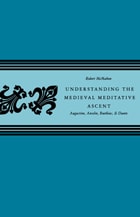
Understanding the Medieval Meditative Ascent
Augustine, Anselm, Boethius and DanteRobert McMahon
Catholic University of America Press, 2006
Understanding the Medieval Meditative Ascent uses literary analysis to discover new philosophical meanings in these works. Clearly written in nontechnical language, its account of their literary structures and of the hidden meanings they generate will inform nonspecialist and specialist alike.
[more]