Results by title
3 books match the query 'Boggs, Grace Lee'

Living For Change
An AutobiographyGrace Lee Boggs
University of Minnesota Press, 1998

Living for Change
An AutobiographyGrace Lee Boggs
University of Minnesota Press, 2016
No one can tell in advance what form a movement will take. Grace Lee Boggs’s fascinating autobiography traces the story of a woman who transcended class and racial boundaries to pursue her passionate belief in a better society. Now with a new foreword by Robin D. G. Kelley, Living for Change is a sweeping account of a legendary human rights activist whose network included Malcolm X and C. L. R. James. From the end of the 1930s, through the Cold War, the Civil Rights era, and the rise of the Black Panthers to later efforts to rebuild crumbling urban communities, Living for Change is an exhilarating look at a remarkable woman who dedicated her life to social justice.
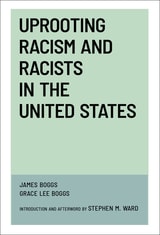
Uprooting Racism and Racists in the United States
James Boggs and Grace Lee Boggs
Disobedience Press, 2027
“Uprooting Racism and Racists in the United States” has become even more timely and instructive today than when James and Grace Lee Boggs first sounded the alarm in 1970. In this essay, the Boggses diagnose the “essential contradiction” of economic overdevelopment and political underdevelopment, tracing its path through key stages: how racism has been interwoven into U.S. economic development; a destructive national drive for economic growth at all costs; and how subsequent generations of Americans prioritize economics over principles—breeding a collective social irresponsibility that leaves us unable to act ethically in the face of pressing social challenges.
Today, the contradiction the Boggses identified has grown more entrenched—and its consequences more destructive. “Uprooting” helps explain why millions voted for Trump in 2024 despite his demonstrated corruption, why society fails to regulate the expansion of AI and data centers, why we are unable to forestall the climate changes that scientists have long warned against, why immigrants face racist vilification, and why the federal government is intent on erasing the centrality of race to the making of the country. Ultimately, “Uprooting” offers a crucial assessment of where this contradiction began, how it shapes the nation, and where we need to go.