Results by title
4 books match the query 'Bogotá (Colombia)'
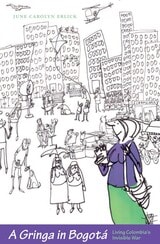
A Gringa in Bogotá
Living Colombia's Invisible WarBy June Carolyn Erlick
University of Texas Press, 2010
To many foreigners, Colombia is a nightmare of drugs and violence. Yet normal life goes on there, and, in Bogotá, it's even possible to forget that war still ravages the countryside. This paradox of perceptions—outsiders' fears versus insiders' realities—drew June Carolyn Erlick back to Bogotá for a year's stay in 2005. She wanted to understand how the city she first came to love in 1975 has made such strides toward building a peaceful civil society in the midst of ongoing violence. The complex reality she found comes to life in this compelling memoir.
Erlick creates her portrait of Bogotá through a series of vivid vignettes that cover many aspects of city life. As an experienced journalist, she lets the things she observes lead her to larger conclusions. The courtesy of people on buses, the absence of packs of stray dogs and street trash, and the willingness of strangers to help her cross an overpass when vertigo overwhelms her all become signs of convivencia—the desire of Bogotanos to live together in harmony despite decades of war. But as Erlick settles further into city life, she finds that "war in the city is invisible, but constantly present in subtle ways, almost like the constant mist that used to drip down from the Bogotá skies so many years ago."
Shattering stereotypes with its lively reporting, A Gringa in Bogotá is must-reading for going beyond the headlines about the drug war and bloody conflict.
Bogotá
A NovelAlan Grostephan
Northwestern University Press, 2013
In Bogotá, a taut, moving novel set in present-day Colombia, Wilfredo decides to uproot his family from their small town, where his ferry service on the river subjects him to the gruesome errands demanded by the local paramilitary. Moving in with relatives in a slum in Bogotá, the family tries desperately to achieve the smallest measure of comfort and hope in a world of almost total ruin, wracked by deprivation, fear, and ceaseless violence.
Alan Grostephan depicts with startling immediacy an urban landscape of extreme harshness and oppressive instability. The tension between the desperate conditions surrounding his characters and their efforts to hold on to their humanity gives Bogotá a ferocious energy. As Wilfredo and his family fight to stay alive and stay together, their plight emerges as equally enraging and uplifting, constituting a portrait of a society always on the verge of disintegration.
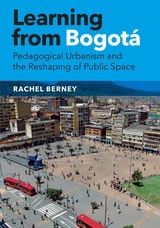
Learning from Bogotá
Pedagogical Urbanism and the Reshaping of Public SpaceBy Rachel Berney
University of Texas Press, 2017
Once known as a “drug capital” and associated with kidnappings, violence, and excess, Bogotá, Colombia, has undergone a transformation that some have termed “the miracle of Bogotá.” Beginning in the late 1980s, the city emerged from a long period of political and social instability to become an unexpected model of urban development through the redesign and revitalization of the public realm—parks, transportation, and derelict spaces—under the leadership of two “public space mayors,” Antanas Mockus and Enrique Peñalosa (the latter reelected in 2015). In Learning from Bogotá, Rachel Berney analyzes how these mayors worked to reconfigure the troubled city into a pedagogical one whose public spaces and urban policy have helped shape a more tolerant and aware citizenry.
Berney examines the contributions of Mockus and Peñalosa through the lenses of both spatial/urban design and the city’s history. She shows how, through the careful intertwining of new public space and transportation projects, the reclamation of privatized public space, and the refurbishment of dilapidated open spaces, the mayors enacted an ambitious urban vision for Bogotá without resorting to the failed method of the top-down city master plan. Illuminating the complex interplay between formal politics, urban planning, and improvised social strategies, as well as the negative consequences that accompanied Bogotá’s metamorphosis, Learning from Bogotá offers significant lessons about the possibility for positive and lasting change in cities around the world.
The Assassination of Gaitán
Public Life and Urban Violence in ColombiaHerbert Braun
University of Wisconsin Press, 1985
Drawn in part from personal interviews with participants and witnesses, Herbert Braun’s analysis of the riot’s roots, its patterns and consequences, provides a dramatic account of this historic turning point and an illuminating look at the making of modern Colombia.
Braun’s narrative begins in the year 1930 in Bogotá, Colombia, when a generation of Liberals and Conservatives came to power convinced they could kept he peace by being distant, dispassionate, and rational. One of these politicians, Jorge Eliécer Gaitán, was different. Seeking to bring about a society of merit, mass participation, and individualism, he exposed the private interests of the reigning politicians and engendered a passionate relationship with his followers. His assassination called forth urban crowds that sought to destroy every visible evidence of public authority of a society they felt no longer had the moral right to exist.
This is a book about behavior in public: how the actors—the political elite, Gaitán, and the crowds—explained and conducted themselves in public, what they said and felt, and what they sought to preserve or destroy, is the evidence on which Braun draws to explain the conflicts contained in Colombian history. The author demonstrates that the political culture that was emerging through these tensions offered the hope of a peaceful transition to a more open, participatory, and democratic society.
“Most Colombians regard Jorge Eliécer Gaitán as a pivotal figure in their nation’s history, whose assassination on April 9, 1948 irrevocably changed the course of events in the twentieth century. . . . As biography, social history, and political analysis, Braun’s book is a tour de force.”—Jane M. Rausch, Hispanic American Historical Review