Results by title
6 books match the query 'Bohemia'
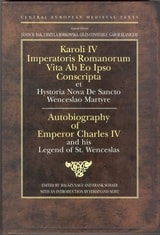
Autobiography of Emperor Charles IV and his Legend of St Wenceslas
Balázs Nagy
Central European University Press, 2001
One of the few autobiographies to have survived from the Middle Ages, this life history of one of the most influential rulers of the fourteenth century, Charles IV of Bohemia, covers his life from birth until his election as King of Germany in 1346.
Charles IV describes his childhood, spent mainly in the court of French kings, his juvenile years, his marriage and his first steps into the international political scene during the early part of the fourteenth century.
A unique addition to this volume is the first ever English translation of the Legend of Saint Wenceslas, written by Charles IV of Luxemburg.
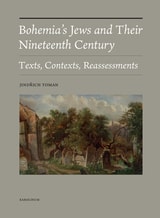
Bohemia's Jews and Their Nineteenth Century
Texts, Contexts, ReassessmentsJindrich Toman
Karolinum Press, 2023
This book on Jewish culture and literature focuses on the “quiet” decades of the nineteenth century, a scarcely written-about period of time in Bohemian Jewish history. Using a myriad of sources, including travelers’ accounts, poems, essays, short stories, guides, and newspaper articles, the volume explores Jewish expression, Jewish-Czech relations, and the changing attitudes toward Jews between the 1820s and 1880s. It offers close readings of writers like Karel Havlíćek Borovský, Ján Kollár, Siegfried Kapper, and Jan Neruda, as well as lesser-known authors and sources. Combining skillful sustained analysis, judicious argumentation, and elegant writing, the book is a truly enriching reading experience.
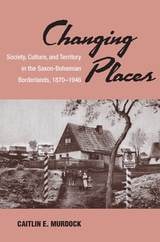
Changing Places
Society, Culture, and Territory in the Saxon-Bohemian Borderlands, 1870-1946Caitlin E. Murdock
University of Michigan Press, 2010
"Changing Places is an interesting meditation on the varying identities and rights claimed by residents of borderlands, the limits placed on the capacities of nation-states to police their borders and enforce national identities, and the persistence of such contact zones in the past and present. It is an extremely well-written and engaging study, and an absolute pleasure to read."
---Dennis Sweeney, University of Alberta
"Changing Places offers a brilliantly transnational approach to its subject, the kind that historians perennially demand of themselves but almost never accomplish in practice."
---Pieter M. Judson, Swarthmore College
Changing Places is a transnational history of the birth, life, and death of a modern borderland and of frontier peoples' changing relationships to nations, states, and territorial belonging. The cross-border region between Germany and Habsburg Austria---and after 1918 between Germany and Czechoslovakia---became an international showcase for modern state building, nationalist agitation, and local pragmatism after World War I, in the 1930s, and again after 1945.
Caitlin Murdock uses wide-ranging archival and published sources from Germany and the Czech Republic to tell a truly transnational story of how state, regional, and local historical actors created, and eventually destroyed, a cross-border region. Changing Places demonstrates the persistence of national fluidity, ambiguity, and ambivalence in Germany long after unification and even under fascism. It shows how the 1938 Nazi annexation of the Czechoslovak "Sudetenland" became imaginable to local actors and political leaders alike. At the same time, it illustrates that the Czech-German nationalist conflict and Hitler's Anschluss are only a small part of the larger, more complex borderland story that continues to shape local identities and international politics today.
Caitlin E. Murdock is Associate Professor of History at California State University, Long Beach.
Jacket Credit: Cover art courtesy of the author
Demographic Avant-Garde
Jews in Bohemia between the Enlightenment and the ShoahJana Vobecká
Central European University Press, 2013
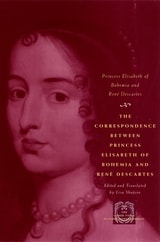
The Correspondence between Princess Elisabeth of Bohemia and René Descartes
Princess Elisabeth of Bohemia and René Descartes
University of Chicago Press, 2007
Between the years 1643 and 1649, Princess Elisabeth of Bohemia (1618–80) and René Descartes (1596–1650) exchanged fifty-eight letters—thirty-two from Descartes and twenty-six from Elisabeth. Their correspondence contains the only known extant philosophical writings by Elisabeth, revealing her mastery of metaphysics, analytic geometry, and moral philosophy, as well as her keen interest in natural philosophy. The letters are essential reading for anyone interested in Descartes’s philosophy, in particular his account of the human being as a union of mind and body, as well as his ethics. They also provide a unique insight into the character of their authors and the way ideas develop through intellectual collaboration.
Philosophers have long been familiar with Descartes’s side of the correspondence. Now Elisabeth’s letters—never before available in translation in their entirety—emerge this volume, adding much-needed context and depth both to Descartes’s ideas and the legacy of the princess. Lisa Shapiro’s annotated edition—which also includes Elisabeth’s correspondence with the Quakers William Penn and Robert Barclay—will be heralded by students of philosophy, feminist theorists, and historians of the early modern period.
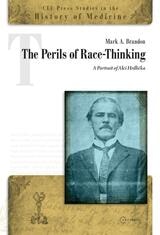
The Perils of Race-Thinking
A Portrait of Ales HrdlickaMark A. Brandon
Central European University Press, 2023
Eugenics and scientific racism are experiencing a resurgence, and an understanding of the ideas of Aleš Hrdlička can help combat them. Today, the racial science of the early twentieth century is both untenable and contemptible. This book is about an arch figure of that period: Aleš Hrdlička served as Curator of Physical Anthropology at the prestigious Smithsonian Institution from 1910 to 1941. Although his ideas about race are today considered pseudoscience, the uncomfortable truth is that he was an internationally respected scientist in his own day.
The Perils of Race-Thinking advances a bold new interpretation of modern racial ideology by exploring Hrdlička’s intellectual world. Using previously untapped Czech-language sources, Brandon irrevocably alters the discussion about this important figure by placing Czech nationalism at the center of his racial thinking. Defying disciplinary categories, Perils of Race-Thinking joins critical analysis of this key American anthropologist with an incisive revisionist perspective of interwar Czechoslovakia to unearth transnational racial presumptions lurking behind the worst crimes of the twentieth century.
At the center of Hrdlička’s race beliefs was his commitment to Czech and Slovak unity and independence. From this center, his next level of concern was what he believed to be a millennial racial struggle between Germans and Slavs. On a global scale, he viewed the Slavs, and especially the Soviet Union, as a eugenic bastion of White strength holding off the “rising tide of color.”
Step by step, Perils of Race-Thinking mercilessly dismantles Hrdlička’s racial system and exposes it as mysticism dressed up in the language of science. Convinced that human individuals belonged “naturally” in racial groups, Hrdlička embraced a revolutionary program of reordering the globe according to a harrowing morality of “Darwinist” struggle. Yet despite a lifetime of measuring body parts, even Hrdlička could not decide how many races there were or how to tell them apart.