63 books match the query 'Bolivia' and 3 start with a
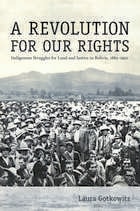
cover of A Revolution for Our Rights: Indigenous Struggles for Land and Justice in Bolivia, 1880-1952

A Revolution for Our Rights

Indigenous Struggles for Land and Justice in Bolivia, 1880-1952

Laura Gotkowitz

Duke University Press, 2008

A Revolution for Our Rights is a critical reassessment of the causes and significance of the Bolivian Revolution of 1952. Historians have tended to view the revolution as the result of class-based movements that accompanied the rise of peasant leagues, mineworker unions, and reformist political projects in the 1930s. Laura Gotkowitz argues that the revolution had deeper roots in the indigenous struggles for land and justice that swept through Bolivia during the first half of the twentieth century. Challenging conventional wisdom, she demonstrates that rural indigenous activists fundamentally reshaped the military populist projects of the 1930s and 1940s. In so doing, she chronicles a hidden rural revolution—before the revolution of 1952—that fused appeals for equality with demands for a radical reconfiguration of political power, landholding, and rights.

Gotkowitz combines an emphasis on national political debates and congresses with a sharply focused analysis of Indian communities and large estates in the department of Cochabamba. The fragmented nature of Cochabamba’s Indian communities and the pioneering significance of its peasant unions make it a propitious vantage point for exploring contests over competing visions of the nation, justice, and rights. Scrutinizing state authorities’ efforts to impose the law in what was considered a lawless countryside, Gotkowitz shows how, time and again, indigenous activists shrewdly exploited the ambiguous status of the state’s pro-Indian laws to press their demands for land and justice. Bolivian indigenous and social movements have captured worldwide attention during the past several years. By describing indigenous mobilization in the decades preceding the revolution of 1952, A Revolution for Our Rights illuminates a crucial chapter in the long history behind present-day struggles in Bolivia and contributes to an understanding of indigenous politics in modern Latin America more broadly.
[more]
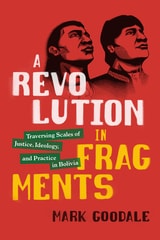
cover of A Revolution in Fragments: Traversing Scales of Justice, Ideology, and Practice in Bolivia

A Revolution in Fragments

Traversing Scales of Justice, Ideology, and Practice in Bolivia

Mark Goodale

Duke University Press, 2019
The years between 2006 and 2015, during which Evo Morales became Bolivia's first indigenous president, have been described as a time of democratic and cultural revolution, world renewal (Pachakuti), reconstituted neoliberalism, or simply “the process of change.” In A Revolution in Fragments Mark Goodale unpacks these various analytical and ideological frameworks to reveal the fragmentary and contested nature of Bolivia's radical experiments in pluralism, ethnic politics, and socioeconomic planning. Privileging the voices of social movement leaders, students, indigenous intellectuals, women's rights activists, and many others, Goodale uses contemporary Bolivia as an ideal case study with which to theorize the role that political agency, identity, and economic equality play within movements for justice and structural change.
[more]
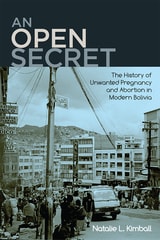
cover of An Open Secret: The History of Unwanted Pregnancy and Abortion in Modern Bolivia

An Open Secret

The History of Unwanted Pregnancy and Abortion in Modern Bolivia

Natalie L. Kimball

Rutgers University Press, 2020

Many women throughout the world face the challenge of confronting an unexpected or an unwanted pregnancy, yet these experiences are often shrouded in silence. An Open Secret draws on personal interviews and medical records to uncover the history of women’s experiences with unwanted pregnancy and abortion in the South American country of Bolivia. This Andean nation is home to a diverse population of indigenous and mixed-race individuals who practice a range of medical traditions. Centering on the cities of La Paz and El Alto, the book explores how women decided whether to continue or terminate their pregnancies and the medical practices to which women recurred in their search for reproductive health care between the early 1950s and 2010. It demonstrates that, far from constituting private events with little impact on the public sphere, women’s intimate experiences with pregnancy contributed to changing policies and services in reproductive health in Bolivia.
[more]