Results by title
5 books match the query 'Bondage'
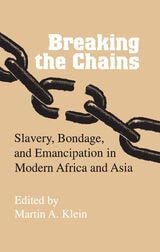
Breaking the Chains
Slavery, Bondage, and Emancipation in Modern Africa and AsiaMartin A. Klein
University of Wisconsin Press, 1993
“Martin Klein has brought together recent work on the abolition of slavery, from Ottoman Turkey to Thailand and from South India to West Africa. This anthology builds on the recent scholarship on both slavery in Asia and Africa and the end of slavery as a world-wide historical phenomenon. Whereas other anthologies have tended to focus on either Africa or Asia, this project brings together in one volume case studies and methodological approaches concerning both regions. Breaking the Chains will be an important part of the relatively sparse literature on emancipation in comparative and global context.”—Richard Roberts, Stanford University
Because the American history of slavery and emancipation tends to be foremost in Western minds, few realize that traditional forms of servitude still exist in a variety of places around the world: children are sold on the streets of Bangkok, bondage persists in India despite official efforts to abolish it, and until 1980 slavery was legal in Mauritania.
Breaking the Chains deals with emancipation in African and Asian societies which were either colonized or came under the domination of European powers in the nineteenth century. In these societies, emancipation involved the imposition on non-European societies of an explicitly European discourse on slavery, and, in most cases, a free labor ideology. Most of the slave masters described in these essays were not European and found European ideas on emancipation difficult to accept.
Against this backdrop, the essayists (many of whom contribute their own non-Western perspective) focus on the transition from slavery (or other forms of bondage) to emancipation. They show that in each case the process involved pressure from European abolition movements, the extension of capitalist relations of production, the concerns and perceptions of the colonial state, and the efforts of non-Western elites to modernize their cultures.
Martin A. Klein argues that the Asian and African experience has much in common with the American experience, particularly in efforts to control labor and family life. The struggle to control the labor of former slaves has often been intense and, he suggests, has had a continuing impact on the social order in former slave societies.
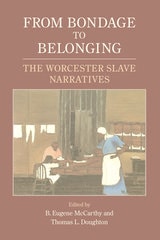
From Bondage to Belonging
The Worcester Slave NarrativesB. Eugene McCarthy
University of Massachusetts Press, 2007
First published between 1842 and 1895, the autobiographical narratives gathered in this volume document the experiences of eight former slaves who eventually took up residence in Worcester, Massachusetts. Each narrative tells a gripping individual story, its author clearly visible in the dress of his or her own words. Together they illuminate not only the inhumanity of slavery but also the dreams and dilemmas of emancipation, tracing the personal journeys of seven men and one woman from bondage to freedom.
In their well-researched introduction, B. Eugene McCarthy and Thomas L. Doughton situate the Worcester slave narratives within a broader historical framework and analyze their meaning and significance. Drawing on a wide range of sources, they reconstruct the black community of Worcester and compare it with other New England black communities of the time, describing how the town evolved from a society with slaves in the colonial era to a hub for free blacks by the eve of the Civil War. They explain why these writings must be understood as part of a long-established tradition of African American self-representation, and show how the four narratives published before 1865 focus on the experience of slavery, while the four written after the war offer the fresh perspective of living in freedom. Headnotes describe the distinctive literary features of each narrative and provide additional information about the lives of the authors. The editors discuss why these ex-slaves came to Worcester, the circumstances in which each wrote his or her narrative, and the audiences they had in mind. No other collection of slave narratives offers such a diverse range of testimony within a specific historical and literary context, or a more compelling account of the transition from bondage to belonging.

Motherhood in Bondage
Foreword by Margaret MarshMargaret Sanger
The Ohio State University Press, 2000
In Motherhood in Bondage, first published in 1928, Sanger reproduced letters written to her from women and sometimes men from all over the country, in both urban and rural areas, who were seeking advice on reproductive matters and marital relations, but mostly imploring her to help them find ways to avoid more pregnancies. The letters are grouped by theme into sixteen chapters, and Sanger wrote an introduction to each chapter. With clear relevance to the current post-Roe moment, these pleas to Sanger for advice on avoiding unwanted pregnancy dramatically detail the desperation for reproductive agency when birth control was unknown, withheld, or otherwise inaccessible.
In her foreword for this edition, Margaret Marsh describes the controversies surrounding these letters and places them in their historical context.
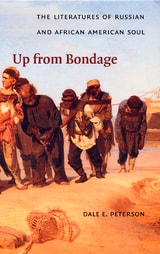
Up from Bondage
The Literatures of Russian and African American SoulDale E. Peterson
Duke University Press, 2000
Illuminating a remarkably widespread cross-pollination between the two cultural and intellectual traditions, Dale E. Peterson frames much of his argument around W. E. B. DuBois’s concept of “double-consciousness,” wherein members of an oppressed section of society view themselves simultaneously through their own self-awareness and through the internalized standards of the dominant culture. He shows how the writings of Dostoevsky, Hurston, Chesnutt, Turgenev, Ellison, Wright, Gorky, and Naylor—texts that enacted and described this sense of double awareness—were used both to perform and to contest the established genres of Western literacy. Woven through Peterson’s textual analyses is his consideration of cultural hybridism and its effects: The writers he examines find multiple ways to testify to and challenge the symptoms of postcolonial trauma. After discussing the strong and significant affinity expressed by contemporary African American cultural theorists for the dialogic thought of Russian linguist Mikhail Bakhtin, Peterson argues that a fuller appreciation of the historic connection between the two cultures will enrich the complicated meanings of being black or Russian in a world that has traditionally avoided acknowledging pluralistic standards of civilization and cultural excellence.
This investigation of comparable moments in the development of Russian and African American ethnic self-consciousness will be valuable to students and scholars of comparative literature, philosophy, cultural theory, ethnicity, linguistics, and postcolonialism, in addition to Slavic and African American studies.
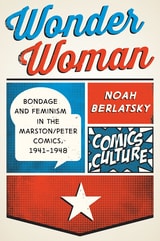
Wonder Woman
Bondage and Feminism in the Marston/Peter Comics, 1941-1948Berlatsky, Noah
Rutgers University Press, 2015
Comics expert Noah Berlatsky takes us on a wild ride through the Wonder Woman comics of the 1940s, vividly illustrating how Marston’s many quirks and contradictions, along with the odd disproportionate composition created by illustrator Harry Peter, produced a comic that was radically ahead of its time in terms of its bold presentation of female power and sexuality. Himself a committed polyamorist, Marston created a universe that was friendly to queer sexualities and lifestyles, from kink to lesbianism to cross-dressing. Written with a deep affection for the fantastically pulpy elements of the early Wonder Womancomics, from invisible jets to giant multi-lunged space kangaroos, the book also reveals how the comic addressed serious, even taboo issues like rape and incest.