Results by title
20 books match the query 'Bones'
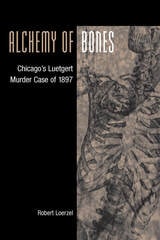
Alchemy of Bones
Chicago's Luetgert Murder Case of 1897Robert Loerzel
University of Illinois Press, 2002
On May 1, 1897, Louise Luetgert disappeared. Although no body was found, Chicago police arrested her husband, Adolph, the owner of a large sausage factory, and charged him with murder. The eyes of the world were still on Chicago following the success of the World's Columbian Exposition, and the Luetgert case, with its missing victim, once-prosperous suspect, and all manner of gruesome theories regarding the disposal of the corpse, turned into one of the first media-fueled celebrity trials in American history.
Newspapers fought one another for scoops, people across the country claimed to have seen the missing woman alive, and each new clue led to fresh rounds of speculation about the crime. Meanwhile, sausage sales plummeted nationwide as rumors circulated that Luetgert had destroyed his wife's body in one of his factory's meat grinders.
Weaving in strange-but-true subplots involving hypnotists, palmreaders, English con artists, bullied witnesses, and insane-asylum bodysnatchers, Alchemy of Bones is more than just a true crime narrative; it is a grand, sprawling portrait of 1890s Chicago--and a nation--getting an early taste of the dark, chaotic twentieth century.
Bones of Contention
Controversies in the Search for Human OriginsRoger Lewin
University of Chicago Press, 1997
in many ways, remains contentious.
"[An] un-put-downable book."—John Gribbon, Times Educational Supplement
"Not just another 'stones and bones' account of human evolution. It is Lewin's thesis, amply demonstrated, that paleoanthropology is the most subjective of sciences because it engages the emotions of virtually everyone; and since the evidence is scrappy, interpretation is everything. . . . A splendid, stirring, and eye-opening account, to be devoured."—Kirkus Reviews, starred review
"[Lewin shows] 'how very unscientific the process of scientific inquiry can be.'. . . Bones of Contention is . . . serious intellectual history."—Edward Dolnick, Wall Street Journal
"[Lewin] documents his thesis in persuasive detail. . . . The reader is carried along by the power of Mr. Lewin's reporting."—Robert Wright, New York Times Book Review
Bones of Contention
The living archive of Vasil Levski and the making of Bulgaria's national heroMaria Todorova
Central European University Press, 2009
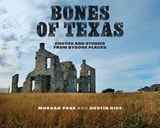
Bones of Texas
Photos and Stories from Bygone PlacesMorgan Page and Dustin Rice
University of Texas Press, 2026
Bones of the Maya
Studies of Ancient SkeletonsEdited by Stephen L. Whittington and David M. Reed
University of Alabama Press, 2006
New techniques in osteology have yielded findings on Maya diet and health that challenge the ecological model of collapse. This benchmark collection of essays defined the state of Mayan skeletal studies. Its coverage spans the formative through colonial periods, with a geographic focus on the Maya lowlands of northern Guatemala, Belize, and western Honduras. Bringing together for the first time a broad spectrum of bioarchaeologists and revealing remarkable data on Maya genetic relationship, demographic, and diseases, the collection covers divers topics such as osteological, dental, bone chemistry, and DNA analyses. The diet and health status of Maya populations is a major theme, especially in relation to social status, gender, and the historical problem of the "collapse."
Bones on the Ground
Elizabeth O'Maley
Indiana Historical Society Press, 2014
Bones, Bodies amd Behavior
Essays in Behavioral AnthropologyEdited by George W. Stocking, Jr.
University of Wisconsin Press, 1990
Bones, Clones, and Biomes
The History and Geography of Recent Neotropical MammalsEdited by Bruce D. Patterson and Leonora P. Costa
University of Chicago Press, 2012
As explorers and scientists have known for decades, the Neotropics harbor a fantastic array of our planet’s mammalian diversity, from capybaras and capuchins to maned wolves and mouse opossums to sloths and sakis. This biological bounty can be attributed partly to the striking diversity of Neotropical landscapes and climates and partly to a series of continental connections that permitted intermittent faunal exchanges with Africa, Antarctica, Australia, and North America. Thus, to comprehend the development of modern Neotropical mammal faunas requires not only mastery of the Neotropics’ substantial diversity, but also knowledge of mammalian lineages and landscapes dating back to the Mesozoic.
Bones, Clones, and Biomes offers just that—an exploration of the development and relationships of the modern mammal fauna through a series of studies that encompass the last 100 million years and both Central and South America. This work serves as a complement to more taxonomically driven works, providing for readers the long geologic and biogeographic contexts that undergird the abundance and diversity of Neotropical mammals. Rather than documenting diversity or distribution, this collection traverses the patterns that the distributions and relationships across mammal species convey, bringing together for the first time geology, paleobiology, systematics, mammalogy, and biogeography. Of critical importance is the book’s utility for current conservation and management programs, part of a rapidly rising conservation paleobiology initiative.
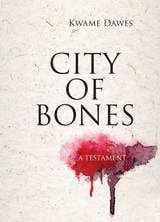
City of Bones
A TestamentKwame Dawes
Northwestern University Press, 2017
As if convinced that all divination of the future is somehow a re-visioning of the past, Kwame Dawes reminds us of the clairvoyance of haunting. The lyric poems in City of Bones: A Testament constitute a restless jeremiad for our times, and Dawes’s inimitable voice peoples this collection with multitudes of souls urgently and forcefully singing, shouting, groaning, and dreaming about the African diasporic present and future.
As the twentieth collection in the poet’s hallmarked career, City of Bones reaches a pinnacle, adding another chapter to the grand narrative of invention and discovery cradled in the art of empathy that has defined his prodigious body of work. Dawes’s formal mastery is matched only by the precision of his insights into what is at stake in our lives today. These poems are shot through with music from the drum to reggae to the blues to jazz to gospel, proving that Dawes is the ambassador of words and worlds.
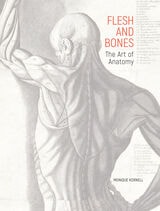
Flesh and Bones
The Art of AnatomyMonique Kornell
J. Paul Getty Trust, The, 2022
This illustrated volume examines the different methods artists and anatomists used to reveal the inner workings of the human body and evoke wonder in its form.
For centuries, anatomy was a fundamental component of artistic training, as artists such as Leonardo da Vinci and Michelangelo sought to skillfully portray the human form. In Europe, illustrations that captured the complex structure of the body—spectacularly realized by anatomists, artists, and printmakers in early atlases such as Andreas Vesalius’s De humani corporis fabrica libri septem of 1543—found an audience with both medical practitioners and artists.
Flesh and Bones examines the inventive ways anatomy has been presented from the sixteenth through the twenty-first century, including an animated corpse displaying its own body for study, anatomized antique sculpture, spectacular life-size prints, delicate paper flaps, and 3-D stereoscopic photographs. Drawn primarily from the vast holdings of the Getty Research Institute, the over 150 striking images, which range in media from woodcut to neon, reveal the uncanny beauty of the human body under the skin.
This volume is published to accompany an exhibition on view at the Getty Research Institute at the Getty Center from February 22 to July 10, 2022.
On the Bones of the Serpent
Person, Memory, and Mortality in Sabarl Island SocietyDebbora Battaglia
University of Chicago Press, 1990
The creative focus of Sabarl cultural life is a series of mortuary feasts and rituals known as segaiya. In assembling and disassembling commemorative food and objects in segaiya exchanges, Sabarl also assemble and disassemble the critical social relations such objects stand for. These commemorative acts create a collective memory yet also a collective experience of forgetting social bonds that are of no future use to the living. Sabarl anticipate this disaggregation in patterns of everyday life, which reveal the importance of categorical distinctions mapped in beliefs about the physical and metaphysical person.
Using remembrance and forgetting as an analytic lens, Battaglia is able to ask questions critical to understanding Melanesian social process. One of the "new ethnographies" addressing the limits of ethnographic representation and the fragmented nature of knowledge from an indigenous perspective, her finely wrought study explores the dynamics of cultural practices in which decontruction is integral to construction, allowing a new perspective on the ephermeral nature of sociality in Melanesia and new insight into the efficacy of cultural images more generally.
Stones, Bones, and Profiles
Exploring Archaeological Context, Early American Hunter-Gatherers, and BisonMarcel Kornfeld
University Press of Colorado, 2016
Stones, Bones, and Profiles addresses key and cutting-edge research of three pillars of hunter-gatherer archaeology. Stones and bones—flaked stone tools and the bones of the prey animals—are the objects most commonly recovered from hunter-gatherer archaeological sites, and profiles represent the geologic context of the archeological record. Together they constitute the foundations of much of early archaeology, from the appearance of the earliest humans to the advent of the Neolithic.
The volume is divided into three sections: Peopling of North America and Paleoindians, Geoarchaeology, and Bison Bone Bed Studies. The first section dissects established theories about the Paleoindians, including the possibility that human populations were in North America before Clovis and the timing of the opening of the Alberta Corridor. The second section provides new perspectives on the age and contexts of several well-known New World localities such as the Lindenmeier Folsom and the UP Mammoth sites, as well as a synthesis of the geoarchaeology of the Rocky Mountains' Bighorn region that addresses significant new data and summarizes decades of investigation. The final section, Bison Bone Bed Studies, consists of groundbreaking zooarchaeological studies offering new perspectives on bison taxonomy and procurement.
Stones, Bones, and Profiles presents new data on Paleoindian archaeology and reconsiders previous sites and perspectives, culminating in a thought-provoking and challenging contribution to the ongoing study of Paleoindians around the world.
Contributors: Leland Bement, Jack W. Brink, John Carpenter, Brian Carter, Thomas J. Connolly, Linda Scott Cummings, Loren G. Davis, Allen Denoyer, Stuart J. Fiedel, Judson Byrd Finley, Andrea Freeman, C. Vance Haynes Jr., Bryan Hockett, Vance T. Holliday, Dennis L. Jenkins, Thomas A. Jennings, Eileen Johnson, George T. Jones, Oleksandra Krotova, Patrick J. Lewis, Vitaliy Logvynenko, Ian Luthe, Katelyn McDonough, Lance McNees, Fred L. Nials, Patrick W. O’Grady, Mary M. Prasciunas, Karl J. Reinhard, Michael Rondeau, Guadalupe Sanchez, William E. Scoggin, Ashley M. Smallwood, Iryna Snizhko, Thomas W. Stafford Jr., Mark E. Swisher, Frances White, Eske Willerslev, Robert M. Yohe II, Chad Yost
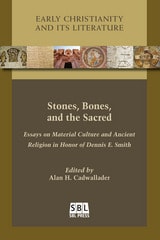
Stones, Bones, and the Sacred
Essays on Material Culture and Ancient Religion in Honor of Dennis E.Alan H. Cadwallader
SBL Press, 2016
A crucial text for any university course on the interaction of archaeology and the Bible
The world of early Christians was not a world lived in texts; it was a world saturated with material reality and concerns: what, where and when to eat or drink; how to present oneself in the space of bodily life and that of death; how to move from one place to another; what impacted status or the adjudication of legal charges. All these and more controlled so much of life in the ancient world. The Christians were not immune from the impact of these realities. Sometimes they absorbed their surrounds; sometimes they quite explicitly rejected the material practices bearing in on them; frequently they modified the practice and the rationale to create a significant Christian alternative. The collection of essays in this volume come from a range of international scholars who, for all their different interests and critical commitments, are yet united in treasuring research into the Greek and Roman worlds in which Christians sought to make their way. They offer these essays in honor of one who has made a lifetime's work in mining ancient material culture to extract nuggets of insight into early Christian dining practices: Dennis E. Smith.
Features
- Rich examples of method in the utilization of ancient material culture for biblical interpretation.
- Thirteen essays with a response from Dennis E. Smith
- Maps, diagrams, and plates

Stored in the Bones
Safeguarding Indigenous Living HeritagesAgnieszka Pawłowska-Mainville
University of Manitoba Press, 2023
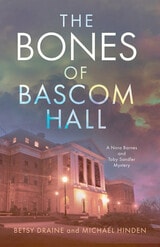
The Bones of Bascom Hall
Betsy Draine and Michael Hinden
University of Wisconsin Press, 2024
Inspired by an event that traumatized Madison and shocked the nation, this absorbing novel blends fact and fiction and is sure to delight both mystery enthusiasts and UW alumni.
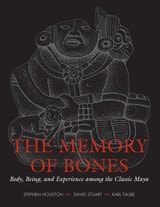
The Memory of Bones
Body, Being, and Experience among the Classic MayaBy Stephen Houston, David Stuart, and Karl Taube
University of Texas Press, 2006
All of human experience flows from bodies that feel, express emotion, and think about what such experiences mean. But is it possible for us, embodied as we are in a particular time and place, to know how people of long ago thought about the body and its experiences? In this groundbreaking book, three leading experts on the Classic Maya (ca. AD 250 to 850) marshal a vast array of evidence from Maya iconography and hieroglyphic writing, as well as archaeological findings, to argue that the Classic Maya developed a coherent approach to the human body that we can recover and understand today.
The authors open with a cartography of the Maya body, its parts and their meanings, as depicted in imagery and texts. They go on to explore such issues as how the body was replicated in portraiture; how it experienced the world through ingestion, the senses, and the emotions; how the body experienced war and sacrifice and the pain and sexuality that were intimately bound up in these domains; how words, often heaven-sent, could be embodied; and how bodies could be blurred through spirit possession.
From these investigations, the authors convincingly demonstrate that the Maya conceptualized the body in varying roles, as a metaphor of time, as a gendered, sexualized being, in distinct stages of life, as an instrument of honor and dishonor, as a vehicle for communication and consumption, as an exemplification of beauty and ugliness, and as a dancer and song-maker. Their findings open a new avenue for empathetically understanding the ancient Maya as living human beings who experienced the world as we do, through the body.
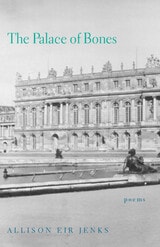
The Palace of Bones
Allison Eir Jenks
Ohio University Press, 2002
The Palace of Bones by Allison Eir Jenks is an often stark and startling vision of the way we live, the places we inhabit, and the relics we make to comfort ourselves.
Haunted by a quiet, unquenchable longing, Jenks expertly and calmly guides the reader through a vivid dreamscape in this first full-length collection of poems.
The Palace of Bones was selected by final judge and Pulitzer Prize winner Carolyn Kizer. At once dark in its vision and light in its tone, this remarkable book is its author’s self-confident invitation for us to join her in a world she knows intimately and has made almost familiar if not entirely safe.
The Palace of Bones is a stunning debut.
The Valley of Bones
Book 7 of A Dance to the Music of TimeAnthony Powell
University of Chicago Press, 1995
Anthony Powell’s universally acclaimed epic A Dance to the Music of Time offers a matchless panorama of twentieth-century London. Now, for the first time in decades, readers in the United States can read the books of Dance as they were originally published—as twelve individual novels—but with a twenty-first-century twist: they’re available only as e-books.
World War II has finally broken out, and The Valley of Bones (1964) finds Nick Jenkins learning the military arts. A stint at a training academy in Wales introduces him to the many unusual characters the army has thrown together, from the ambitious bank clerk-turned-martinet, Gwatkin, to the hopelessly slovenly yet endearing washout, Bithel. Even during wartime, however, domestic life proceeds, as a pregnant Isobel nears her term and her siblings’ romantic lives take unexpected turns—their affairs of the heart lent additional urgency by the ever-darkening shadow of war.
"Anthony Powell is the best living English novelist by far. His admirers are addicts, let us face it, held in thrall by a magician."--Chicago Tribune
"A book which creates a world and explores it in depth, which ponders changing relationships and values, which creates brilliantly living and diverse characters and then watches them grow and change in their milieu. . . . Powell's world is as large and as complex as Proust's."--Elizabeth Janeway, New York Times
"One of the most important works of fiction since the Second World War. . . . The novel looked, as it began, something like a comedy of manners; then, for a while, like a tragedy of manners; now like a vastly entertaining, deeply melancholy, yet somehow courageous statement about human experience."--Naomi Bliven, New Yorker
“The most brilliant and penetrating novelist we have.”--Kingsley Amis
To the Bones
VALERIE NIEMAN
West Virginia University Press, 2019
2020 Killer Nashville Silver Falchion Award finalist
Darrick MacBrehon, a government auditor, wakes among the dead. Bloodied and disoriented from a gaping head wound, the man who staggers out of the mine crack in Redbird, West Virginia, is much more powerful—and dangerous—than the one thrown in. An orphan with an unknown past, he must now figure out how to have a future.
Hard-as-nails Lourana Taylor works as a sweepstakes operator and spends her time searching for any clues that might lead to Dreama, her missing daughter. Could this stranger’s tale of a pit of bones be connected? With help from disgraced deputy Marco DeLucca and Zadie Person, a local journalist investigating an acid mine spill, Darrick and Lourana push against everyone who tries to block the truth. Along the way, the bonds of love and friendship are tested, and bodies pile up on both sides.
In a town where the river flows orange and the founding—and controlling—family is rumored to “strip a man to the bones,” the conspiracy that bleeds Redbird runs as deep as the coal veins that feed it.
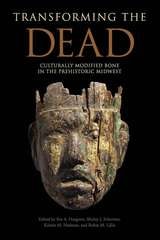
Transforming the Dead
Culturally Modified Bone in the Prehistoric MidwestEve A. Hargrave
University of Alabama Press, 2015
Revealing how the dead continued to shape the spiritual and social worlds of prehistoric North America.
Transforming the Dead is a collection of essays that examines culturally modified human bones and their roles as “cultural and ritual objects” among prehistoric Eastern Woodland cultures. Previous scholarship has explored the role of human body parts in Native American cultures as trophies of war and revered ancestors. This collection discusses new evidence that human elements were also important components of daily and ritual activities across the Eastern Woodlands. The contributors to this volume discuss each case study within the unique regional and temporal contexts of the material, rather than seeking universal answers to how these objects were used.
Most research addressing modified human bone has focused on cut marks and trauma associated with warfare, trophy taking, and burial practices. The editors and contributors of Transforming the Dead document the varied and often overlooked ways that human bone was intentionally modified through drilling, incising, cutting, and polishing for utilitarian, ornamental, spiritual, or ritual use. Examples include bracelets and gorgets to be worn, as well as musical rasps, pipe stems, masks, and protective talismans. The form and function of these objects are not unusual; their construction from the remains of “another” sets them apart.
Through a flexible but systematic analysis of the archaeological record, the contributors bring into focus how the careful selection, modification, and retention of particular bones or body parts of an individual after death offer insights into concepts of personhood, the body, life, and death among the prehistoric Native Americans in the Midwest.