Results by title
4 books match the query 'Booker T . Washington'
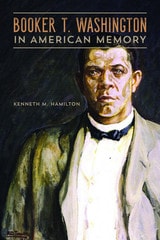
Booker T. Washington in American Memory
Kenneth M. Hamilton
University of Illinois Press, 2017
Since the 1960s, many historians have condemned Booker T. Washington as a problematic, even negative, influence on African American progress. This attitude dramatically contrasts with the nationwide outpouring of grief and reverence that followed Washington's death in 1915. Kenneth M. Hamilton describes how, when, where, and why Americans commemorated the life of Booker T. Washington. For months following his death, tens of thousands of Americans, especially blacks, honored his memory. Their memorials revealed that Washington enjoyed widespread national support for his vision of America and the programs that he imparted to achieve his aspirations. Their actions and articulations provide rich insight into how a cross section of Washington's contemporaries viewed him. From private messages of solace to public pronouncements, countless Americans portrayed him as a revered national icon. Among other characteristics, commemorates voiced their appreciation of his humanitarianism, humility, nationalism, perseverance, philanthropy, progressivism, spirituality, and wisdom. Washington was the leading advocate of the Yankee Protestantism Ethic, which promoted education, and personal qualities such as pragmatism, perseverance, cleanliness, thrift, and the dignity of labor among African Americans.
[more]
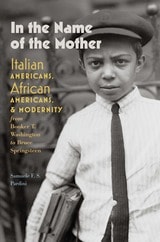
In the Name of the Mother
Italian Americans, African Americans, and Modernity from Booker T. Washington to Bruce SpringsteenSamuele F. S. Pardini
Dartmouth College Press, 2017
In the Name of the Mother examines the cultural relationship between African American intellectuals and Italian American writers and artists, and how it relates to American blackness in the twentieth century. Samuele Pardini links African American literature to the Mediterranean tradition of the Italian immigrants and examines both against the white intellectual discourse that defines modernism in the West. This previously unexamined encounter offers a hybrid, transnational model of modernity capable of producing democratic forms of aesthetics, social consciousness, and political economy. This volume emphasizes the racial “in-betweenness” of Italian Americans rearticulated as “invisible blackness,” a view that enlarges and complicates the color-based dimensions of American racial discourse. This strikingly original work will interest a wide spectrum of scholars in American Studies and the humanities.
[more]
Negro Thought in America, 1880-1915
Racial Ideologies in the Age of Booker T. WashingtonAugust Meier
University of Michigan Press, 1963
An analysis of the ideas of Booker T. Washington, Frederick Douglass, W. E. B. DuBois, and other black leaders from the turn of the century
[more]
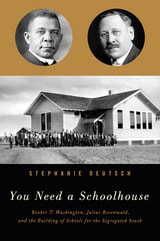
You Need a Schoolhouse
Booker T. Washington, Julius Rosenwald, and the Building of Schools for the Segregated SouthStephanie Deutsch
Northwestern University Press, 2011
Booker T. Washington, the founder of Tuskegee Institute, and Julius Rosenwald, the president of Sears, Roebuck, and Company, first met in 1911 at a Chicago luncheon. By charting the lives of these two men both before and after the meeting, Stephanie Deutsch offers a fascinating glimpse into the partnership that would bring thousands of modern schoolhouses to African American communities in the rural South in the era leading up to the civil rights movement. Trim and vital at just shy of fifty, Rosenwald was the extraordinarily rich chairman of one of the nation’s largest businesses, interested in using his fortune to do good not just in his own Jewish community but also to promote the well-being of African Americans.
Washington, though widely admired, had weathered severe crises both public and private in his fifty-six years. He had dined with President Theodore Roosevelt and drunk tea with Queen Victoria, but he had also been assaulted on a street in New York City. He had suffered personal heartbreak, years of overwork, and the discouraging knowledge that, despite his optimism and considerable success, conditions for African Americans were not improving as he had assumed they would. From within his own community, Washington faced the bitter charge of accommodationism that haunts his legacy to this day. Despite their differences, the two men would work together well and their collaboration would lead to the building of five thousand schoolhouses. By the time segregation ended, the “Rosenwald Schools” that sprang from this unlikely partnership were educating one third of the South’s African American children. These schoolhouses represent a significant step in the ongoing endeavor to bring high quality education to every child in the United States—an ideal that remains to be realized even today.
Washington, though widely admired, had weathered severe crises both public and private in his fifty-six years. He had dined with President Theodore Roosevelt and drunk tea with Queen Victoria, but he had also been assaulted on a street in New York City. He had suffered personal heartbreak, years of overwork, and the discouraging knowledge that, despite his optimism and considerable success, conditions for African Americans were not improving as he had assumed they would. From within his own community, Washington faced the bitter charge of accommodationism that haunts his legacy to this day. Despite their differences, the two men would work together well and their collaboration would lead to the building of five thousand schoolhouses. By the time segregation ended, the “Rosenwald Schools” that sprang from this unlikely partnership were educating one third of the South’s African American children. These schoolhouses represent a significant step in the ongoing endeavor to bring high quality education to every child in the United States—an ideal that remains to be realized even today.
[more]