Results by title
2 books match the query 'Boon, Marcus'
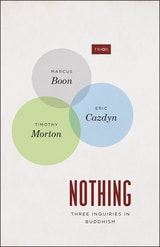
Nothing
Three Inquiries in BuddhismMarcus Boon, Eric Cazdyn, and Timothy Morton
University of Chicago Press, 2015
Though contemporary European philosophy and critical theory have long had a robust engagement with Christianity, there has been no similar engagement with Buddhism—a surprising lack, given Buddhism’s global reach and obvious affinities with much of Continental philosophy. This volume fills that gap, focusing on “nothing”—essential to Buddhism, of course, but also a key concept in critical theory from Hegel and Marx through deconstruction, queer theory, and contemporary speculative philosophy. Through an elaboration of emptiness in both critical and Buddhist traditions; an examination of the problem of praxis in Buddhism, Marxism, and psychoanalysis; and an explication of a “Buddhaphobia” that is rooted in modern anxieties about nothingness, Nothing opens up new spaces in which the radical cores of Buddhism and critical theory are renewed and revealed.
[more]
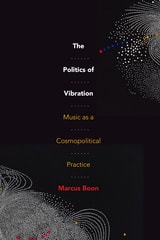
The Politics of Vibration
Music as a Cosmopolitical PracticeMarcus Boon
Duke University Press, 2022
In The Politics of Vibration Marcus Boon explores music as a material practice of vibration. Focusing on the work of three contemporary musicians—Hindustani classical vocalist Pandit Pran Nath, Swedish drone composer and philosopher Catherine Christer Hennix, and Houston-based hip-hop musician DJ Screw—Boon outlines how music constructs a vibrational space of individual and collective transformation. Contributing to a new interdisciplinary field of vibration studies, he understands vibration as a mathematical and a physical concept, as a religious or ontological force, and as a psychological determinant of subjectivity. Boon contends that music, as a shaping of vibration, needs to be recognized as a cosmopolitical practice—in the sense introduced by Isabelle Stengers—in which what music is within a society depends on what kinds of access to vibration are permitted, and to whom. This politics of vibration constitutes the hidden ontology of contemporary music because the organization of vibration shapes individual music scenes as well as the ethical choices that participants in these scenes make about how they want to live in the world.
[more]