Results by title

6 books match the query 'Boredom'

cover of A Philosophy of Boredom

A Philosophy of Boredom

Lars Svendsen

Reaktion Books, 2005

It has been described as a "tame longing without any particular object" by Schopenhauer, "a bestial and indefinable affliction" by Dostoevsky, and "time's invasion of your world system" by Joseph Brodsky, but still very few of us today can explain precisely what boredom is. A Philosophy of Boredom investigates one of the central preoccupations of our age as it probes the nature of boredom, how it originated, how and why it afflicts us, and why we cannot seem to overcome it by any act of will.

Lars Svendsen brings together observations from philosophy, literature, psychology, theology, and popular culture, examining boredom's pre-Romantic manifestations in medieval torpor, philosophical musings on boredom from Pascal to Nietzsche, and modern explorations into alienation and transgression by twentieth-century artists from Beckett to Warhol. A witty and entertaining account of our dullest moments and most maddening days, A Philosophy of Boredom will appeal to anyone curious to know what lies beneath the overwhelming inertia of inactivity.

[more]
cover of Boredom: The Literary History of a State of Mind

Boredom

The Literary History of a State of Mind

Patricia Meyer Spacks

University of Chicago Press, 1994

This book offers a witty explanation of why boredom both haunts and motivates the literary imagination. Moving from Samuel Johnson to Donald Barthelme, from Jane Austen to Anita Brookner, Spacks shows us at last how we arrived in a postmodern world where boredom is the all-encompassing name we give our discontent. Her book, anything but boring, gives us new insight into the cultural usefulness—and deep interest—of boredom as a state of mind.
[more]
cover of Fada: Boredom and Belonging in Niger

Fada

Boredom and Belonging in Niger

Adeline Masquelier

University of Chicago Press, 2019

Niger most often comes into the public eye as an example of deprivation and insecurity. Urban centers have become concentrated areas of unemployment filled with young men trying, against all odds, to find jobs and fill their time with meaningful occupations. At the heart of Adeline Masquelier’s groundbreaking book is the fada—a space where men gather to escape boredom by talking, playing cards, listening to music, and drinking tea. As a place in which new forms of sociability and belonging are forged outside the unattainable arena of work, the fada has become an integral part of Niger’s urban landscape. By considering the fada as a site of experimentation, Masquelier offers a nuanced depiction of how young men in urban Niger engage in the quest for recognition and reinvent their own masculinity in the absence of conventional avenues to self-realization. In an era when fledgling and advanced economies alike are struggling to support meaningful forms of employment, this book offers a timely glimpse into how to create spaces of stability, respect, and creativity in the face of diminished opportunities and precarity.
 
[more]
cover of On Boredom: Essays in Art and Writing

On Boredom

Essays in Art and Writing

Edited by Rye Dag Holmboe and Susan Morris

University College London, 2021

An idiosyncratic volume featuring artwork and essays on the history of boredom.

What do we mean when we say that we are bored? Contributors to this volume, which include artists, art historians, psychoanalysts, and a novelist, examine boredom in its manifold and uncertain reality. Each part of the book takes up a crucial moment in the history of boredom and presents it in a new light, taking the reader from the trials of the consulting room to the experience of hysteria in the nineteenth century. The book pays particular attention to boredom’s relationship with the sudden and rapid advances in technology that have occurred in recent decades, specifically technologies of communication, surveillance, and automation. On Boredom is idiosyncratic for its combination of image and text, and the artworks included in its pages—featuring Mathew Hale, Martin Creed, and Susan Morris—help turn this volume into a material expression of boredom itself. It will appeal to readers in the fields of art history, literature, cultural studies, and visual culture.
 
[more]
cover of The Space of Boredom: Homelessness in the Slowing Global Order

The Space of Boredom

Homelessness in the Slowing Global Order

Bruce O'Neill

Duke University Press, 2017
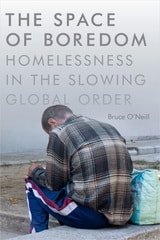
In The Space of Boredom Bruce O'Neill explores how people cast aside by globalism deal with an intractable symptom of downward mobility: an unshakeable and immense boredom. Focusing on Bucharest, Romania, where the 2008 financial crisis compounded the failures of the postsocialist state to deliver on the promises of liberalism, O'Neill shows how the city's homeless are unable to fully participate in a society that is increasingly organized around practices of consumption. Without a job to work, a home to make, or money to spend, the homeless—who include pensioners abandoned by their families and the state—struggle daily with the slow deterioration of their lives. O'Neill moves between homeless shelters and squatter camps, black labor markets and transit stations, detailing the lives of men and women who manage boredom by seeking stimulation, from conversation and coffee to sex in public restrooms or going to the mall or IKEA. Showing how boredom correlates with the downward mobility of Bucharest's homeless, O'Neill theorizes boredom as an enduring affect of globalization in order to provide a foundation from which to rethink the politics of alienation and displacement.
[more]
cover of Young Men, Time, and Boredom in the Republic of Georgia

Young Men, Time, and Boredom in the Republic of Georgia

Martin Frederiksen

Temple University Press, 2016

In the midst of societal optimism, how do young men cope with the loss of a vibrant future? Young Men, Time, and Boredom in the Republic of Georgia provides a vivid exploration of the tension between subjective and societal time and the ways these tensions create experiences of marginality among under- or unemployed young men in the Republic of Georgia.

Based on long-term ethnographic fieldwork, Martin Demant Frederiksen shows how the Georgian state has attempted to make the so-called post-Soviet transition a thing of the past as it creates new ideas about the future. Yet some young men in the regional capital of Batumi do not feel that they are part of the progression these changes create. Instead, they feel marginalized both by space and time—passed over and without prospects.


This distinctive case study provides empirical evidence for a deeper understanding of contemporary societal developments and their effects on individual experiences. 

[more]