Results by title
3 books match the query 'Boredom in literature'
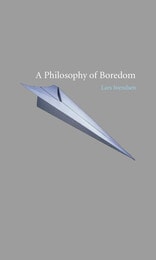
A Philosophy of Boredom
Lars Svendsen
Reaktion Books, 2005
It has been described as a "tame longing without any particular object" by Schopenhauer, "a bestial and indefinable affliction" by Dostoevsky, and "time's invasion of your world system" by Joseph Brodsky, but still very few of us today can explain precisely what boredom is. A Philosophy of Boredom investigates one of the central preoccupations of our age as it probes the nature of boredom, how it originated, how and why it afflicts us, and why we cannot seem to overcome it by any act of will.
Lars Svendsen brings together observations from philosophy, literature, psychology, theology, and popular culture, examining boredom's pre-Romantic manifestations in medieval torpor, philosophical musings on boredom from Pascal to Nietzsche, and modern explorations into alienation and transgression by twentieth-century artists from Beckett to Warhol. A witty and entertaining account of our dullest moments and most maddening days, A Philosophy of Boredom will appeal to anyone curious to know what lies beneath the overwhelming inertia of inactivity.
Lars Svendsen brings together observations from philosophy, literature, psychology, theology, and popular culture, examining boredom's pre-Romantic manifestations in medieval torpor, philosophical musings on boredom from Pascal to Nietzsche, and modern explorations into alienation and transgression by twentieth-century artists from Beckett to Warhol. A witty and entertaining account of our dullest moments and most maddening days, A Philosophy of Boredom will appeal to anyone curious to know what lies beneath the overwhelming inertia of inactivity.
[more]
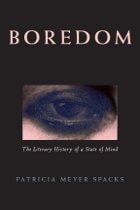
Boredom
The Literary History of a State of MindPatricia Meyer Spacks
University of Chicago Press, 1994
This book offers a witty explanation of why boredom both haunts and motivates the literary imagination. Moving from Samuel Johnson to Donald Barthelme, from Jane Austen to Anita Brookner, Spacks shows us at last how we arrived in a postmodern world where boredom is the all-encompassing name we give our discontent. Her book, anything but boring, gives us new insight into the cultural usefulness—and deep interest—of boredom as a state of mind.
[more]

Power to Hurt
THE VIRTUES OF ALIENATIONWilliam Monroe
University of Illinois Press, 1998
William Monroe addresses what William J. Bennett ignores in The Book of Virtues: How do readers use literature as "equipment for living"? Tackling modernism and postmodernism, Monroe outlines "virtue criticism," an alternative to current theory. Focusing on works by T. S. Eliot, Vladimir Nabokov, and Donald Barthelme, he demonstrates that these alienistic texts are not just filled with belligerence but are also endowed with virtues, such as trust and the promise of solidarity with the reader. By considering these vital texts as responses to personal situations and institutional practices, Monroe brings literature back to the common reader and shows how it offers functional responses to the dysfunctional situations of modern life. Readers interested in literary criticism, American culture, and the relationship between ethics and literature will be fascinated by virtue criticism and this fresh look at the virtues and vices of alienation.
Chosen as a Choice Magazine's Outstanding Academic Book for 1999.
Chosen as a Choice Magazine's Outstanding Academic Book for 1999.
[more]