Results by title
4 books match the query 'Botany, Economic'
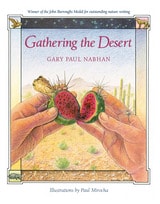
Gathering the Desert
Gary Paul Nabhan; Illustrations by Paul Mirocha
University of Arizona Press, 1985
To the untrained eye, a desert is a wasteland that defies civilization; yet the desert has been home to native cultures for centuries and offers sustenance in its surprisingly wide range of plant life. Gary Paul Nabhan has combed the desert in search of plants forgotten by all but a handful of American Indians and Mexican Americans. In Gathering the Desert readers will discover that the bounty of the desert is much more than meets the eye—whether found in the luscious fruit of the stately organpipe cactus or in the lowly tepary bean.
Nabhan has chosen a dozen of the more than 425 edible wild species found in the Sonoran Desert to demonstrate just how bountiful the land can be. From the red-hot chiltepines of Mexico to the palms of Palm Springs, each plant exemplifies a symbolic or ecological relationship which people of this region have had with plants through history. Each chapter focuses on a particular plant and is accompanied by an original drawing by artist Paul Mirocha. Word and picture together create a total impression of plants and people as the book traces the turn of seasons in the desert.
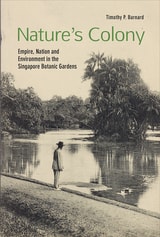
Nature's Colony
Empire, Nation and Environment in the Singapore Botanic GardensTimothy P. Barnard
National University of Singapore Press, 2017
Initially conceived to exploit nature for the benefit of empire, the Gardens were part of a symbolic struggle by administrators, scientists, and gardeners to assert dominance within Southeast Asia’s tropical landscape, reflecting shifting understandings of power, science, and nature among local administrators and distant mentors in Britain. Consequently, as an outpost of imperial science, the Gardens were instrumental in the development of plantation crops, such as rubber and oil palm, which went on to shape landscapes across the globe. Since the independence of Singapore, the Gardens have played a role in the “greening” of the country and have been named as Singapore’s first World Heritage Site. Setting the Gardens alongside the Royal Botanic Gardens, Kew, and botanic gardens in India, Ceylon, Mauritius, and the West Indies, Nature’s Colony provide the first in-depth look at the history of this influential institution.
Plants for Food and Medicine
Edited by H. D. V. Prendergast, N. L. Etkin, D. R. Harris, and P. J. Houghton
Royal Botanic Gardens, Kew, 2000
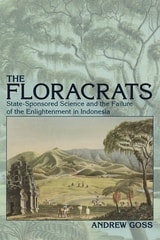
The Floracrats
State-Sponsored Science and the Failure of the Enlightenment in IndonesiaAndrew Goss
University of Wisconsin Press, 2011
Situated along the line that divides the rich ecologies of Asia and Australia, the Indonesian archipelago is a hotbed for scientific exploration, and scientists from around the world have made key discoveries there. But why do the names of Indonesia’s own scientists rarely appear in the annals of scientific history? In The Floracrats Andrew Goss examines the professional lives of Indonesian naturalists and biologists, to show what happens to science when a powerful state becomes its greatest, and indeed only, patron.
With only one purse to pay for research, Indonesia’s scientists followed a state agenda focused mainly on exploiting the country’s most valuable natural resources—above all its major export crops: quinine, sugar, coffee, tea, rubber, and indigo. The result was a class of botanic bureaucrats that Goss dubs the “floracrats.” Drawing on archives and oral histories, he shows how these scientists strove for the Enlightenment ideal of objective, universal, and useful knowledge, even as they betrayed that ideal by failing to share scientific knowledge with the general public. With each chapter, Goss details the phases of power and the personalities in Indonesia that have struggled with this dilemma, from the early colonial era, through independence, to the modern Indonesian state. Goss shows just how limiting dependence on an all-powerful state can be for a scientific community, no matter how idealistic its individual scientists may be.