Results by title

7 books match the query 'Botswana'
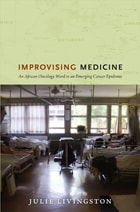
cover of Improvising Medicine: An African Oncology Ward in an Emerging Cancer Epidemic

Improvising Medicine

An African Oncology Ward in an Emerging Cancer Epidemic

Julie Livingston

Duke University Press, 2012
In Improvising Medicine, Julie Livingston tells the story of Botswana's only dedicated cancer ward, located in its capital city of Gaborone. This affecting ethnography follows patients, their relatives, and ward staff as a cancer epidemic emerged in Botswana. The epidemic is part of an ongoing surge in cancers across the global south; the stories of Botswana's oncology ward dramatize the human stakes and intellectual and institutional challenges of an epidemic that will shape the future of global health. They convey the contingencies of high-tech medicine in a hospital where vital machines are often broken, drugs go in and out of stock, and bed-space is always at a premium. They also reveal cancer as something that happens between people. Serious illness, care, pain, disfigurement, and even death emerge as deeply social experiences. Livingston describes the cancer ward in terms of the bureaucracy, vulnerability, power, biomedical science, mortality, and hope that shape contemporary experience in southern Africa. Her ethnography is a profound reflection on the social orchestration of hope and futility in an African hospital, the politics and economics of healthcare in Africa, and palliation and disfigurement across the global south.
[more]
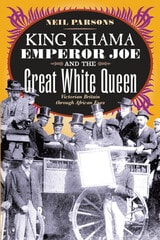
cover of King Khama, Emperor Joe, and the Great White Queen: Victorian Britain through African Eyes

King Khama, Emperor Joe, and the Great White Queen

Victorian Britain through African Eyes

Neil Parsons

University of Chicago Press, 1997

In 1895 three African chiefs, dressed in the finest British clothing available, began a tour of the British Isles. That tour foiled Cecil Rhodes' grand plan for Africa and culminated in the Chamberlain Settlement, the document that indirectly led to the independence of present-day Botswana. King Khama, Emperor Joe, and the Great White Queen is the story of this bizarre journey, one of the most neglected events in British Victorian history, here revealed for the first time in its full detail and cultural complexity.

The chiefs initially went to England to persuade Queen Victoria not to give their lands to ruthless Rhodes and his British South Africa Company. Abandoned by the Secretary of State for the Colonies, Joseph Chamberlain, and denied an audience with the queen, the three rulers decided to tour the British Isles to plead their case to the populace. Appealing to the middle-class morality of Victorian society, the chiefs were remarkably successful in gaining support, eventually swaying Chamberlain into drafting the agreement that secured their territories against the encroachment of Rhodesia.

Historian Neil Parsons has reconstructed this journey with the help of African archival materials and news clippings from British papers, garnered from the clippings service the chiefs had the foresight to employ. In equal parts narrative of pilgrimage, voyage of discovery, and colonial resistance, King Khama, Emperor Joe, and the Great White Queen provides a view from the other side of colonialism and imperialism. It demonstrates the nuances of cultural and religious interaction between Africans and Europeans, and it does so with the richness and depth of a fully realized novel.
[more]
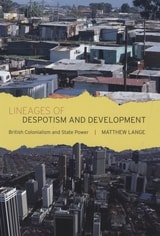
cover of Lineages of Despotism and Development: British Colonialism and State Power

Lineages of Despotism and Development

British Colonialism and State Power

Matthew Lange

University of Chicago Press, 2009

Traditionally, social scientists have assumed that past imperialism hinders the future development prospects of colonized nations. Challenging this widespread belief, Matthew Lange argues in Lineages of Despotism and Development that countries once under direct British imperial control have developed more successfully than those that were ruled indirectly.

            Combining statistical analysis with in-depth case studies of former British colonies, this volume argues that direct rule promoted cogent and coherent states with high levels of bureaucratization and inclusiveness, which contributed to implementing development policy during late colonialism and independence. On the other hand, Lange finds that indirect British rule created patrimonial, weak states that preyed on their own populations. Firmly grounded in the tradition of comparative-historical analysis while offering fresh insight into the colonial roots of uneven development, Lineages of Despotism and Development will interest economists, sociologists, and political scientists alike.
[more]
cover of Mormon Women at the Crossroads: Global Narratives and the Power of Connectedness

Mormon Women at the Crossroads

Global Narratives and the Power of Connectedness

Caroline Kline

University of Illinois Press, 2022

Winner of the Mormon History Association Best International Book Award

The Church of Jesus Christ of Latter-day Saints continues to contend with longstanding tensions surrounding gender and race. Yet women of color in the United States and across the Global South adopt and adapt the faith to their contexts, many sharing the high level of satisfaction expressed by Latter-day Saints in general. Caroline Kline explores the ways Latter-day Saint women of color in Mexico, Botswana, and the United States navigate gender norms, but also how their moral priorities and actions challenge Western feminist assumptions. Kline analyzes these traditional religious women through non-oppressive connectedness, a worldview that blends elements of female empowerment and liberation with a broader focus on fostering positive and productive relationships in different realms. Even as members of a patriarchal institution, the women feel a sense of liberation that empowers them to work against oppression and against alienation from both God and other human beings.

Vivid and groundbreaking, Mormon Women at the Crossroads merges interviews with theory to offer a rare discussion of Latter-day Saint women from a global perspective.
[more]
cover of Self-Devouring Growth: A Planetary Parable as Told from Southern Africa

Self-Devouring Growth

A Planetary Parable as Told from Southern Africa

Julie Livingston

Duke University Press, 2019

Under capitalism, economic growth is seen as the key to collective well-being. In Self-Devouring Growth Julie Livingston upends this notion, showing that while consumption-driven growth may seem to benefit a particular locale, it produces a number of unacknowledged, negative consequences that ripple throughout the wider world. Structuring the book as a parable in which the example of Botswana has lessons for the rest of the globe, Livingston shows how fundamental needs for water, food, and transportation become harnessed to what she calls self-devouring growth: an unchecked and unsustainable global pursuit of economic growth that threatens catastrophic environmental destruction. As Livingston notes, improved technology alone cannot stave off such destruction; what is required is a greater accounting of the web of relationships between humans, nonhuman beings, plants, and minerals that growth entails.  Livingston contends that by failing to understand these relationships and the consequences of self-devouring growth, we may be unknowingly consuming our future. 
[more]
cover of Succession to High Office in Botswana: Three Case Studies

Succession to High Office in Botswana

Three Case Studies

Jack Parson

Ohio University Press, 1990
This book examines the process through which the mantle of leadership passed from one leader to another in Botswana. It concerns the succession to high office in Botswana over the course of more than half a century from the colonial time to the present. Three case studies explore the relationship between the British colonial authorities and the tribal leaders in affirming the legitimacy of the tribal chiefs of the Bangwato tribe in the former Bechuanaland protectorate. The studies examine the succession crises of the Bangwato first in 1925 and again between 1948 to 1953 and the political changes from the Botswana National Archives contained in the appendices fully support the text.
[more]
cover of The Nature of Politics: State Building and the Conservation Estate in Postcolonial Botswana

The Nature of Politics

State Building and the Conservation Estate in Postcolonial Botswana

Annette A. LaRocco

Ohio University Press, 2024

This case study of Botswana focuses on the state-building qualities of biodiversity conservation in southern Africa. Drawing on extensive fieldwork, Annette A. LaRocco argues that discourses and practices related to biodiversity conservation are essential to state building in the postcolonial era. These discourses and practices invoke the ways the state exerts authority over people, places, and resources; enacts and remakes territorial control; crafts notions of ideal citizenship and identity; and structures economic relationships at the local, national, and global levels. The book’s key innovation is its conceptualization of the “conservation estate,” a term most often used as an apolitical descriptor denoting land set aside for the purpose of conservation. LaRocco argues that this description is inadequate and proposes a novel and much-needed alternative definition that is tied to its political elements. The components of conservation—control over land, policing of human behavior, and structuring of the authority that allows or disallows certain subjectivities—render conservation a political phenomenon that can be analyzed separately from considerations of “nature” or “wildlife.” In doing so, it addresses a gap in the scholarship of rural African politics, which focuses overwhelmingly on productive agrarian dynamics and often fails to recognize that land nonuse can be as politically significant and wide reaching as land use. Botswana is an ideal empirical case study upon which to base these theoretical claims. With 39 percent of its land set aside for conservation, Botswana is home to large populations of wildlife, particularly charismatic megafauna, such as the largest herd of elephants on the continent. Utilizing more than two hundred interviews, participant observation, and document analysis, this book examines a series of conservation policies and their reception by people living on the conservation estate. These phenomena include securitized antipoaching enforcement, a national hunting ban (2014–19), restrictions on using wildlife products, forced evictions from conservation areas, limitations on mobility and freedom of movement, the political economy of Botswana’s wildlife tourism industry, and the conservation of globally important charismatic megafauna species.
[more]