Results by title
4 books match the query 'Boundaries in literature'
Border Writing
The Multidimensional TextD. Emily HicksForeword by Neil Larsen
University of Minnesota Press, 1991
Border Writing was first published in 1991. Minnesota Archive Editions uses digital technology to make long-unavailable books once again accessible, and are published unaltered from the original University of Minnesota Press editions.
Until recently, literary theory has been grounded in the histories of English, French, German, and Spanish literature. The terms and models for the production of literature and its function in culture and society were decided in Western Europe, and any deviations were immediately marginalized. This Eurocentric view has been widely attached by postmodern, feminist, and postcolonial political practices.
Drawing on a variety of critical and theoretical sources, D. Emily Hicks employs the concept of border writing to consider the complexities of contemporary Latin American writing. With its emphasis on the multiplicity of languages and the problems of translation, border writing connotes a perspective that is no longer determined by neat distinctions. Hicks combines Deleuze and Guattari's notion of "deterritorialization" (the geographic, linguistic, or cultural displacement from one's own country, language, or native culture) with a holographic metaphor in provocative readings of Latin America writers, including Gabriel Garcia Marquez, Luisa Valenzuela, and Julio Cortazar. The result is a volume that forces the reader to consider the development of literature in terms of strategies and tactics that contribute to the production of meaning in culturally complex and politically repressive societies.
D. Emily Hicks is associate professor of English and comparative literature and a member of the Latin American studies faculty at San Diego State University. Neil Larsen is associate professor of Spanish and Latin American literature at Northeastern University and the author of Modernism and Hegemony: A Materialist Critique of Aesthetic Agencies (Minnesota, 1990).

Heartless Immensity
Literature, Culture, and Geography in Antebellum AmericaAnne Baker
University of Michigan Press, 2010
Building on extensive archival research as well as insights from cultural geographers and theorists of nationhood, Heartless Immensity demonstrates that national expansion had a far more complicated, multifaceted impact on antebellum American culture than has previously been recognized. Baker shows that Americans developed a variety of linguistic strategies for imagining the form of the United States and its position in relation to other geopolitical entities. Comparisons
to European empires, biblical allusions, body politic metaphors, and metaphors derived from science all reflected—and often attempted to assuage—fears that the nation was becoming either monstrously large or else misshapen in ways that threatened cherished beliefs and national self-images.
Heartless Immensity argues that, in order to understand the nation’s shift from republic to empire and to understand American culture in a global context, it is first necessary to pay close attention to the processes by which the physical entity known as the United States came into being. This impressively thorough study will make a valuable contribution to the fields of American studies and literary studies.
Anne Baker is Assistant Professor of English at North Carolina State University.
Thoreau beyond Borders
New International Essays on America's Most Famous Nature WriterFrançois Specq
University of Massachusetts Press, 2020
Henry David Thoreau spent his life as an intellectual vagrant, jumping fences, pushing boundaries, and crossing borders. How, why, and to what end are the questions asked by contributors to this new volume of essays, whose work crosses national and disciplinary borders to think about Thoreau anew.
Deliberately invoking Thoreau's commitment to “living a border life,” a life located between the world of nature and that of the polis, these varied essays explore the writer's thinking and writing as situated not merely against, but across and beyond borders and boundaries—whether geographic, temporal, or spiritual. Arguing that literary texts are governed by mediation and dialogue, lines of force becoming lines of connection that entail complex patterns and interweavings, the contributors draw on methodologies that freely combine literary and philosophical approaches with cultural and political ones—in turn moving us beyond borders.
Contributors include the volume editors as well as Kristen Case, Danielle Follett, Rochelle Johnson, John J. Kucich, Daniel S. Malachuk, Henrik Otterberg, Sandra Harbert Petrulionis, Benjamin Pickford, David M. Robinson, Christa Holm Vogelius, and Michael C. Weisenburg.
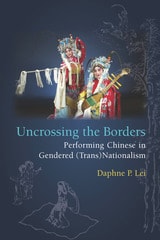
Uncrossing the Borders
Performing Chinese in Gendered (Trans)NationalismDaphne P. Lei
University of Michigan Press, 2019
Over many centuries, women on the Chinese stage committed suicide in beautiful and pathetic ways just before crossing the border for an interracial marriage. Uncrossing the Borders asks why this theatrical trope has remained so powerful and attractive. The book analyzes how national, cultural, and ethnic borders are inevitably gendered and incite violence against women in the name of the nation. The book surveys two millennia of historical, literary, dramatic texts, and sociopolitical references to reveal that this type of drama was especially popular when China was under foreign rule, such as in the Yuan (Mongol) and Qing (Manchu) dynasties, and when Chinese male literati felt desperate about their economic and political future, due to the dysfunctional imperial examination system. Daphne P. Lei covers border-crossing Chinese drama in major theatrical genres such as zaju and chuanqi, regional drama such as jingju (Beijing opera) and yueju (Cantonese opera), and modernized operatic and musical forms of such stories today.