Results by title

4 books match the query 'Bowen, Elizabeth'
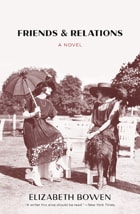
cover of Friends and Relations: A Novel

Friends and Relations

A Novel

Elizabeth Bowen

University of Chicago Press, 2012

In his introduction to a collection of criticism on the Anglo-Irish author Elizabeth Bowen, Harold Bloom wrote, “What then has Bowen given us except nuance, bittersweet and intelligent? Much, much more.” Born in 1899, Bowen became part of the famous Bloomsbury scene, and her novels have a much-deserved place in the modernist canon. In recent years, however, her work has not been as widely read or written about, and as Bloom points out, her evocative and sometimes enigmatic prose requires careful parsing. Yet in addition to providing a fertile ground for criticism, Bowen’s novels are both wonderfully entertaining, with rich humor, deep insight, and a tragic sense of human relationships.

Friends and Relations follows the exploits of four wealthy families whose lives are changed forever by a torrid affair. The Studdart sisters each take a husband; for beautiful Laurel there is Edward Tilney, and for the introverted Janet there is Rodney Meggatt. But the marriages are complicated by changeable passions, and each character must navigate the conflict between familial piety and individual desire. With Bowen’s signature blend of tragedy and comedy,  Friends and Relations is truly an investigation into the human heart, and the book is as beautiful, mysterious, and moving as its subject.
[more]
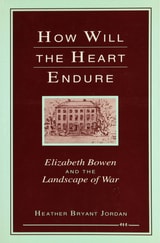
cover of How Will the Heart Endure: Elizabeth Bowen and the Landscape of War

How Will the Heart Endure

Elizabeth Bowen and the Landscape of War

Heather Bryant Jordan

University of Michigan Press, 1992
The career of Elizabeth Bowen (1899-1973) has been hard to categorize. As an Anglo-lrish writer, a follower of the modernists but not technically one herself; as an independent woman writer but not, by her admission, a feminist; and as a creative writer in time of war, she has eluded compartmentalization. In How Will the Heart Endure, Heather Bryant Jordan provides a new assessment of Bowen’s achievement, arguing that Bowen’s response to war is the best lens for elucidating the relation between art and life expressed in Bowen’s work.Bowen created novels, short stories, essays, and autobiographical works in a war-torn world that saw successively the Troubles in Ireland, the Irish Civil War, World War I, and World War Il. The strains she felt as a result of these experiences were expressed in the intensely personal vision of loss and betrayal that her fiction conveys.Jordan’s study combines historical and literary analysis and incorporates new archival research on Bowen’s correspondence and on her war reports to the Ministry of Information. How Will the Heart Endure offers not only a new reading of Bowen’s work, but an insightful look into the wartime publishing climate in which Bowen and her circle—which included Virginia Woolf, T. S. Eliot, John and Rosalind Lehmann, Cyril Connolly, Evelyn Waugh, Graham Greene, and Stephen Spender—operated. It will be of interest to specialists in modern British fiction, women’s studies, Irish studies, and Anglo-lrish literature.
[more]
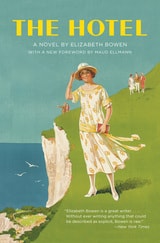
cover of The Hotel: A Novel

The Hotel

A Novel

Elizabeth Bowen

University of Chicago Press, 2012

In his introduction to a collection of criticism on the Anglo-Irish author Elizabeth Bowen, Harold Bloom wrote, “What then has Bowen given us except nuance, bittersweet and intelligent? Much, much more.” Born in 1899, Bowen became part of the famous Bloomsbury scene, and her novels have a much-deserved place in the modernist canon. In recent years, however, her work has not been as widely read or written about, and as Bloom points out, her evocative and sometimes enigmatic prose requires careful parsing. Yet in addition to providing a fertile ground for criticism, Bowen’s novels are both wonderfully entertaining, with rich humor, deep insight, and a tragic sense of human relationships.

Bowen’s first novel, The Hotel, is a wonderful introduction to her disarming, perceptive style. Following a group of British tourists vacationing on the Italian Riviera during the 1920s, The Hotel explores the social and emotional relationships that develop among the well-heeled residents of the eponymous establishment. When the young Miss Sydney falls under the sway of an older woman, Mrs. Kerr, a sapphic affair simmers right below the surface of Bowen’s writing, creating a rich story that often relies as much on what is left unsaid as what is written on the page. Bowen depicts an intense interpersonal drama with wit and suspense, while playing with and pushing the English language to its boundaries.
[more]
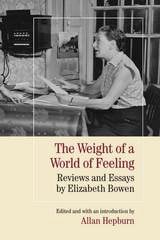
cover of The Weight of a World of Feeling: Reviews and Essays by Elizabeth Bowen

The Weight of a World of Feeling

Reviews and Essays by Elizabeth Bowen

Elizabeth Bowen / Edited and with an introduction by Allan Hepburn

Northwestern University Press, 2017

Elizabeth Bowen began reviewing books in August 1935. By that time she was already an experienced fiction writer with four short story collections and four novels to her credit. Her fifth novel, The House in Paris, was published on 26 August 1935, just nine days after her first book review appeared in The New Statesman. She reviewed regularly for that journal, known for its commitment to leftist politics, until 1943. At the same time, she accepted requests to review for Purpose, The Spectator, The Listener, The Bell, The Observer, and other publications. From 1941 until 1950, and again from 1954 until 1958, she filed weekly columns for The Tatler and Bystander. Especially after she began to travel time to the US in the 1950s, she was asked to review books for The New York Times Book Review and The New York Herald Tribune.

This fascinating collection of reviews is filled with first impressions of novels, autobiographies, memoirs, illustrated books, biographies of politicians and artists, short story collections, and literary criticism. Books spark statements from Bowen about general principles of fictional technique; she articulates her understanding of the inner workings of fiction incidentally, while providing an opinion about the book at hand. In this volume, Hepburn draws together all the reviews that Bowen left uncollected in her non-fiction collections, as well as several more familiar essays that that she published in The Tatler, in order to make them accessible to a broader audience.
[more]