Results by title
7 books match the query 'Bowers, Janice Emily'
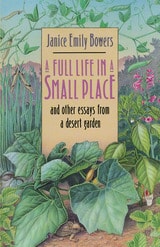
A Full Life in a Small Place and Other Essays from a Desert Garden
Janice Emily Bowers
University of Arizona Press, 1993
The frustrations and pleasures of gardening are evident; its implications for life are more subtle, lurking under a leaf or buried in a compost pile. Janice Emily Bowers senses these implications, and communicates them as only a fine writer can. In A Full Life in a Small Place, she shows how backyard gardening opens up a broader appreciation of both life and living. Her observations on organic gardening inspire further meditations on nature and wildlife, and demonstrate how gardens both complicate and enrich our lives. In their entirety, these sixteen essays ask how we shall live, and recognize that "before we can determine how, we need to find out why."
[more]
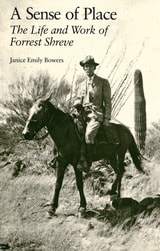
A Sense of Place
The Life and Work of Forrest ShreveJanice Emily Bowers
University of Arizona Press, 1988
Forrest Shreve (1878-1950) was an internationally known plant ecologist who spent most of his career at the Carnegie Institution's Desert Laboratory in Tucson, Arizona. Shreve's contributions to the study of plant ecology laid the groundwork for modern studies and several of his works came to be regarded as classics by ecologists worldwide. This first full-length study of Shreve's life and work demonstrates that he was more than a desert ecologist. His early work in Maryland and Jamaica gave him a breadth of expertise matched by few of his ecological contemporaries, and his studies of desert plant demography, the physiological ecology of rain-forest plants, and vegetational gradients on southwestern mountain ranges anticipated by decades recent trends in ecology.
Tracing Shreve's development from student to scientist, Bowers evokes the rigors and delights of fieldwork in the first half of this century and shows how Shreve's sense of place informed his scientific thought—making him, in his own words, "not an exile from some better place, but a man at home in an environment to which his life can be adjusted without physical or intellectual loss."
Tracing Shreve's development from student to scientist, Bowers evokes the rigors and delights of fieldwork in the first half of this century and shows how Shreve's sense of place informed his scientific thought—making him, in his own words, "not an exile from some better place, but a man at home in an environment to which his life can be adjusted without physical or intellectual loss."
[more]
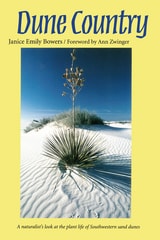
Dune Country
A Naturalist's Look at the Plant Life of Southwestern Sand DunesJanice Emily Bowers
University of Arizona Press, 1998
Janice Emily Bowers takes readers from New Mexico’s White Sands to Utah’s Coral Pink Dunes to the Death Valley dunes of California and beyond. Beautifully written and illustrated, Dune Country is a perfect introduction to the fragile ecosystems of sand dunes.
[more]
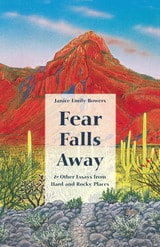
Fear Falls Away
and Other Essays from Hard and Rocky PlacesJanice Emily Bowers
University of Arizona Press, 1997
Jan Bowers lives in the right place. A lover of nature and the outdoors, an avid hiker and backpacker, she is surrounded by mountain ridges, peaks, and canyons of almost every description. In this book, she invites us to come along and find out why some of these places are special, why some of them stay in her mind long after she has returned to the workaday world of the city. Readers have come to expect the best from this writer, termed "a rare talent. . . uncommonly good at the craft" by Wilderness magazine. Her new book is filled with creeks and meadows, tiny ferns and towering oaks, bears and butterflies and Red-tailed Hawks. We see gray clouds clogging the sky in a canyon, "wildly, almost tastelessly romantic, as full of clouds as a tea kettle with steam," and we startle a female grouse and her half-dozen fuzzy chicks "exploding from underfoot like billiard balls scattered with a cue stick."
Faced with the prospect of moving to another place, Bowers finds herself thinking about the familiar world in new and unfamiliar ways. Through her eyes, too, we see how an interest in nature and the outdoors developed from early childhood and how simple curiosity has led her to the most surprising discoveries. At odd and unexpected moments, her work also seems to bring new insights into herself and her life as a writer, a wife, and a mother. These pages promise a new adventure at every turn in the trail. For sheer terror, there's a climb up the face of Baboquivari, for laughs, there's the great bagworm caper, and for some quiet truths, there are themes of gain and loss, of connection and reconcilliation. Crunching through winter snow or sweating under summer sun, we know we're in the hands of an experienced guide. And we know we couldn't ask for a better companion.
Faced with the prospect of moving to another place, Bowers finds herself thinking about the familiar world in new and unfamiliar ways. Through her eyes, too, we see how an interest in nature and the outdoors developed from early childhood and how simple curiosity has led her to the most surprising discoveries. At odd and unexpected moments, her work also seems to bring new insights into herself and her life as a writer, a wife, and a mother. These pages promise a new adventure at every turn in the trail. For sheer terror, there's a climb up the face of Baboquivari, for laughs, there's the great bagworm caper, and for some quiet truths, there are themes of gain and loss, of connection and reconcilliation. Crunching through winter snow or sweating under summer sun, we know we're in the hands of an experienced guide. And we know we couldn't ask for a better companion.
[more]
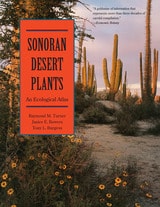
Sonoran Desert Plants
An Ecological AtlasRaymond M. Turner, Janice E. Bowers, and Tony L. Burgess
University of Arizona Press, 1995
The Sonoran Desert, a fragile ecosystem, is under ever-increasing pressure from a burgeoning human population. This ecological atlas of the region's plants, a greatly enlarged and full revised version of the original 1972 atlas, will be an invaluable resource for plant ecologists, botanists, geographers, and other scientists, and for all with a serious interest in living with and protecting a unique natural southwestern heritage.
An encyclopedia as well as an atlas, this monumental work describes the taxonomy, geographic distribution, and ecology of 339 plants, most of them common and characteristic trees, shrubs, or succulants. Also included is valuable information on natural history and ethnobotanical, commercial, and horticultural uses of these plants. The entry for each species includes a range map, an elevational profile, and a narrative account. The authors also include an extensive bibliography, referring the reader to the latest research and numerous references of historical importance, with a glossary to aid the general reader. Sonoran Desert Plants is a monumental work, unlikely to be superseded in the next generation. As the region continues to attract more people, there will be an increasingly urgent need for basic knowledge of plant species as a guide for creative and sustainable habitation of the area. This book will stand as a landmark resource for many years to come.
An encyclopedia as well as an atlas, this monumental work describes the taxonomy, geographic distribution, and ecology of 339 plants, most of them common and characteristic trees, shrubs, or succulants. Also included is valuable information on natural history and ethnobotanical, commercial, and horticultural uses of these plants. The entry for each species includes a range map, an elevational profile, and a narrative account. The authors also include an extensive bibliography, referring the reader to the latest research and numerous references of historical importance, with a glossary to aid the general reader. Sonoran Desert Plants is a monumental work, unlikely to be superseded in the next generation. As the region continues to attract more people, there will be an increasingly urgent need for basic knowledge of plant species as a guide for creative and sustainable habitation of the area. This book will stand as a landmark resource for many years to come.
[more]
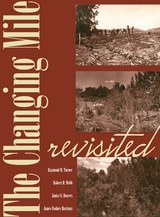
The Changing Mile Revisited
An Ecological Study of Vegetation Change with Time in the Lower Mile of an Arid and Semiarid RegionRaymond M. Turner, Robert H. Webb, Janice E. Bowers, and James Rodney Hastings
University of Arizona Press, 2003
The Changing Mile, originally published in 1965, was a benchmark in ecological studies, demonstrating the prevalence of change in a seemingly changeless place. Photographs made throughout the Sonoran Desert region in the late 1800s and early 1900s were juxtaposed with photographs of the same locations taken many decades later. The nearly one hundred pairs of images revealed that climate has played a strong role in initiating many changes in the region. This new book updates the classic by adding recent photographs to the original pairs, providing another three decades of data and showing even more clearly the extent of change across the landscape. During these same three decades, abundant information about climatic variability, land use, and plant ecology has accumulated, making it possible to determine causes of change with more confidence.
Using nearly two hundred additional triplicate sets of unpublished photographs, The Changing Mile Revisited utilizes repeat photographs selected from almost three hundred stations located in southern Arizona, in the Pinacate region of Mexico, and along the coast of the Gulf of California. Coarse photogrammetric analysis of this enlarged photographic set shows the varied response of the region's major plant species to the forces of change. The images show vegetation across the entire region at sites ranging in elevation from sea level to a mile above sea level. Some sites are truly arid, while others are located above the desert in grassland and woodland. Common names are used for most plants and animals (with Latin equivalents in endnotes) to make the book more accessible to non-technical readers.
The original Changing Mile was based upon a unique set of data that allowed the authors to evaluate the extent and magnitude of vegetation change in a large geographic region. By extending the original landmark study, The Changing Mile Revisited will remain an indispensable reference for all concerned with the fragile desert environment.
[more]
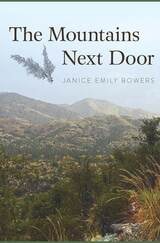
The Mountains Next Door
Janice Emily Bowers
University of Arizona Press, 1991
The Rincon Mountains east of Tucson are a small and seemingly undistinguished range; rounded and arid, they are more a site for foothill walks than serious exploring. Yet these unassuming mountains disclose many wonders and curiosities upon close inspection, as Janice Emily Bowers discovered while conducting a botanical study there. Over the course of two years she made 38 excursions into the Rincons—some for two or three days at a time—and garnered not only plant specimens but thoughts along the way. The Mountains Next Door is the first book to describe and celebrate the natural history of these mountains that even longtime Arizonans may often take for granted.
"I watched the seasons march through the canyons," writes Bowers, "followed the wildflower parade from February through November, and throughout it all realized that I could travel in the Rincon Mountains forever and never learn all they contained." It is also a book of meditations, as Bowers reflects upon the meaning of nature, the similarities between the scientific and creative processes, the value of wilderness in the face of urban encroachment, and other ideas. Participating in the long tradition of reflective natural history writing, she has produced a memorable book that depicts the delights and dilemmas of field botany as it explores the perennial struggle between science and mysticism that tugs at every naturalist's heart.
"I watched the seasons march through the canyons," writes Bowers, "followed the wildflower parade from February through November, and throughout it all realized that I could travel in the Rincon Mountains forever and never learn all they contained." It is also a book of meditations, as Bowers reflects upon the meaning of nature, the similarities between the scientific and creative processes, the value of wilderness in the face of urban encroachment, and other ideas. Participating in the long tradition of reflective natural history writing, she has produced a memorable book that depicts the delights and dilemmas of field botany as it explores the perennial struggle between science and mysticism that tugs at every naturalist's heart.
[more]