Results by title
3 books match the query 'Boycotts'
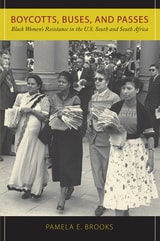
Boycotts, Buses, and Passes
Black Women's Resistance in the U.S. South and South AfricaPamela E. Brooks
University of Massachusetts Press, 2008
In the mid-1950s, as many developing nations sought independence from colonial rule, black women in the American South and in South Africa launched parallel campaigns to end racial injustice within their respective communities. Just as the dignified obstinacy of Mrs. Rosa Parks sparked the Montgomery bus boycott in 1955, the 20,000 South African women who marched in Pretoria a year later to protest the pass laws signaled a new wave of resistance to the system of apartheid. In both places women who had previously been consigned to subordinate roles brought fresh leadership to the struggle for political freedom and social equality.
In this book, Pamela E. Brooks tells their story, documenting the extraordinary achievements of otherwise ordinary women. In comparing the experiences of black women activists in two different parts of the African diaspora, Brooks draws heavily on oral histories that provide clear, and often painful, insight into their backgrounds, their motives, their hopes, and their fears. We learn how black women from all walks of life—domestic and factory workers, householders, teachers, union organizers, churchwomen, clubwomen, rural and urban dwellers alike—had to overcome their class differences and work through the often difficult gender relations within their families and communities. Yet eventually they came together to forge their own political organizations, such as the Women's Political Council and the Federation of South African Women, or joined orga-nizations of women and men, such as the Montgomery Improvement Association and the African National Congress, to advance the common agenda of black liberation.By tracing the dual rise of political consciousness and activism among the black women of the U.S. South and South Africa, Brooks not only illuminates patterns that have long been overlooked but places that shared history within the context of a larger global struggle to bring an end to the vestiges of European colonialism.
Buying Power
A History of Consumer Activism in AmericaLawrence B. Glickman
University of Chicago Press, 2009
A definitive history of consumer activism, Buying Power traces the lineage of this political tradition back to our nation’s founding, revealing that Americans used purchasing power to support causes and punish enemies long before the word boycott even entered our lexicon. Taking the Boston Tea Party as his starting point, Lawrence Glickman argues that the rejection of British imports by revolutionary patriots inaugurated a continuous series of consumer boycotts, campaigns for safe and ethical consumption, and efforts to make goods more broadly accessible. He explores abolitionist-led efforts to eschew slave-made goods, African American consumer campaigns against Jim Crow, a 1930s refusal of silk from fascist Japan, and emerging contemporary movements like slow food. Uncovering previously unknown episodes and analyzing famous events from a fresh perspective, Glickman illuminates moments when consumer activism intersected with political and civil rights movements. He also sheds new light on activists’ relationship with the consumer movement, which gave rise to lobbies like the National Consumers League and Consumers Union as well as ill-fated legislation to create a federal Consumer Protection Agency.
Inter/Nationalism
Decolonizing Native America and PalestineSteven Salaita
University of Minnesota Press, 2016
“The age of transnational humanities has arrived.” According to Steven Salaita, the seemingly disparate fields of Palestinian Studses and American Indian studies have more in common than one may think. In Inter/Nationalism, Salaita argues that American Indian and Indigenous studies must be more central to the scholarship and activism focusing on Palestine.
Salaita offers a fascinating inside account of the Boycott, Divestment, and Sanctions (BDS) movement—which, among other things, aims to end Israel’s occupation of Palestinian land. In doing so, he emphasizes BDS’s significant potential as an organizing entity as well as its importance in the creation of intellectual and political communities that put Natives and other colonized peoples such as Palestinians into conversation. His discussion includes readings of a wide range of Native poetry that invokes Palestine as a theme or symbol; the speeches of U.S. President Andrew Jackson and early Zionist thinker Ze’ev Jabotinsky; and the discourses of “shared values” between the United States and Israel.
Inter/Nationalism seeks to lay conceptual ground between American Indian and Indigenous studies and Palestinian studies through concepts of settler colonialism, indigeneity, and state violence. By establishing Palestine as an indigenous nation under colonial occupation, this book draws crucial connections between the scholarship and activism of Indigenous America and Palestine.