Results by title
6 books match the query 'Boys in literature'
All-American Boy
By Larzer Ziff
University of Texas Press, 2012
From his celebrated appearance, hatchet in hand, in Parson Mason Locke Weems’s Life of Washington to Booth Tarkington’s Penrod, the all-American boy was an iconic figure in American literature for well over a century. Sometimes he was a “good boy,” whose dutiful behavior was intended as a model for real boys to emulate. Other times, he was a “bad boy,” whose mischievous escapades could be excused either as youthful exuberance that foreshadowed adult industriousness or as deserved attacks on undemocratic pomp and pretension. But whether good or bad, the all-American boy was a product of the historical moment in which he made his appearance in print, and to trace his evolution over time is to take a fresh view of America’s cultural history, which is precisely what Larzer Ziff accomplishes in All-American Boy.
Ziff looks at eight classic examples of the all-American boy—young Washington, Rollo, Tom Bailey, Tom Sawyer, Ragged Dick, Peck’s “bad boy,” Little Lord Fauntleroy, and Penrod—as well as two notable antitheses—Huckleberry Finn and Holden Caulfield. Setting each boy in a rich cultural context, Ziff reveals how the all-American boy represented a response to his times, ranging from the newly independent nation’s need for models of democratic citizenship, to the tales of rags-to-riches beloved during a century of accelerating economic competition, to the recognition of adolescence as a distinct phase of life, which created a stage on which the white, middle-class “solid citizen” boy and the alienated youth both played their parts.
Boys Abducted
The Homoerotics of Empire and Race in Early ModernityAbdulhamit Arvas
Duke University Press, 2025
Huckleberry Finn as Idol and Target
The Functions of Criticism in Our TimeJonathan Arac
University of Wisconsin Press, 1997
If racially offensive epithets are banned on CNN air time and in the pages of USA Today, Jonathan Arac asks, shouldn’t a fair hearing be given to those who protest their use in an eighth-grade classroom? Placing Mark Twain’s comic masterpiece, Huckleberry Finn, in the context of long-standing American debates about race and culture, Jonathan Arac has written a work of scholarship in the service of citizenship.
Huckleberry Finn, Arac points out, is America’s most beloved book, assigned in schools more than any other work because it is considered both the “quintessential American novel” and “an important weapon against racism.” But when some parents, students, and teachers have condemned the book’s repeated use of the word “nigger,” their protests have been vehemently and often snidely countered by cultural authorities, whether in the universities or in the New York Times and the Washington Post. The paradoxical result, Arac contends, is to reinforce racist structures in our society and to make a sacred text of an important book that deserves thoughtful reading and criticism. Arac does not want to ban Huckleberry Finn, but to provide a context for fairer, fuller, and better-informed debates.
Arac shows how, as the Cold War began and the Civil Rights movement took hold, the American critics Lionel Trilling, Henry Nash Smith, and Leo Marx transformed the public image of Twain’s novel from a popular “boy’s book” to a central document of American culture. Huck’s feelings of brotherhood with the slave Jim, it was implied, represented all that was right and good in American culture and democracy. Drawing on writings by novelists, literary scholars, journalists, and historians, Arac revisits the era of the novel’s setting in the 1840s, the period in the 1880s when Twain wrote and published the book, and the post–World War II era, to refute many deeply entrenched assumptions about Huckleberry Finn and its place in cultural history, both nationally and globally. Encompassing discussion of Harriet Beecher Stowe, Frederick Douglass, Ralph Ellison, Archie Bunker, James Baldwin, Shelley Fisher Fishkin, and Mark Fuhrman, Arac’s book is trenchant, lucid, and timely.
Making American Boys
Boyology and the Feral TaleKenneth B. Kidd
University of Minnesota Press, 2005
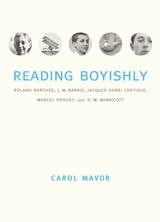
Reading Boyishly
Roland Barthes, J. M. Barrie, Jacques Henri Lartigue, Marcel Proust, and D. W. WinnicottCarol Mavor
Duke University Press, 2007
To “read boyishly” is to covet the mother’s body as a home both lost and never lost, to desire her as only a son can, as only a body that longs for, but will never become Mother, can. Nostalgia (from the Greek nostos = return to native land, and algos = suffering or grief) is at the heart of the labor of boyish reading, which suffers in its love affair with the mother. The writers and the photographer that Mavor lovingly considers are boyish readers par excellence: Barrie, creator of Peter Pan, the boy who refused to grow up; Barthes, the “professor of desire” who lived with or near his mother until her death; Proust, the modernist master of nostalgia; Winnicott, therapist to “good enough” mothers; and Lartigue, the child photographer whose images invoke ghostlike memories of a past that is at once comforting and painful.
Drawing attention to the interplay between writing and vision, Reading Boyishly is stuffed full with more than 200 images. At once delicate and powerful, the book is a meditation on the threads that unite mothers and sons and on the writers and artists who create from those threads art that captures an irretrievable past.
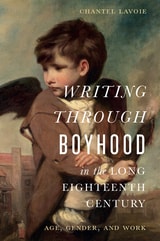
Writing through Boyhood in the Long Eighteenth Century
Age, Gender, and WorkChantel Lavoie
University of Delaware Press, 2024