Results by title
3 books match the query 'Bradley, Martha Sonntag'

Differing Visions
DISSENTERS IN MORMON HISTORYEdited by Roger D. Launius and Linda Thatcher: Foreword by Leonard J. Arrington
University of Illinois Press, 1994
"An absolute necessity for anyone interested in the history/direction of the Latter Day Saint Movement." -- Gerald John Kloss, Latter Day Saint History
"Well done. . . . Respectful and professional." -- Lynn D. Wardle, BYU Studies
"Makes a valuable contribution to our improved understanding of the rich heritage and faith of Mormonism." -- Milan D. Smith Jr., Sunstone
"An important and thought-provoking book." -- Lola Van Wagenen, Utah Historical Quarterly
"A splendid collection. . . . Essential reading for anyone interested even slightly in the Restoration movement." -- Paul Shupe, The John Whitmer Historical Association Journal
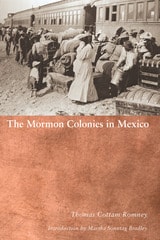
Mormon Colonies in Mexico
Thomas Cottam Romney
University of Utah Press, 2005
"Romney’s unique vantage point is the strongest draw of this narrative: Romney and his family lived much of their life in the Mexican Mormon colonies. But the narrative’s value is much broader and deeper than just that. Romney’s insights into Mexican politics and personalities, and his view of the course of history from inside rather than from outside, are fascinating, colorful and opinionated. He was clear about who he admired and why, and who he did not."
—from the Foreword
In the 1880s, as a precondition to granting Utah statehood, the United States government enacted laws to put a stop to the Mormon practice of polygamy. Those who continued to practice this principle were forced underground as federal marshals roamed the territory searching for "polygs." In response, the Church of Jesus Christ of Latter-day Saints looked for safe places to send its members; many found refuge across the border in Mexico.
Unavailable since its original publication in 1938, this important document of a little-known chapter in Mormon history is now reprinted with a foreword by Martha Sonntag Bradley. Romney was raised and spent much of his life in the colonies, making this book a significant contribution to LDS history. It chronicles a new kind of Mormon pioneer facing the hardships of an unfamiliar land, a tenuous relationship with the government, and the necessary fortitude to hold fast to one’s belief in the face of difficulty and trial.

Plural Wife
The Life Story of Mabel Finlayson AllredMabel Finlayson Allred, author, and Martha Sonntag Bradley, editor
Utah State University Press, 2012
Mabel Finlayson Allred was a wife of Rulon Allred, leader of the Apostolic United Brethren, one of the major groups of fundamentalist Mormons who, since about the 1930s, have practiced plural marriage as separatists from the mainstream Latter-day Saints Church.
Mabel’s autobiography maintains a mood of everyday normalcy strikingly in contrast with the stress of the ostracized life she was living. Her cheerful tone, expressive of her wish to live simply and gracefully in this world, is tempered by more somber descriptions of her personal struggle with clinical depression, of Rulon Allred’s inner struggles, of tensions with the law and with Allred’s fundamentalist colleagues, and ultimately by her forthright account of his assassination.
Emerging from this unique narrative is the portrait of a woman buoyed by faith in both her religion and her husband, a window into the interior life of a woman seeking a resilient simplicity in an uncommonly challenging life.
Plural Wife, conntextualized by Martha Bradley’s introduction, gives us insight into Mabel’s experience of history during an important period of the 20th century and advances our understanding of life ways of 20th century polygamy and the growth of the fundamentalist movement.