Results by title
2 books match the query 'Braxton Bragg'
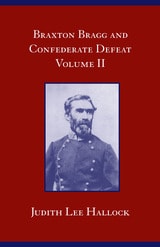
Braxton Bragg and Confederate Defeat V. II
Judith Lee Hallock
University of Alabama Press, 2009
The second volume in a two-part examination of one of the Confederacy's most controversial and unsuccessful military commanders
In the summer of 1863, Confederate General Braxton Bragg was commander of the Army of Tennessee., still reeling from its defeat in January at Murfreesboro, Tennessee. Failing to establish a strong defensive position at either Tullahoma or Chattanooga, Bragg saw the heartland of the South gradually slip away from him. Victory at Chickamauga Creek in September—Bragg’s last military success—was followed by disaster at Missionary Ridge and, shortly thereafter, his removal from army command.
Within three months, however, President Jefferson Davis had restored Bragg to active military involvement, naming him military adviser for the Confederacy. Here, finally, Bragg’s skills as an administrator and organizer bore fruit—as did his penchant for provoking quarrels and disunity within the military establishment. Reassigned to field command in late 1864, Bragg concluded his army service with defeats at Wilmington and Bentonville, North Carolina. The prevailing view of Bragg’s is a false one. Rather, he was a valuable asset to the Confederacy, a talented organizer whose gifts were misused by the nation he served. For the first time, Bragg’s tenure in Richmond is examined carefully and evaluated. Contrary to the common view that Bragg was nothing more than a sycophant to President Davis, this study shows that he and Davis often disagreed on policy. Much of Bragg’s present reputation among civil war scholars is based upon how contemporaries viewed him. Despite Bragg’s determined devotion to the Confederacy, his frailties have shaped the literature to such an extent that his real accomplishments have been distorted or ignored. In this study the author has tried, as General Joseph E. Johnston once advised, to “have a little charity for Bragg.”
Judith Lee Hallock draws a balanced picture of Bragg and of his important role in the Confederacy beginning in 1863. Her volume continues and completes the biography of Bragg published in Volume I by Grady McWhiney in 1969. Along with the military details, the author provides a full accounting of Bragg’s fractious relationships with other members of the military, a critical factor in this period for the entire Confederate command. This sympathetic biography of Bragg gives valuable insight into the workings of the Confederacy in the last two years of its struggle for independence.
[more]
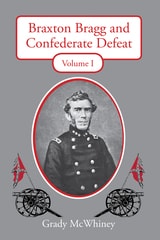
Braxton Bragg and Confederate Defeat
Volume 1Grady McWhiney
University of Alabama Press, 1991
Born in 1817 in North Carolina, Bragg ranked high in the graduating class of 1837 at West Point. He served with distinction in both the Seminole War and the Mexican War. Just prior to the outbreak of the Civil War, Bragg was promoted to major general. In June 1862 Bragg was named Commander of the Army of Tennessee, the principal Confederate force in the West, and was described by Secretary of War Judah P. Benjamin as “the greatest General.”
Yet less than two years later Bragg was the South’s most discredited commander. Much of this criticism was justified, for he had done as much as any Confederate general to lose the war. Under his direction the army fought four major campaigns before retreating from Kentucky through Tennessee to Georgia. The army’s failures were Bragg’s failures, and after his defeat at Chattanooga in November 1863 Bragg was relieved of field command. Instead of retirement to the obscurity most people believed he so richly deserved, Bragg received a remarkable promotion: he went to Richmond as President Davis’s military adviser.
McWhiney intended this work – first published in 1969 – to be the first of two volumes covering the life of the Confederacy’s most problematic general. This reprint edition is issued along with Braxton Bragg and Confederate Defeat, Volume II by Judith Lee Hallock. McWhiney’s work carries Bragg through the defeat at Murfreesboro in January 1863, and Hallock’s book continues through the staff appointment in Richmond and Bragg’s final days as a private citizen.
[more]