Results by title

3 books match the query 'Bright, Charles'
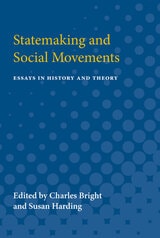
cover of Statemaking and Social Movements: Essays in History and Theory

Statemaking and Social Movements

Essays in History and Theory

Edited by Charles Bright and Susan Harding

University of Michigan Press, 1984
Statemaking does not end once states emerge but is a continuous process, argue the contributors to this volume. In their view, states are not static structures that “act upon" society, nor are states simple reflections of economic relations; states are instead highly dynamic structures that are constantly built up, dismantled, and transformed by complex interplays of political, social, and economic processes. This collection of original essays by leading scholars in the fields of history, anthropology, sociology, and economics argues for historically specific theories of states and politics in place of ahistorical models. Case studies range in scope from Aztec Mexico and feudal Europe to Nazi Germany and contemporary America. What emerges from this ground-breaking interdisciplinary dialogue is a historically sensitive way of thinking about states, politics, and social movements and the transformative relationship between states and societies.
[more]
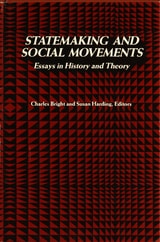
cover of Statemaking and Social Movements: Essays in History and Theory

Statemaking and Social Movements

Essays in History and Theory

Charles Bright and Susan Harding, Editors

University of Michigan Press, 1984
Statemaking does not end once states emerge but is a continuous process, argue the contributors to this volume. In their view, states are not static structures that “act upon" society, nor are states simple reflections of economic relations; states are instead highly dynamic structures that are constantly built up, dismantled, and transformed by complex interplays of political, social, and economic processes. This collection of original essays by leading scholars in the fields of history, anthropology, sociology, and economics argues for historically specific theories of states and politics in place of ahistorical models. Case studies range in scope from Aztec Mexico and feudal Europe to Nazi Germany and contemporary America. What emerges from this ground-breaking interdisciplinary dialogue is a historically sensitive way of thinking about states, politics, and social movements and the transformative relationship between states and societies.
[more]
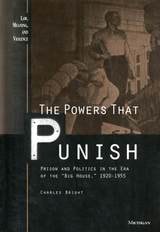
cover of The Powers that Punish: Prison and Politics in the Era of the "Big House", 1920-1955

The Powers that Punish

Prison and Politics in the Era of the "Big House", 1920-1955

Charles Bright

University of Michigan Press, 1996

In a pathbreaking study of a major state prison, Michigan's Jackson State Penitentiary during the middle years of this century, Charles Bright addresses several aspects of the history and theory of punishment. The study is an institutional history of an American penitentiary, concerned with how a carceral regime was organized and maintained, how prisoners were treated and involved in the creation of a regime of order and how penal practices were explained and defended in public. In addition, it is a meditation upon punishment in modern society and a critical engagement with prevailing theories of punishment coming out of liberal, Marxist and post structuralist traditions. Deploying theory critically in a historic narrative, it applies new, relational theories of power to political institutions and practices. Finally, in studying the history of the Jackson prison, Bright provides a rich account, full of villains and a few heroes, of state politics in Michigan during a period of rapid transition between the 1920s to the 1950s.

The book will be of direct relevance to criminologists and scholars of punishment, and to historians concerned with the history of punishment and prisons in the United States. It will also be useful to political scientists and historians concerned with exploring new approaches to the study of power and with the transformation of state politics in the 1930s and 1940s. Finally Bright tells a story which will fascinate students of modern Michigan history.

Charles Bright is a historian and Lecturer at the Residential College of the University of Michigan.

[more]