Results by title
5 books match the query 'Bringardner, Chase'
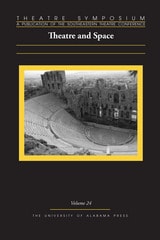
Theatre Symposium, Vol. 24
Theatre and SpaceEdited by Becky K. Becker
University of Alabama Press, 2016
Exploring the dynamic intersections of performance and place.
At a time when so many options exist for access to theatrical entertainments, it is no surprise that theatre practitioners and scholars are often preoccupied with the role of the audience. While space undoubtedly impacts the rehearsal and production processes, its greater significance seems to rest in the impact a specific location has on the audience.
This volume provides diverse viewpoints on theatre and space, as well as its relationship to the audience. Sebastian Trainor and Samuel T. Shanks offer contemporary perspectives on two ancient theatre spaces, while Lisa Marie Bowler describes the Globe Theatre, a replica of the original, as embodying a kind of absence despite its rich link to the past. Focusing on distinctly different periods and settings, both Andrew Gibb and Christine Woodworth describe a politics of space in which specific players gain prestige and power. Chase Bringardner identifies the audience as playing an important role in creating a space for parody in a historic Nashville venue, while Arnab Banerji describes an exhausting process for members of the Bengali group theatre who must continually move from space to space. Finally, Alicia Corts discusses virtual performance spaces and the degree to which participants are able to control their online identities within virtual performances. Bookending these eight essays are Marvin Carlson’s keynote presentation “Whose Space Is It Anyway?” and his closing remarks for the symposium, both of which allude to, and richly explicate, the ultimate arbiters of theatrical space: the audience.
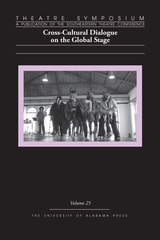
Theatre Symposium, Vol. 25
Cross-Cultural Dialogue on the Global StageEdited by Becky K. Becker
University of Alabama Press, 2017
Globalization may strike many as a phenomenon of our own historical moment, but it is truly as old as civilization: we need only look to the ancient Silk Road linking the Far East to the Mediterranean in order to find some of the earliest recorded impacts of people and goods crossing borders. Yet, in the current cultural moment, tensions are high due to increased migration, economic unpredictability, complicated acts of local and global terror, and heightened political divisions all over the world.
Thus globalization seems new and a threat to our ways of life, to our nations, and to our cultures. In what ways have theatre practitioners, educators, and scholars worked to support cross-cultural dialogue historically? And in what ways might theatre embrace the complexities and contradictions inherent in any meaningful exchange? The essays in Theatre Symposium, Volume 25 reflect on these questions.
Featured in Theatre Symposium, Volume 25
- “Theatre as Cultural Exchange: Stages and Studios of Learning” by Anita Gonzalez
- “Certain Kinds of Dances Used among Them: An Initial Inquiry into Colonial Spanish Encounters with the Areytos of the Taíno in Puerto Rico” by E. Bert Wallace
- “Gertrude Hoffmann’s Lawful Piracy: ‘A Vision of Salome’ and the Russian Season as Transatlantic Production Impersonations” by Sunny Stalter-Pace
- “Greasing the Global: Princess Lotus Blossom and the Fabrication of the ‘Orient’ to Pitch Products in the American Medicine Show” by Chase Bringardner
- “Dismembering Tennessee Williams: The Global Context of Lee Breuer’s A Streetcar Named Desire” by Daniel Ciba
- “Transformative Cross-Cultural Dialogue in Prague: Americans Creating Czech History Plays” by Karen Berman
- “Finding Common Ground: Lessac Training across Cultures” by Erica Tobolski and Deborah A. Kinghorn
Theatre Symposium, Vol. 28
Theatre and CitizenshipEdited by Andrew Gibb
University of Alabama Press, 2020
A collection of essays whose authors reach beyond simple definitions of citizenship as determined by documents and legal rights
The scholarly conference from which this publication emerged was circulated in the waning months of 2018, following a summer of urgent and emotional debate surrounding new US immigration policies regarding immigrant family separations, arguments fueled on one side by fears about the loss of social cohesion, and on the other by photographs of incarcerated children. Given the then-prevailing political atmosphere, editor Andrew Gibb anticipated that a good number of submissions might draw connections between the patterns, policies, and histories of immigration on the one hand, and theatrical or otherwise performance-centered expressions of citizenship, whether inclusive or exclusionary, on the other. In retrospect, what could have been foreseen is that theatre scholars, educators, and professionals would interpret recent events against a wider and more complex backdrop. The ultimate result of that initial call is this volume, a collection of essays whose authors reach beyond simple definitions of citizenship as determined by documents and legal rights, and who engage in larger conversations about what citizenship can mean, and how such meanings are expressed through theatre and performance.
Interestingly, while none of the authors published herein take up immigration as a central issue, they all make use of some combination of three particular analytical frameworks, all of which happen to be pertinent to the current immigrant experience and attempts to regulate it: bodies, institutions, and technologies.
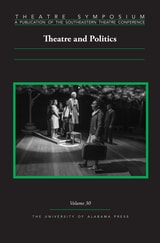
Theatre Symposium, Vol. 30
Theatre and Politicsedited by Chase Bringardner
University of Alabama Press, 2023
Illustrates how theatre’s engagement with politics changes over time
For the thirtieth volume of Theatre Symposium, the editors return to a topic first proposed over twenty years ago in volume 9 (theatre and politics in the twentieth century), reimaged for a broader, more comprehensive time frame. In this volume on theater and politics, scholars explore what constitutes the political, how the political is performed, and how theatre engages with politics over time, drawing on the following framing questions: What is the historical and ongoing role of theatre in framing our ideas and conversations about politics? How do politics and theatre engage one another in an increasingly mediated landscape? From theatrical analysis of the political arena to political analysis of the theatrical stage, discussions of theatre and politics can challenge ethical, theoretical, and artistic considerations of our world.
The current moment presents a compelling opportunity to revisit, revise, and reengage. Certainly, in the twenty-one volumes since volume 9, the political landscape both nationally and internationally has shifted dramatically. The past two years specifically have seen an increase in the already prevalent presence of the political in our daily discourse. The COVID-19 global pandemic and ongoing racial reckonings have further unmoored many systems and structures, requiring action and change. Rather than a moment of pause or passivity, pandemic times have seen an increase in political activity and political discourse on the local, national, and global levels. Within the theatre and performance communities, these calls to action have resulted in movements like #weseeyouWAT and other calls to break down old systems and create new ones, to privilege access for those of the global majority, and to explicitly demand advocacy and activism. Organizations like the Southeastern Theatre Conference (SETC) itself crafted new ethos statements and engaged in the necessary work of boldly foregrounding equity, diversity, inclusion, and accessibility at the center of all its efforts.
The editors and contributors to this volume respond to the immediacy of this moment and the clarion call for change. From Shakespeare to new productions like Alabama Love Stories, presented at Auburn University, contributors grapple with a range of examples, contemporary and historical, and argue with renewed urgency for the importance of intentionally interrogating the interplay of performance and politics. The essays in this volume demonstrate that theatre and performance cannot rise to this moment or even begin to address it without doing that substantial work to clean its own house and create accessible new spaces.
Contributors
Chase Bringardner / Tessa Carr / Lily Climenhaga / Abena Foreman-Trice / Emma Givens / TK Manwill / Boomie Pederson / Royal Shirée / Teresa Simone / Tony Tambasco / Jonathon W. Taylor / Justice von Maur / Patricia Ybarra
Theatre Symposium, Vol. 31
Theatre and the PopularEdited by Chase Bringardner
University of Alabama Press, 2024
A new issue of the longstanding theatre journal, documenting conversations that traverse disciplinary boundaries
The essays in the thirty-first volume of Theatre Symposium traverse disciplinary boundaries to explore what constitutes the “popular” in theater and performance in an increasingly frenetic and mediated landscape. Amid the current resurgence of populist discourse and the enduring impact of popular culture, this volume explores what is considered popular, how that determination gets made, and who makes it. The answers to these questions shape the structures and systems of performance in an interaction that is reciprocal, intricate, and multifaceted. Productions often succeed or fail based on their ability to align with what is popular—sometimes productively, sometimes clumsily, sometimes brazenly, and sometimes tragically.
In our current moment, what constitutes the popular profoundly affects the real world politically, economically, and socially. Controversies about the electoral college system hinge on the primacy of the “popular” vote. Streaming services daily update lists of their most popular content and base future decisions on opaque measures of popularity. Social media platforms broadcast popular content across the globe, triggering new products, social activism, and political revolutions.
The contributors to this volume engage with a range of contemporary and historical examples and argue with clarity and acuity the interplay of performance and the popular. Theatre and performance deeply engage with the popular at every level—from audience response to box office revenue. The variety of methodologies and sites of inquiry showcased in this volume demonstrates the breadth and depth of the popular and the importance of such work to understanding our present moment onstage and off.
CONTRIBUTORS
Mysia Anderson / Chase Bringardner / Elizabeth M. Cizmar / Chelsea Curto / Janet M. Davis / Tom Fish / Kyla Kazuschyk / Sarah McCarroll / Eleanor Owicki / Sunny Stalter-Pace / Chelsea Taylor / Chris Woodworth