Results by title
6 books match the query 'Bringing'

Bringing in the Future
Strategies for Farsightedness and Sustainability in Developing CountriesWilliam Ascher
University of Chicago Press, 2009
Humans are plagued by shortsighted thinking, preferring to put off work on complex, deep-seated, or difficult problems in favor of quick-fix solutions to immediate needs. When short-term thinking is applied to economic development, especially in fragile nations, the results—corruption, waste, and faulty planning—are often disastrous. In Bringing in the Future, William Ascher draws on the latest research from psychology, economics, institutional design, and legal theory to suggest strategies to overcome powerful obstacles to long-term planning in developing countries.
Drawing on cases from Africa, Asia, and Latin America, Ascher applies strategies such as the creation and scheduling of tangible and intangible rewards, cognitive exercises to increase the understanding of longer-term consequences, self-restraint mechanisms to protect long-term commitments and enhance credibility, and restructuring policy-making processes to permit greater influence of long-term considerations. Featuring theoretically informed research findings and sound policy examples, this volume will assist policy makers, activists, and scholars seeking to understand how the vagaries of human behavior affect international development.

Bringing the Arts into the Library
Carol Smallwood
American Library Association, 2013
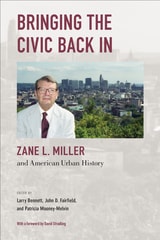
Bringing the Civic Back In
Zane L. Miller and American Urban HistoryEdited by Larry Bennett, John D. Fairfield, and Patricia Mooney-Melvin
Temple University Press, 2022
With the passing of Zane L. Miller in 2016, academia lost a renowned scholar and one of the key founders of new urban history—a branch of the discipline that placed urban life at the center of American history and treated the city as an arena for civic and political action. He was a devoted, tireless mentor who published or fostered dozens of books and articles on urban history. He also co-founded Temple University Press’ foundational series Urban Life, Landscape, and Policy.
Bringing the Civic Back In provides a critical overview, appreciation, and extension of Miller’s work as scholar, editor, mentor, colleague, and citizen. Included are three excerpts from Miller’s final, unfinished work, in which he presented cities as the source of a civic nationalism he viewed as fundamental to the development of American democracy. The editors—along with contributors Robert B. Fairbanks and Charles Lester—reflect on the life and work of their friend as well as his role in creating a Cincinnati school of urban history. These original essays by practitioners of Miller’s approach highlight the power of ideas to shape social change.

Bringing the Devil to His Knees
The Craft of Fiction and the Writing LifeCharles Baxter and Peter Turchi, Editors
University of Michigan Press, 2001
Each of the contributors is a current or former lecturer at the Warren Wilson College MFA Program for Writers, one of the most highly respected writing programs in the country. Included are essays by Charles Baxter, Robert Boswell, Karen Brennan, Judith Grossman, Ehud Havazelet, C. J. Hribal, Margot Livesey, Michael Martone, Kevin McIlvoy, Pablo Medina, Antonya Nelson, Susan Neville, Richard Russo, Steven Schwartz, Jim Shepard, Joan Silber, Debra Spark, Peter Turchi, and Chuck Wachtel.
Rich with masterful examples and personal anecdotes, these imaginative essays provide hard-earned insight into a writer's work. The book will interest not only those seeking inspiration and guidance to become stronger writers, but also readers of contemporary literary fiction, who will find a number of surprising and original approaches to the writer's work by award-winning practitioners adept at teaching others what they know.
Charles Baxter is author of several novels, including The Feast of Love, Shadow Play, and First Light. and collections of stories including Believers and A Relative Stranger. He teaches writing at the University of Michigan. Peter Turchi is author of the novel The Girls Next Door, a collection of stories, Magician, and a book of non-fiction, The Pirate Prince. He is Director of the MFA Program for Writers, Warren Wilson College.

Bringing the Empire Back Home
France in the Global AgeHerman Lebovics
Duke University Press, 2004
In Bringing the Empire Back Home, the inventive cultural historian Herman Lebovics provides a riveting account of how intense disputes about what it means to be French have played out over the past half-century, redefining Paris, the regions, and the former colonies in relation to one another and the world at large. In a narrative populated with peasants, people from the former colonies, museum curators, former colonial administrators, left Christians, archaeologists, anthropologists, soccer players and their teenage fans, and, yes, leading government officials, Lebovics reveals contemporary French society and cultures as perhaps the West’s most important testing grounds of pluralism and assimilation. A lively cultural history, Bringing the Empire Back Home highlights not only the political significance of France’s efforts to synthesize the regional, national, European, ethnic postcolonial, and global but also the chaotic beauty of the endeavor.

Bringing the Empire Home
Race, Class, and Gender in Britain and Colonial South AfricaZine Magubane
University of Chicago Press, 2003
Bringing the Empire Home tracks colonial images of blackness from South Africa to England and back again to answer questions such as these. Before the mid-1800s, black Africans were considered savage to the extent that their plight mirrored England's internal Others—women, the poor, and the Irish. By the 1900s, England's minority groups were being defined in relation to stereotypes of black South Africans. These stereotypes, in turn, were used to justify both new capitalist class and gender hierarchies in England and the subhuman treatment of blacks in South Africa. Bearing this in mind, Zine Magubane considers how marginalized groups in both countries responded to these racialized representations.
Revealing the often overlooked links among ideologies of race, class, and gender, Bringing the Empire Home demonstrates how much black Africans taught the English about what it meant to be white, poor, or female.