Results by title

3 books match the query 'Brintlinger, Angela'
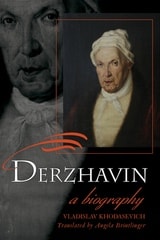
cover of Derzhavin: A Biography

Derzhavin

A Biography

Vladislav Khodasevich, Translated and with an introduction by Angela Brintlinger

University of Wisconsin Press, 2007

Russian poet, soldier, and statesman Gavriil Derzhavin (1743–1816) lived during an epoch of momentous change in Russia—imperial expansion, peasant revolts, war with Turkey, and struggle with Napoleon—and he served three tsars, including Catherine the Great. Here in its first English translation is the masterful biography of Derzhavin by another acclaimed Russian man of letters, Vladislav Khodasevich.
            Derzhavin occupied a position at the center of Russian life, uniting civic service with poetic inspiration and creating an oeuvre that at its essence celebrated the triumphs of Russia and its rulers, particularly Catherine the Great. His biographer Khodasevich, by contrast, left Russia in 1922, unable to abide the increasingly repressive regime of the Soviets. For Khodasevich, whose lyric poems were as commonplace in their focus as Derzhavin’s odes were grand, this biography was in a sense a rediscovery of a lost and idyllic era, a period when it was possible to aspire to the pinnacles of artistic achievement while still occupying a central role in Russian society.
Khodasevich writes with humor, intelligence, and understanding, and his work stands as a monument to the last three centuries of Russian history, lending keen insight into Russia’s past as well as its present and future.


“Khodasevich’s light narrative touch (as translated by Brintlinger) lends a novelistic quality to the biography, making it a genuine tour de force. All students and scholars – of history, literature, poetry, biography – will find something of interest here.”—Choice
[more]
cover of The Silver Age in Our Home: A Memoir of Russian Literary Life in the 20th Century

The Silver Age in Our Home

A Memoir of Russian Literary Life in the 20th Century

Sophia Bogatyreva

Central European University Press, 2027

Before emigrating to the United States, Sophia Bogatyreva was a prominent literary editor and a part of Moscow and Leningrad literary circles that included Joseph Brodsky, Konstantin Bogatyrev, Korney Chukovsky, Nadezhda Mandelshtam, Lilya Brik and many other celebrities. Her memoirs, written in a brilliantly lucid and humorous style, represent several generations of Soviet literary intelligentsia. Her focus is on those segments of Soviet intelligentsia that preserved their living connections with traditions of modernism and avant-garde despite ideological control and political repressions, while at the same not retreating into the “underground” but rather being well-published and well-read. Bogatyreva’s memoirs convey the complex and multi-layered atmosphere uniting those writers who had to discover ingenious and frequently brilliant ways to use their remarkable talents in the narrow space of the permissible. Angela Brintlinger and Catherine O’Neil’s translation excellently conveys the original style, lucidity and humor of Bogatyreva’s book.

These memoirs read as a significant contribution to scholarship, full of important facts and characterizations. At the same time, they become an original intellectual novel with real-life protagonists seen from the point of view of a child, teenager and young woman. The position of the narrator creates a “defamiliarizing” effect similar to the one about which the Formalists and first and foremost Viktor Shklovsky wrote. However, this powerful effect is “hidden in plain view” – the style of Bogatyreva’s memoirs is strikingly transparent and non-pretentious, which makes her book available even for an unprepared reader.

Mark Lipovetsky, Columbia University
[more]
cover of Writing a Usable Past: Russian Literary Culture, 1917-1937

Writing a Usable Past

Russian Literary Culture, 1917-1937

Angela Brintlinger

Northwestern University Press, 2008


In <i>Writing a Usable Past</i>, Brintlinger considers the interactions of post-Revolutionary Russian and emigre culture with the genre of biography in its various permutations, arguing that in the years after the Revolution, Russian writers looked to the great literary figures of the past to help them construct a post-Revolutionary present. In detailed looks at the biographical writing of Yuri Tynianov, Vladislav Khodasevich, and Mikhail Bulgakov, Brintlinger follows each author's successful biography/ies and their failed attempts at biographies of Alexander Pushkin on the centennial anniversary of his death. Brintlinger compares the Pushkin biographies to the other biographies examined, and in a concluding chapter she considers other, more successful commemorations of the great poet's death. She argues that popular commemorations--exhibits, concerts, special issues of journals--were a more fitting biography than the genre of the "usable past." For post-revolutionary cultural actors, including Tynianov, Khodasevich, and Bulgakov, Pushkin was a symbol rather than a model for constructing that usable past.

[more]