Results by title
8 books match the query 'British Empire'

Black People in the British Empire
Peter Fryer
Pluto Press, 1988
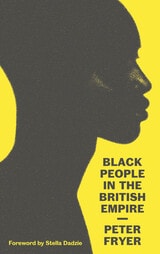
Black People in the British Empire
Peter Fryer
Pluto Press, 2021
Black People in the British Empire is a challenge to the official version of British history. It tells the story of Britain's exploitation and oppression of its subject peoples in its colonies, and in particular the people of Africa, Asia and Australasia
Peter Fryer reveals how the ideology of racism was used as justification for acquiring and expanding the Empire; how the British Industrial Revolution developed out of profits from the slave trade; and how the colonies were deliberately de-industrialised to create a market for British manufacturers.
In describing the frequency and the scale of revolts by subject peoples against slavery and foreign domination - and the brutality used in crushing them - Peter Fryer exposes the true history of colonialism, and restores to Black people their central role in Britain's past.
Black People in the British Empire
Peter Fryer
Pluto Press, 2021
'Fantastic … the most important book on Black British history’ - Akala
Black People in the British Empire is a challenge to the official version of British history. It tells the story of Britain's exploitation and oppression of its subject peoples in its colonies, and in particular the people of Africa, Asia and Australasia
Peter Fryer reveals how the ideology of racism was used as justification for acquiring and expanding the Empire; how the British Industrial Revolution developed out of profits from the slave trade; and how the colonies were deliberately de-industrialised to create a market for British manufacturers.
In describing the frequency and the scale of revolts by subject peoples against slavery and foreign domination - and the brutality used in crushing them - Peter Fryer exposes the true history of colonialism, and restores to Black people their central role in Britain's past.
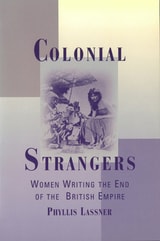
Colonial Strangers
Women Writing the End of the British EmpireLassner, Phyllis
Rutgers University Press, 2004
Drawing on memoirs, fiction, reportage, and film adaptations, Colonial Strangers explores the critical perspectives of writers who correct prevailing stereotypes of British women as agents of imperialism. They also question their own participation in British claims of moral righteousness and British politics of cultural exploitation. These authors take center stage in debates about connections between the racist ideologies of the Third Reich and the British Empire.
Colonial Strangers reveals how the literary responses of key artists represent not only compelling reading, but also a necessary intervention in colonial and postcolonial debates and the canons of modern British fiction.
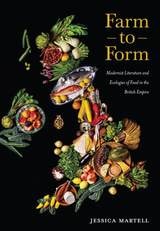
Farm to Form
Modernist Literature and Ecologies of Food in the British EmpireJessica Martell
University of Nevada Press, 2020
Deeply informed by Martell’s extensive knowledge of modern British, Irish, American, and World Literatures, this progressive work positions modernism as central to the study of narratives of resistance against social and environmental degradation. Analyzed works include those of Thomas Hardy, E. M. Forster, Virginia Woolf, Joseph Conrad, George Russell, and James Joyce.
In light of climate change, fossil fuel supremacy, nutritional dearth, and other pressing food issues, modernist texts bring to life an era of crisis and anxiety similar to our own. In doing so, Martell summons the past as a way to employ the modernist term of “defamiliarizing” the present so that entrenched perceptions can be challenged. Our current food regime is both new and constantly evolving with the first industrial food trades. Studying earlier cultural responses to them invites us to return to persistent problems with new insights and renewed passion.

Imperial White
Race, Diaspora, and the British EmpireRadhika Mohanram
University of Minnesota Press, 2007
Radhika Mohanram shows not just how British imperial culture shaped the colonies, but how the imperial rule of colonies shifted—and gave new meanings to—what it meant to be British.
Imperial White looks at literary, social, and cultural texts on the racialization of the British body and investigates British whiteness in the colonies to address such questions as: How was the whiteness in Britishness constructed by the presence of Empire? How was whiteness incorporated into the idea of masculinity? Does heterosexuality have a color? And does domestic race differ from colonial race? In addition to these inquiries on the issues of race, class, and sexuality, Mohanram effectively applies the methods of whiteness studies to British imperial material culture to critically racialize the relationship between the metropole and the peripheral colonies.
Considering whether whiteness, like theory, can travel, Mohanram also provides a new perspective on white diaspora, a phenomenon of the nineteenth century that has been largely absent in diaspora studies, ultimately rereading—and rethinking—British imperial whiteness.
Radhika Mohanram teaches postcolonial cultural studies in the School of English, Communication and Philosophy at Cardiff University, Wales. She is the author of Black Body: Women, Colonialism, Space (Minnesota, 1999) and edits the journal Social Semiotics.

Organised Militarism in Interwar Britain
The Navy League and the Air League of the British EmpireRowan Thompson
University of London Press, 2026
While militaristic and patriotic organizations formed an important part of political culture in Edwardian Britain, 1918 often marks a terminus for histories of organized militarism. Taking the end of the First World War as its starting point, this book argues that militarism was able to survive World War I, despite the competing rise of liberal internationalism, pacifism, and anti-war sentiment. Focusing on the ideas, aims, and activities of the Navy League and the Air League of the British Empire—two extra-parliamentary organizations established to promote naval and aerial supremacy—the book examines how the Leagues negotiated the trauma of the First World War and how they contributed to the societal and military preparation for a second global conflict as the clouds of war gathered in the late 1930s.
Drawing on extensive archival research, Organised Militarism in Interwar Britain explains how these Leagues mobilized broad public and political support and what the story of each organization tells us about the impact of war on British society and culture, civil-military relations, political and private activism, military theater and commemoration, youth, and the politics of disarmament, collective security, internationalism, and national defense. In doing so, it demonstrates that martial and militaristic sentiment remained an important part of mainstream British political culture, despite the ravages of war.
Ten Books That Shaped the British Empire
Creating an Imperial CommonsAntionette Burton and Isabel Hofmeyr, eds.
Duke University Press, 2014
Contributors. Tony Ballantyne, Elleke Boehmer, Catherine Hall, Isabel Hofmeyr, Aaron Kamugisha, Marilyn Lake, Charlotte Macdonald, Derek Peterson, Mrinalini Sinha, Tridip Suhrud, André du Toit