Results by title
2 books match the query 'British Visitors'
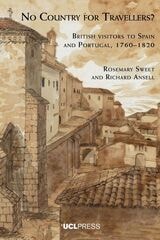
No Country for Travellers?
British Visitors to Spain and Portugal, 1760–1820Rosemary Sweet and Richard Ansell
University College London, 2025
A reexamination of British engagement with Iberia in the eighteenth and nineteenth centuries.
Using extensive archival and printed sources left by contemporary travelers, No Country for Travellers? explores the rise and nature of British travel to Spain and Portugal in the late eighteenth and early nineteenth centuries. Not only is it the first book to address the trend of travelers to the Iberian Peninsula during this time, revealing the extent of British interest in Islamic Spain before the Romantic era, but it also brings to light the role of non-combatant travelers to Iberia during the Peninsular War. Beyond uncovering a previously overlooked dimension of the Peninsular War, this history contends with stereotypes of Iberia that were embedded in early modern confessional and civilizational hierarchies.
Using extensive archival and printed sources left by contemporary travelers, No Country for Travellers? explores the rise and nature of British travel to Spain and Portugal in the late eighteenth and early nineteenth centuries. Not only is it the first book to address the trend of travelers to the Iberian Peninsula during this time, revealing the extent of British interest in Islamic Spain before the Romantic era, but it also brings to light the role of non-combatant travelers to Iberia during the Peninsular War. Beyond uncovering a previously overlooked dimension of the Peninsular War, this history contends with stereotypes of Iberia that were embedded in early modern confessional and civilizational hierarchies.
[more]
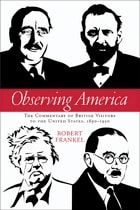
Observing America
The Commentary of British Visitors to the United States, 1890–1950Robert Frankel
University of Wisconsin Press, 2006
Beginning with Alexis de Tocqueville and Frances Trollope, visitors to America have written some of the most penetrating and, occasionally, scathing commentaries on U.S. politics and culture. Observing America focuses on four of the most insightful British commentators on America between 1890 and 1950. The colorful journalist W. T. Stead championed Anglo-American unity while plunging into reform efforts in Chicago. The versatile writer H. G. Wells fiercely criticized capitalist America but found reason for hope in the administrations of Theodore Roosevelt and Franklin Roosevelt. G. K. Chesterton, one of England’s great men of letters, urged Americans to preserve the vestiges of Jeffersonian democracy that he still discerned in the small towns of the heartland. And the influential political theorist and activist Harold Laski assailed the business ethos that he believed dominated the nation, especially after Franklin Roosevelt’s death.
Robert Frankel examines the New World experiences of these commentators and the books they wrote about America. He also probes similar writings by other prominent observers from the British Isles, including Beatrice Webb, Rudyard Kipling, and George Bernard Shaw. The result is a book that offers keen insights into America’s national identity in a time of vast political and cultural change.
Robert Frankel examines the New World experiences of these commentators and the books they wrote about America. He also probes similar writings by other prominent observers from the British Isles, including Beatrice Webb, Rudyard Kipling, and George Bernard Shaw. The result is a book that offers keen insights into America’s national identity in a time of vast political and cultural change.
[more]