Results by title
2 books match the query 'Brito, Francisco de Paula'

Faith in Disguise
A NovellaMayra Santos-Febres; Translated from the Spanish by John A. Mundell
Vanderbilt University Press, 2026
Faith in Disguise follows Martín Tirado, a white Puerto Rican digital historian and research assistant to Fe Verdejo, an Afro-Venezuelan scholar curating an exhibition in Chicago on enslaved and freed Black women in Latin America. As Martín becomes increasingly enmeshed in Fe’s intellectual and erotic orbit, his role as subordinate and interpreter exposes the entanglement of race, power, and desire in the production of historical knowledge. Through the interplay of archival fragments and contemporary encounters, Mayra Santos-Febres illuminates how the afterlives of slavery persist within Latin American racial and sexual imaginaries, and how the erotic, as both method and experience, may gesture toward forms of liberation from them.
[more]
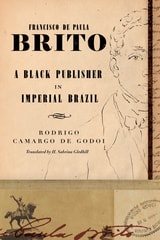
Francisco de Paula Brito
A Black Publisher in Imperial BrazilRodrigo Camargo de Godoi
Vanderbilt University Press, 2020
Francisco de Paula Brito is a biography of a merchant, printer, bookseller, and publisher who lived in Rio de Janeiro from his birth in 1809 until his death in 1861. That period was key to the history of Brazil, because it coincided with the relocation of the Portuguese Court from Lisbon to Rio de Janeiro (1808); the dawning of Brazilian Independence (1822) and the formation of the nation-state; the development of the press and of Brazilian literature; the expansion and elimination of the trans-Atlantic slave trade; and the growth of Rio de Janeiro’s population and the coffee economy. Nevertheless, although it covers five generations of Paula Brito’s family—men and women who left slavery in the eighteenth century—this book focuses on its protagonist’s activities between the 1830s and 1850s.
During that period, Francisco de Paula Brito became one of the central figures in the cultural and political scene in the Imperial capital, particularly through his work as a publisher. Paula Brito’s success was due in part to his ability to forge solid alliances with the Empire’s ruling elite—among them leading politicians responsible for the unification of the vast Brazilian territory and for the maintenance of slavery and the illegal trafficking of Africans. Consequently, through the books and newspapers he published, Francisco de Paula Brito became part of a much larger project.
During that period, Francisco de Paula Brito became one of the central figures in the cultural and political scene in the Imperial capital, particularly through his work as a publisher. Paula Brito’s success was due in part to his ability to forge solid alliances with the Empire’s ruling elite—among them leading politicians responsible for the unification of the vast Brazilian territory and for the maintenance of slavery and the illegal trafficking of Africans. Consequently, through the books and newspapers he published, Francisco de Paula Brito became part of a much larger project.
[more]