Results by title
2 books match the query 'Broadband'
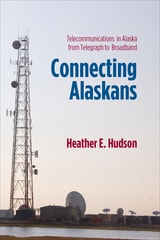
Connecting Alaskans
Telecommunications in Alaska from Telegraph to BroadbandHeather E. Hudson
University of Alaska Press, 2015
“Alaska is now open to civilization.” With those six words in 1900, the northernmost territory finally had a connection with the rest of the country. The telegraph system put in place by the US Army Signal Corps heralded the start of Alaska’s communication network. Yet, as hopeful as that message was, Alaska faced decades of infrastructure challenges as remote locations, extreme weather, and massive distances all contributed to less-than-ideal conditions for establishing reliable telecommunications.
Connecting Alaskans tells the unique history of providing radio, television, phone, and Internet services to more than six hundred thousand square miles. It is a history of a place where military needs often trumped civilian ones, where ham radios offered better connections than telephone lines, and where television shows aired an entire day later than in the rest of the country.
Heather E. Hudson covers more than a century of successes while clearly explaining the connection problems still faced by remote communities today. Her comprehensive history is perfect for anyone interested in telecommunications technology and history, and she provides an important template for policy makers, rural communities, and developing countries struggling to develop their own twenty-first-century infrastructure.
[more]
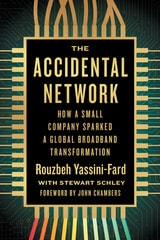
The Accidental Network
How a Small Company Sparked a Global Broadband TransformationRouzbeh Yassini-Fard
West Virginia University Press, 2025
“How would our lives change,” wondered entrepreneur Rouzbeh Yassini-Fard in 1987, “if everyday people had a stable, high-speed data connection to the Internet?” While he wasn’t the first to imagine a world of digital connectivity, Yassini-Fard was in the vanguard by creating the cable modem, which transformed residential Internet access from its slow, frustrating dial-up origins to a fast, always-on, and extraordinary connectivity tool by harnessing the existing infrastructure of the residential cable network.
The Accidental Network shares the untold story of the invention of the cable modem by the small, struggling tech company LANcity in the early 1990s, illustrating how Yassini-Fard overcame a cascade of technical challenges, investment community naysayers, and unnerving business obstacles to create the cable modem technology that has changed the way billions of individuals across the globe now manage their daily lives and commerce. The cable modem delivered broadband, with speeds ranging from 10 megabits per second (Mbps) to 10 gigabits per second (Gbps)—a big leap from the dial-up speeds of 56 kilobits per second (Kbps). This platform, along with the adoption of the DOCSIS (Data Over Cable Service Interface Specification) standard, engendered the modern revolution in broadband Internet access. Shunned by venture capitalists and surviving on a shoestring budget, Yassini-Fard and his colleagues were willing to bet it all (including the deed for Yassini-Fard’s home) on the creation of the cable modem and the pursuit of global adoption.
The Accidental Network is both a valuable history of technology innovation and an engrossing account of business conducted at high speed. The book details Yassini-Fard’s journey from electrical engineer to entrepreneur in the race to secure technology partners, create a wholly new marketplace, and convince cable industry executives that a bold business awaited in transmitting data to households at a time when skepticism about the reach of personal computing was the norm.
Written from the lens of a devoted idealist and WVU alum known as “the father of the cable modem,” this book reveals how a perfect storm of forces—the rise of cable television, the onset of the personal computing era, a growing awareness of the Internet for information and commerce, and the development of the cable modem—converged to usher in the age of broadband access.
[more]