Results by title
16 books match the query 'Broadcasting'

Broadcasting and National Imagination in Post-Communist Latvia
Defining the Nation, Defining Public TelevisionJanis Juzefovics
Intellect Books, 2017
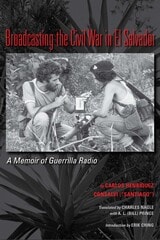
Broadcasting the Civil War in El Salvador
A Memoir of Guerrilla RadioBy Carlos Henriquez Consalvi ("Santiago")
University of Texas Press, 2010
During the 1980s war in El Salvador, Radio Venceremos was the main news outlet for the Frente Farabundo Martí para la Liberación Nacional (FMLN), the guerrilla organization that challenged the government. The broadcast provided a vital link between combatants in the mountains and the outside world, as well as an alternative to mainstream media reporting. In this first-person account, "Santiago," the legend behind Radio Venceremos, tells the story of the early years of that conflict, a rebellion of poor peasants against the Salvadoran government and its benefactor, the United States.
Originally published as La Terquedad del Izote, this memoir also addresses the broader story of a nationwide rebellion and its international context, particularly the intensifying Cold War and heavy U.S. involvement in it under President Reagan. By the war's end in 1992, more than 75,000 were dead and 350,000 wounded—in a country the size of Massachusetts. Although outnumbered and outfinanced, the rebels fought the Salvadoran Army to a draw and brought enough bargaining power to the negotiating table to achieve some of their key objectives, including democratic reforms and an overhaul of the security forces.
Broadcasting the Civil War in El Salvador is a riveting account from the rebels' point of view that lends immediacy to the Salvadoran conflict. It should appeal to all who are interested in historic memory and human rights, U.S. policy toward Central America, and the role the media can play in wartime.
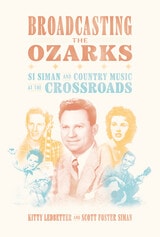
Broadcasting the Ozarks
Si Siman and Country Music at the CrossroadsKitty Ledbetter
University of Arkansas Press, 2024
“It’s good to see Si Siman and the Ozark Jubilee get their due in Broadcasting the Ozarks.”
—Willie Nelson
Broadcasting the Ozarks explores the vibrant country music scene that emerged in Springfield, Missouri, in the 1930s and thrived for half a century. Central to this history is the Ozark Jubilee (1955–60), the first regularly broadcast live country music show on network television. Dubbed the “king of the televised barn dances,” the show introduced the Ozarks to viewers across America and put Springfield in the running with Nashville for dominance of the country music industry—with the Jubilee’s producer, Si Siman, at the helm.
Siman’s life story is almost as remarkable as the show he produced. He was booking Tommy Dorsey, Ella Fitzgerald, and Glenn Miller during the mid-1930s while still a high school student and produced nationally syndicated country music radio shows in the decades that followed. Siman was a promotional genius with an ear for talent, a persuasive gift for gab, and the energy and persistence to make things happen for many future Country Music Hall of Famers, including Chet Atkins, Porter Wagoner, the Browns, and Brenda Lee. Following the Jubilee’s five-year run, Siman had a hand in some of the greatest hits of the twentieth century as a music publisher, collaborating with such songwriters as rockabilly legend and fellow Springfieldian Ronnie Self, who wrote Brenda Lee’s signature hit, “I’m Sorry,” and Wayne Carson, who wrote Willie Nelson’s “Always on My Mind.” Although Siman had numerous opportunities to find success in bigger cities, he chose to do it all from his hometown in the Ozarks.
Broadcasting, Voice, and Accountability
A Public Interest Approach to Policy, Law, and RegulationSteve Buckley, Kreszentia Duer, Toby Mendel, and Seán Ó Siochrú
University of Michigan Press, 2008
---Ruth Teer-Tomaselli, UNESCO Chair in Communication for Southern Africa, Culture, Communication and Media Studies, University of KwaZulu-Natal
digitalculturebooks is an imprint of the University of Michigan Press and the Scholarly Publishing Office of the University of Michigan Library dedicated to publishing innovative and accessible work exploring new media and their impact on society, culture, and scholarly communication. Visit the website at www.digitalculture.org.
Cold War Broadcasting
Impact on the Soviet Union and Eastern EuropeR. Eugene Parta
Central European University Press, 2010
Empires of Entertainment
Media Industries and the Politics of Deregulation, 1980-1996Holt, Jennifer
Rutgers University Press, 2011
Empires of Entertainment integrates legal, regulatory, industrial, and political histories to chronicle the dramatic transformation within the media between 1980 and 1996. As film, broadcast, and cable grew from fundamentally separate industries to interconnected, synergistic components of global media conglomerates, the concepts of vertical and horizontal integration were redesigned. The parameters and boundaries of market concentration, consolidation, and government scrutiny began to shift as America's politics changed under the Reagan administration. Through the use of case studies that highlight key moments in this transformation, Jennifer Holt explores the politics of deregulation, the reinterpretation of antitrust law, and lasting modifications in the media landscape.
Holt skillfully expands the conventional models and boundaries of media history. A fundamental part of her argument is that these media industries have been intertwined for decades and, as such, cannot be considered separately. Instead, film, cable and broadcast must be understood in relation to one another, as critical components of a common history. Empires of Entertainment is a unique account of deregulation and its impact on political economy, industrial strategies, and media culture at the end of the twentieth century.
Feminine Frequencies
Gender, German Radio, and the Public Sphere 1923-1945Kate Lacey
University of Michigan Press, 1996
Freedom of the Air and the Public Interest
First Amendment Rights in Broadcasting to 1935Louise M. Benjamin
Southern Illinois University Press, 2006
Drawing on primary resources from sixteen archives plus contemporary secondary sources, Benjamin analyzes interactions among the players involved and argues that First Amendment rights in radio evolved in the 1920s and 1930s through the interaction of many entities having social, political, or economic interests in radio. She shows how free speech and First Amendment rights were defined and perceived up to 1935.
Focusing on the evolution of various electronic media rights, Benjamin looks at censorship, speakers’ rights of access to the medium, broadcasters’ rights to use radio as they desired, and listeners’ rights to receive information via the airwaves. With many interested parties involved, conflict was inevitable, resulting in the establishment of industry policies and government legislation—particularly the Radio Act of 1927. Further debate led to the Communications Act of 1934, which has provided the regulatory framework for broadcasting for over sixty years. Controversies caused by new technology today continue to rage over virtually the same rights and issues that Benjamin deals with.
Hollywood and Broadcasting
From Radio to CableMichelle Hilmes
University of Illinois Press, 1990
an excellent introduction to a most important subject. This is an invaluable
work for both scholars and students that places film, radio, and television
within the context of the national culture experience."
--- American Historical Review
"Hilmes is one of the few historians
of broadcasting to move beyond a political economy of the media. . . . Her work
should serve as a model for future histories of broadcasting."
--- Journal of Communication
"All media historians will
find this work a critical addition to their bookshelves."
--- American Journalism
"A major addition to media
history literature."
--- Journalism History
Immigration, Diversity, and Broadcasting in the United States 1990—2001
Vibert C. Cambridge
Ohio University Press, 2004
Muting Israeli Democracy
How Media and Cultural Policy Undermine Free ExpressionAmit M. Schejter
University of Illinois Press, 2009
Radiophonic Feminisms
Latina Voices in the Digital Age of BroadcastingEsther Díaz Martín
University of Texas Press, 2025
2026 Gold Medal for the Best Women's Issues Book, Conference on Latin American History (CLAH)
How Latina voices in commercial radio and podcasting subvert cultural norms and bring feminism to the fore of their work.
What does Latina feminism sound like in popular culture? Drawing on case studies of commercial radio programs and podcasts hosted by Latinas and oriented toward Latinx listenership, Esther Díaz Martín explores how Latina voices create female-specific aural spaces that interrupt the misogynist status quo in US mainstream media.
Radiophonic Feminisms focuses on radio/podcasting as a medium in which women find methods for resisting oppressive gendered cultural imaginaries. Through their specific articulations—that is, the quality of their voices—their music choices, and the soundscapes they construct, Latina hosts since the early 1990s have offered feminist responses to a cultural moment marked by the demographic changes brought on by the political economy of migration and the social changes wrought by media in the digital age. Drawing attention to the invisible antisexist work of creating sound, and to its reception, Díaz Martín bridges the epistemic insights of Chicana feminist theory and sound studies, enriching and further decolonizing our thinking about auditory meaning making.
Republic on the Wire
Cable Television, Pluralism, and the Politics of New Technologies, 1948-1984McMurria, John
Rutgers University Press, 2017
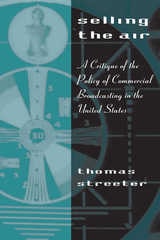
Selling the Air
A Critique of the Policy of Commercial Broadcasting in the United StatesThomas Streeter
University of Chicago Press, 1996
With an impressive command of broadcast history, as well as critical and cultural studies of the media, Streeter shows that liberal marketplace principles—ideas of individuality, property, public interest, and markets—have come into contradiction with themselves. Commercial broadcasting is dependent on government privileges, and Streeter provides a searching critique of the political choices of corporate liberalism that shape our landscape of cultural property and electronic intangibles.
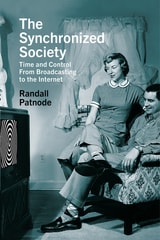
The Synchronized Society
Time and Control From Broadcasting to the InternetRandall Patnode
Rutgers University Press, 2023
The Synchronized Society traces the history of the synchronous broadcast experience of the twentieth century and the transition to the asynchronous media that dominate today. Broadcasting grew out of the latent desire by nineteenth-century industrialists, political thinkers, and social reformers to tame an unruly society by controlling how people used their time. The idea manifested itself in the form of the broadcast schedule, a managed flow of information and entertainment that required audiences to be in a particular place – usually the home – at a particular time and helped to create “water cooler” moments, as audiences reflected on their shared media texts. Audiences began disconnecting from the broadcast schedule at the end of the twentieth century, but promoters of social media and television services still kept audiences under control, replacing the schedule with surveillance of media use. Author Randall Patnode offers compelling new insights into the intermingled roles of broadcasting and industrial/post-industrial work and how Americans spend their time.
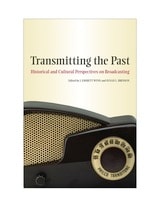
Transmitting the Past
Historical and Cultural Perspectives on BroadcastingEdited by J. Emmett Winn and Susan L. Brinson
University of Alabama Press, 2005
Original essays exploring important developments in radio and television broadcasting
The essays included in this collection represent some of the best cultural and historical research on broadcasting in the U. S. today. Each one concentrates on a particular event in broadcast history—beginning with Marconi’s introduction of wireless technology in 1899.
Michael Brown examines newspaper reporting in America of Marconi's belief in Martians, stories that effectively rendered Marconi inconsequential to the further development of radio. The widespread installation of radios in automobiles in the 1950s, Matthew Killmeier argues, paralleled the development of television and ubiquitous middle-class suburbia in America. Heather Hundley analyzes depictions of male and female promiscuity as presented in the sitcom Cheers at a time concurrent with media coverage of the AIDS crisis. Fritz Messere examines the Federal Radio Act of 1927 and the clash of competing ideas about what role radio should play in American life. Chad Dell recounts the high-brow programming strategy NBC adopted in 1945 to distinguish itself from other networks. And George Plasketes studies the critical reactions to Cop Rock, an ill-fated combination of police drama and musical, as an example of society's resistance to genre-mixing or departures from formulaic programming.
The result is a collection that represents some of the most recent and innovative scholarship, cultural and historical, on the intersections of broadcasting and American cultural, political, and economic life.