Results by title
4 books match the query 'Broch, Hermann'
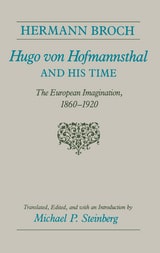
Hugo von Hofmannsthal and His Time
The European Imagination, 1860-1920Hermann Broch
University of Chicago Press, 1984
Through an analysis of the changing thought and career of the Austrian poet, librettist, and essaist Hugo von Hofmannsthal (1874-1929), Broch attempts to define and analyze the major intellectual issues of the European fin de siècle, a period that he characterizes according to the Nietzschean concepts of the breakdown of rationality and the loss of a central value system. The result is a major examination of European thought as well as a comparative study of political systems and artistic styles.
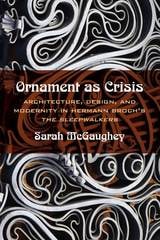
Ornament as Crisis
Architecture, Design, and Modernity in Hermann Broch's "The Sleepwalkers"Sarah McGaughey
Northwestern University Press, 2015
Ornament as Crisis explores the ways in which the novels of Hermann Broch’s Sleepwalkers (Schlafwandler) trilogy participate in and employ the history of architecture and architectural theory.
Beginning with the visual and architectural experiences of the figures in each novel, Sarah McGaughey analyzes the role of architecture in the trilogy as a whole, while discussing work by Broch’s contemporaries on architecture. She argues that The Sleepwalkers allows us to better understand how literature responds and contributes to social, theoretical, and spatial concepts of architecture. Ornament as Crisis guides readers through the spaces of Broch’s mdernist masterpiece and the architectural debates of his time.
The Guiltless
Hermann Broch
Northwestern University Press, 2001
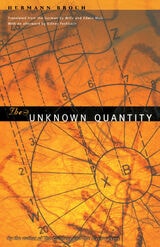
The Unknown Quantity
Hermann Broch
Northwestern University Press, 2000
Published in 1933, The Unknown Quantity is Hermann Broch's study of the underlying chaos-and finally the impossibility-of life within a society whose values are in decay. As Richard seeks to reconcile the conflicting demands of love and science, of passion and reason, societal and family values begin to undermine him and those in orbit around him.