Results by title
8 books match the query 'Brown'
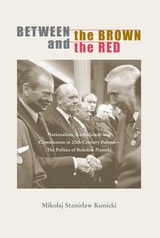
Between the Brown and the Red
Nationalism, Catholicism, and Communism in Twentieth-Century Poland—The Politics of Boleslaw PiaseckiMikolaj Stanislaw Kunicki
Ohio University Press, 2012
Between the Brown and the Red captures the multifaceted nature of church-state relations in communist Poland, relations that oscillated between mutual confrontation, accommodation, and dialogue. Ironically, under communism the bond between religion and nation in Poland grew stronger. This happened in spite of the fact that the government deployed nationalist themes in order to portray itself as more Polish than communist. Between the Brown and the Red also introduces one of the most fascinating figures in the history of twentieth-century Poland and the communist world.
In this study of the complex relationships between nationalism, communism, authoritarianism, and religion in twentieth-century Poland, Mikołaj Kunicki shows the ways in which the country’s communist rulers tried to adapt communism to local traditions, particularly ethnocentric nationalism and Catholicism. Focusing on the political career of Bolesław Piasecki, a Polish nationalist politician who began his surprising but illuminating journey as a fascist before the Second World War and ended it as a procommunist activist, Kunicki demonstrates that Polish communists reinforced an ethnocentric self-definition of Polishness and—as Piasecki’s case demonstrates—thereby prolonged the existence of Poland’s nationalist Right.
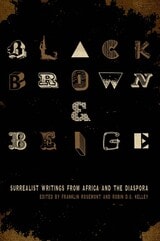
Black, Brown, & Beige
Surrealist Writings from Africa and the DiasporaEdited by Franklin Rosemont and Robin D.G. Kelley
University of Texas Press, 2009
Surrealism as a movement has always resisted the efforts of critics to confine it to any static definition—surrealists themselves have always preferred to speak of it in terms of dynamics, dialectics, goals, and struggles. Accordingly, surrealist groups have always encouraged and exemplified the widest diversity—from its start the movement was emphatically opposed to racism and colonialism, and it embraced thinkers from every race and nation.
Yet in the vast critical literature on surrealism, all but a few black poets have been invisible. Academic histories and anthologies typically, but very wrongly, persist in conveying surrealism as an all-white movement, like other "artistic schools" of European origin. In glaring contrast, the many publications of the international surrealist movement have regularly featured texts and reproductions of works by comrades from Martinique, Haiti, Cuba, Puerto Rico, South America, the United States, and other lands. Some of these publications are readily available to researchers; others are not, and a few fall outside academia's narrow definition of surrealism.
This collection is the first to document the extensive participation of people of African descent in the international surrealist movement over the past seventy-five years. Editors Franklin Rosemont and Robin D. G. Kelley aim to introduce readers to the black, brown, and beige surrealists of the world—to provide sketches of their overlooked lives and deeds as well as their important place in history, especially the history of surrealism.
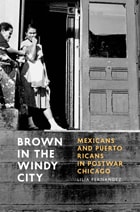
Brown in the Windy City
Mexicans and Puerto Ricans in Postwar ChicagoLilia Fernández
University of Chicago Press, 2012
Brown in the Windy City is the first history to examine the migration and settlement of Mexicans and Puerto Ricans in postwar Chicago. Lilia Fernández reveals how the two populations arrived in Chicago in the midst of tremendous social and economic change and, in spite of declining industrial employment and massive urban renewal projects, managed to carve out a geographic and racial place in one of America’s great cities. Through their experiences in the city’s central neighborhoods over the course of these three decades, Fernández demonstrates how Mexicans and Puerto Ricans collectively articulated a distinct racial position in Chicago, one that was flexible and fluid, neither black nor white.
Brown on Brown
Chicano/a Representations of Gender, Sexuality, and EthnicityBy Frederick Luis Aldama
University of Texas Press, 2005
Common conceptions permeating U.S. ethnic queer theory tend to confuse aesthetics with real-world acts and politics. Often Chicano/a representations of gay and lesbian experiences in literature and film are analyzed simply as propaganda. The cognitive, emotional, and narrational ingredients (that is, the subject matter and the formal traits) of those representations are frequently reduced to a priori agendas that emphasize a politics of difference.
In this book, Frederick Luis Aldama follows an entirely different approach. He investigates the ways in which race and gay/lesbian sexuality intersect and operate in Chicano/a literature and film while taking into full account their imaginative nature and therefore the specific kind of work invested in them. Also, Aldama frames his analyses within today's larger (globalized) context of postcolonial literary and filmic canons that seek to normalize heterosexual identity and experience. Throughout the book, Aldama applies his innovative approach to throw new light on the work of authors Arturo Islas, Richard Rodriguez, John Rechy, Ana Castillo, and Sheila Ortiz Taylor, as well as that of film director Edward James Olmos. In doing so, Aldama aims to integrate and deepen Chicano literary and filmic studies within a comparative perspective. Aldama's unusual juxtapositions of narrative materials and cultural personae, and his premise that literature and film produce fictional examples of a social and historical reality concerned with ethnic and sexual issues largely unresolved, make this book relevant to a wide range of readers.
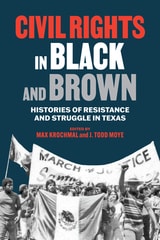
Civil Rights in Black and Brown
Histories of Resistance and Struggle in TexasEdited by Max Krochmal and J. Todd Moye
University of Texas Press, 2021
2022 Best Book Award, Oral History Association
Hundreds of stories of activists at the front lines of the intersecting African American and Mexican American liberation struggle
Not one but two civil rights movements flourished in mid-twentieth-century Texas, and they did so in intimate conversation with one another. Far from the gaze of the national media, African American and Mexican American activists combated the twin caste systems of Jim Crow and Juan Crow. These insurgents worked chiefly within their own racial groups, yet they also looked to each other for guidance and, at times, came together in solidarity. The movements sought more than integration and access: they demanded power and justice.
Civil Rights in Black and Brown draws on more than 500 oral history interviews newly collected across Texas, from the Panhandle to the Piney Woods and everywhere in between. The testimonies speak in detail to the structure of racism in small towns and huge metropolises—both the everyday grind of segregation and the haunting acts of racial violence that upheld Texas’s state-sanctioned systems of white supremacy. Through their memories of resistance and revolution, the activists reveal previously undocumented struggles for equity, as well as the links Black and Chicanx organizers forged in their efforts to achieve self-determination.
Racializing the Ummah
Muslim Humanitarians beyond Black, Brown, and WhiteRhea Rahman
University of Minnesota Press, 2026
A robust ethnography of Islamic Relief explores difficult questions about the extensive reach of white supremacy
An ethnography of Islamic Relief (IR), the largest Islamic NGO based in the West, Racializing the Ummah explores how a Muslim organization can do good in a world that defines Muslimness as less than human. Rooted in more than a decade of international research, Rhea Rahman’s study on the organization’s projects, methods, and limitations reveals how racial capitalism permeates all aspects of humanitarianism.
Beginning with a counterhistory of Muslims in the United Kingdom following World War II, Rahman analyzes IR’s mission and transnational activities in and across places including the UK, South Africa, and Mali in the broader context of global white supremacy. She shows how IR’s approaches often effectively secularize Islam to evade anti-Muslim racism and Islamophobia, implicating concepts such as the “good” Muslim aid worker, who complies with War on Terror surveillance while attending to victims of Western colonialism. Meanwhile, Rahman theorizes the tactics of aid workers on the ground, who creatively draw on an Islamic Black radical tradition to drive real change.
Through her engagement with IR and other organizations, Rahman paints a frank, nuanced portrait of the constraints Islamic aid entities face in the effort to disentangle themselves from neocolonialism and Western hegemony. Yet she also locates the possibility of escape from the all-encompassing dictates of racial capitalism in alternative visions of doing good—ones that are grounded in Islam as the foundation of a revolutionary praxis.
Retail e-book files for this title are screen-reader friendly.
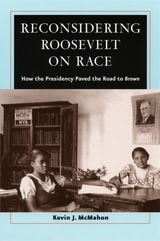
Reconsidering Roosevelt on Race
How the Presidency Paved the Road to BrownKevin J. McMahon
University of Chicago Press, 2003
McMahon shows how FDR's attempt to strengthen the presidency and undermine the power of conservative Southern Democrats dovetailed with his efforts to seek racial equality through the federal courts. By appointing a majority of rights-based liberals deferential to presidential power, Roosevelt ensured that the Supreme Court would be receptive to civil rights claims, especially when those claims had the support of the executive branch.
The Sense of Brown
José Esteban Muñoz. Edited and with an Introduction by Joshua Chambers-Letson and Tavia Nyong'o
Duke University Press, 2020