Results by title
4 books match the query 'Brown, Charles Brockden'
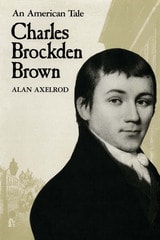
Charles Brockden Brown
An American TaleBy Alan Axelrod
University of Texas Press, 1983
Charles Brockden Brown: An American Tale is the first comprehensive literary, biographical, and cultural study of the novelist whom critic Leslie Fiedler has dubbed "the inventor of the American writer."
The author of Wieland, Arthur Mervyn, Ormond, and Edgar Huntly, Charles Brockden Brown (1771-1810) is considered the first American professional author. He introduced Indian characters into American fiction. His keen interest in character delineation and abnormal psychology anticipates the stories of Poe, Hawthorne, and later masters of the psychological novel.
Brown was eager to establish for himself an American identity as a writer, to become what Crèvecoeur called "the new man in the New World." It is especially this intimate identification of writer with country that makes Brown a telling precursor of our most characteristic authors from Poe, Hawthorne, and Cooper to Fitzgerald, Hemingway, and Faulkner.
To understand its significance, Brown's work must be examined as both art and artifact. Accordingly, Charles Brockden Brown: An American Tale is literary history as well as criticism, embued with insights into a writer's sources and influences and the psychology of literary composition. It is also a fascinating examination of a nation's emotional and intellectual impact on a young man in search of his identity as creative artist.

Dreaming Revolution
Transgression in the Development of American RomanceScott Bradfield
University of Iowa Press, 1993
Dreaming Revolution usefully employs current critical theory to address how the European novel of class revolt was transformed into the American novel of imperial expansion. Bradfield shows that early American romantic fiction—including works by William Godwin, Charles Brockden Brown, James Fenimore Cooper, and Edgar Allan Poe—can and should be considered as part of a genre too often limited to the nineteenth-century European novel. In a spirited discussion of the works from these four authors, Bradfield argues that Americans take the class dynamics of the European psychological novel and apply them to the American landscape, reimagining psychological spaces as geographical ones.

Loose Ends
Closure and Crisis in the American Social TextRussell Reising
Duke University Press, 1996
Reising suggests that these "non-endings" entirely refocus the narrative structures they appear to conclude, accentuate the narrative stresses and ideological fissures that the texts seem to suppress, and reveal "shadow narratives" that trail alongside the dominant story line. He argues that unless the reader notices the ruptures in the closing moments of these works, the social and historical moments in which the narrative and the reader are embedded will be missed. This reading not only offers new interpretive possibilities, but also uncovers startling affinities between the poetry of Phillis Wheatley and the fiction of Henry James, between Charles Brockden Brown’s Wieland and Melville’s least-studied novel, and between Emily Dickinson’s poem "I Started Early—Took My Dog" and Disney’s animated classic.
Pursuing the implications of these failed moments of closure, Reising elaborates on topics ranging from the roots of domestic violence and mass murder in early American religious texts to the pornographic imperative of mid-century nature writing, and from James’s "descent" into naturalist and feminist fiction to Dumbo’s explosive projection of commercial, racial, and political agendas for postwar U. S. culture.
The Plight of Feeling
Sympathy and Dissent in the Early American NovelJulia A. Stern
University of Chicago Press, 1997
Stern argues that these novels gave voice to a collective mourning over the violence of the Revolution and the foreclosure of liberty for the nation's noncitizens—women, the poor, Native and African Americans. Properly placed in the context of late eighteenth-century thought, the republican novel emerges as essentially political, offering its audience gothic and feminized counternarratives to read against the dominant male-authored accounts of national legitimation.
Drawing upon insights from cultural history and gender studies as well as psychoanalytic, narrative, and genre theory, Stern convincingly exposes the foundation of the republic as an unquiet crypt housing those invisible Americans who contributed to its construction.