Results by title
4 books match the query 'Brown, Nicholas'

Autonomy
The Social Ontology of Art under CapitalismNicholas Brown
Duke University Press, 2019
In Autonomy Nicholas Brown theorizes the historical and theoretical argument for art's autonomy from its acknowledged character as a commodity. Refusing the position that the distinction between art and the commodity has collapsed, Brown demonstrates how art can, in confronting its material determinations, suspend the logic of capital by demanding interpretive attention. He applies his readings of Marx, Hegel, Adorno, and Jameson to a range of literature, photography, music, television, and sculpture, from Cindy Sherman's photography and the novels of Ben Lerner and Jennifer Egan to The Wire and the music of the White Stripes. He demonstrates that through their attention and commitment to form, such artists turn aside the determination posed by the demand of the market, thereby defeating the foreclosure of meaning entailed in commodification. In so doing, he offers a new theory of art that prompts a rethinking of the relationship between art, critical theory, and capitalism.
[more]

Paper Empire
William Gaddis and the World SystemEdited by Joseph Tabbi and Rone Shavers
University of Alabama Press, 2007
Celebrates and illuminates the legacy of one of America’s most innovative and consequential 20th century novelists
In 2002, following the posthumous publication of William Gaddis’s collected nonfiction and his final novel and Jonathan Franzen’s lengthy attack on him in The New Yorker, a number of partisan articles appeared in support of Gaddis’s legacy. In a review in The London Review of Books, critic Hal Foster suggested a reason for disparate responses to Gaddis’s reputation: Gaddis’s unique hybridity, his ability to “write in the gap between two dispensations—between science and literature, theory and narrative, and—different orders of linguistic imagination.
Gaddis (1922-1998) is often cited as the link between literary modernism and postmodernism in the United States. His novels—The Recognitions, JR, Carpenter’s Gothic, and A Frolic of His Own—are notable in the ways that they often restrict themselves to the language and communication systems of the worlds he portrays. Issues of corporate finance, the American legal system, economics, simulation and authenticity, bureaucracy, transportation, and mass communication permeate his narratives in subject, setting, and method. The essays address subjects as diverse as cybernetics theory, the law, media theory, race and class, music, and the perils and benefits of globalization. The collection also contains a memoir by Gaddis’s son, an unpublished interview with Gaddis from just after the publication of JR, and an essay on the Gaddis archive, newly opened at Washington University in St. Louis.
The editors acknowledge that we live in an age of heightened global awareness. But as these essays testify, few American writers have illuminated as poignantly or incisively just how much the systemic forces of capitalism and mass communication have impacted individual lives and identity—imparting global dimensions to private pursuits and desires—than William Gaddis.
[more]
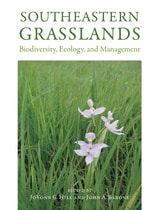
Southeastern Grasslands
Biodiversity, Ecology, and ManagementJoVonn G. Hill and John A. Barone, eds.
University of Alabama Press, 2019
A holistic approach to analyzing distinct grassland habitats that integrates ecological, historical, and archaeological data
Today the southeastern United States is a largely rural, forested, and agricultural landscape interspersed with urban areas of development. However, two centuries ago it contained hundreds of thousands of acres of natural grasslands that stretched from Florida to Texas. Now more than 99 percent of these prairies, glades, and savannas have been plowed up or paved over, lost to agriculture, urban growth, and cattle ranching. The few remaining grassland sites are complex ecosystems, home to hundreds of distinct plant and animal species, and worthy of study.
Southeastern Grasslands: Biodiversity, Ecology, and Management brings together the latest research on southeastern prairie systems and species, provides a complete picture of an increasingly rare biome, and offers solutions to many conservation biology queries. Editors JoVonn G. Hill and John A. Barone have gathered renowned experts in their fields from across the region who address questions related to the diversity, ecology, and management of southeastern grasslands, along with discussions of how to restore sites that have been damaged by human activity.
Over the last twenty years, both researchers and the public have become more interested in the grasslands of the Southeast. This volume builds on the growing knowledge base of these remarkable ecosystems with the goal of increasing appreciation for them and stimulating further study of their biota and ecology. Topics such as the historical distribution of grasslands in the South, the plants and animals that inhabit them, as well as assessments of several techniques used in their conservation and management are covered in-depth. Written with a broad audience in mind, this book will serve as a valuable introduction and reference for nature enthusiasts, scientists, and land managers.
[more]
The Future of Totality
Fredric Jameson and the Prospects of Critical TheoryNicholas Brown, Maria Elisa Cevasco, Fabio Akcelrud Durão, and Robert T. Tally Jr., editors
Duke University Press, 2026
Following his death in 2024, Fredric Jameson’s vast body of work continues to challenge orthodoxies while retaining close ties to older critical and philosophical traditions, notably dialectical criticism, formal analysis, and utopian discourse. The Future of Totality brings together a selection of Jameson's former students and other prominent scholars thinking from Jameson, rather than writing on him, to represent future directions of Jamesonian thought in the tradition of dialectical criticism and cultural study. Through four sections reflecting and building on Jameson’s legacy, focusing on theory, critical reading of new forms, the reshaping of contemporary problematics, and new dimensions inspired by Jameson, The Future of Totality makes its own intervention about the continuity and innovation of Jameson’s contributions. Serving both as a tribute to the scholar and as a space for thinking about the future of his work, these essays explore new and unforeseen dimensions to which Jameson’s work leads.
[more]