Results by title
5 books match the query 'Brown, Steven'
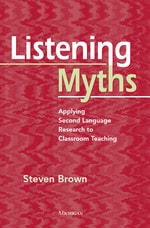
Listening Myths
Applying Second Language Research to Classroom TeachingSteven Brown
University of Michigan Press, 2011
This volume was conceived as a "best practices" resource for teachers of ESL listening courses in the way that Vocabulary Myths by Keith S. Folse (and Writing Myths by Joy Reid) is one for reading and vocabulary teachers. It was written to help ensure that teachers of listening are not perpetuating the myths of teaching listening.
Both the research and pedagogy in this book are based on the newest research in the field of second language acquisition. Steven Brown is the author of the Active Listening textbook series and is a teacher trainer.
The myths debunked in this book are:
§ Listening is the same as reading.
§ Listening is passive.
§ Listening equals comprehension.
§ Because L1 language ability is effortlessly acquired, L2 listening ability is too.
§ Listening means listening to conversations.
§ Listening is an individual, inside-the-head process.
§ Students should only listen to authentic materials.
§ Listening can’t be taught
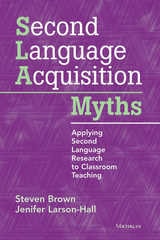
Second Language Acquisition Myths
Applying Second Language Research to Classroom TeachingSteven Brown and Jenifer Larson-Hall
University of Michigan Press, 2012
This volume was conceived as a first book in SLA for advanced undergraduate or introductory master’s courses that include education majors, foreign language education majors, and English majors. It’s also an excellent resource for practicing teachers.
Both the research and pedagogy in this book are based on the newest research in the field of second language acquisition. It is not the goal of this book to address every SLA theory or teach research methodology. It does however address the myths and questions that non-specialist teacher candidates have about language learning.
Steven Brown is the co-author of the introductory applied linguistics textbook Understanding Language Structure, Interaction, and Variation textbook (and workbook).
The myths challenged in this book are:
§ Children learn languages quickly and easily while adults are ineffective in comparison.
§ A true bilingual is someone who speaks two languages perfectly.
§ You can acquire a language simply through listening or reading.
§ Practice makes perfect.
§ Language students learn (and retain) what they are taught.
§ Language learners always benefit from correction.
§ Individual differences are a major, perhaps the major, factor in SLA.
§ Language acquisition is the individual acquisition of grammar.
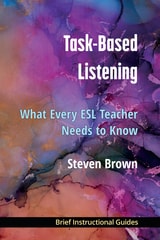
Task-Based Listening
What Every ESL Teacher Needs to KnowSteven Brown
University of Michigan Press, 2019
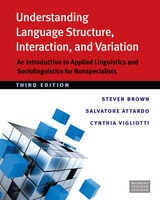
Understanding Language Structure, Interaction, and Variation, Third Ed.
An Introduction to Applied Linguistics and Sociolinguistics for NonspecialistsSteven Brown, Salvatore Attardo, and Cynthia Vigliotti
University of Michigan Press, 2014
Understanding Language Structure, Interaction, and Variation is an introduction to the study of language and applied linguistics for students who have had a minimum of exposure to the discipline of linguistics. Using clear, easy-to-understand explanations and examples, this text avoids the in-depth theoretical coverage found in texts written for those who specialize in linguistics or SLA. As a result, this book is perfect for students whose chosen fields require them to be acquainted with the ways language works--such as future teachers, psychologists, sociologists, and anthropologists--but who do not intend to become linguists. The text is also suitable for English or ESL/EFL teachers who need a reference volume about various aspects of language, particularly as it applies to teaching. Each chapter includes research projects and further readings.
The third edition of Understanding Language Structure, Interaction, and Variation features a new design and reorganization. All content has been significantly revised and updated. Each chapter also debunks a common language myth and now incorporates exercises that, for prior editions, appeared in a supplementary workbook. Extra practice for students is available online, as is additional materials for teachers. (There is no workbook for the third edition.)

Understanding Language Structure, Interaction, and Variation
An Introduction to Applied Linguistics and Sociolinguistics for NonspecialistsSalvatore Attardo and Steven Brown
University of Michigan Press, 2027
In the age of Artificial Intelligence hallucinations and slop, the need for a clear, accessible, uncluttered, and authoritative textbook is more important than ever. The fourth edition of Understanding Language Structure, Interaction, and Variation retains the informal and reader-friendly style of previous editions and has been substantively updated and rewritten to incorporate recent scholarship throughout. Language is important for a number of fields, including teaching, psychology, sociology, and anthropology. The wide coverage of language structure, sociolinguistics, language acquisition, and grammar makes this book suitable for pre-service teachers, undergraduates, and graduate students who need some exposure to linguistics, but do not need highly technical training in formal linguistics.
This extensively classroom-tested book is organized for use in a semester or can be customized for shorter terms by omitting chapters after the foundational core provided by chapters 1–3. The encyclopedic nature of the book, which includes a glossary and an index, make it appropriate for self-study and any reader who is interested in the study of language.
Readers of the fourth edition of Understanding Language Structure, Interaction, and Variation will find:
- Expanded coverage of Prosody, the phonetic alphabet, African American Language, neurodiversity and language, English as a world language, and English as a lingua franca;
- New content on biolinguistics, translanguaging, enregisterment, indexicality, the semiotic turn in sociolinguistics, code-meshing, complex dynamic systems theory, and personality theory in SLA;
- A thorough overview of the basics of English grammar.