Results by title
3 books match the query 'Brown, Virginia Pounds'
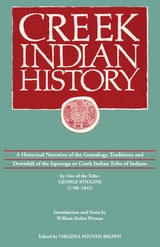
Creek Indian History
A Historical Narrative of the Genealogy, Traditions and Downfall of the Ispocoga or Creek Indian Tribe of Indians by One of the Tribe, George Stiggins (1788-1845)George Stiggins
University of Alabama Press, 2003
An essential narrative preserving the cultural memory, social life, and internal conflicts of the Creek people from an author within the tribe.
George Stiggins, a Creek Indian half blood living in Alabama, wrote this history more than 150 years ago. Raised in the white culture by his father, an English trader, Stiggins nevertheless lived in close contact with the Creeks because his mother was a full blood of the Natchez tribe, part of the Creek Confederacy.
Stiggins writes with firsthand knowledge of the tribes in the central southeast—the Alabamas, Natchez, Abekas, Uchees, and others. He tells of their origins, their towns and chiefs, and their way of life, he traces critical events leading to the Creek War—the battles of Burnt Corn and Fort Mims—and details the roles of the Indian leaders involved. In “Tecumseh and the Age of Prophecy,” he describes how the powerful influence of prophets, such as Josiah Francis and Jim Boy, who incited the Creeks to civil war as the confederacy split into war and peace factions. Stiggin’s account of William Weatherford’s controversial role in the Creek War has special value because Weatherford was Stiggins’s brother-in-law. His descriptions of religious and social aspects of the Creek lifeways make this work prime source material.
William Wyman’s notes and introduction put the Stiggins account into historical perspective and trace its circuitous route to publication. First issued in 1989, Creek Indian History has become an important primary document for the study of Native American history and culture.
Sketches of Alabama
Mary Duffee, edited by Jane Porter Nabers and Virginia Pounds Brown
University of Alabama Press, 1970
Rediscover the spirit, stories, and landscapes of Alabama through a timeless collection of observations and historical reflections.
In Sketches of Alabama, Mary Duffee offers a richly detailed portrait of a state shaped by diverse communities, enduring traditions, and a deeply rooted cultural identity. Through a series of engaging sketches, Duffee captures the essence of Alabama’s towns, people, and everyday life, preserving moments that might otherwise be lost to time.
Blending historical insight with narrative charm, this collection explores the character of Alabama from multiple perspectives—rural and urban, past and present. Readers encounter vivid depictions of local customs, notable figures, and the evolving social fabric of the region. Duffee’s work not only chronicles the state’s development but also reflects the broader story of the American South, illuminating its complexities, resilience, and sense of place.
This collection contains typescripts of some of Mary Gordon Duffee's Iron Age columns "Sketches of Alabama," manuscripts of seven of Duffee's poems, a typed biographical sketch of Duffee, undated, and Duffee's obituary from the Birmingham Age-Herald. Ideal for students, historians, and general readers alike, Sketches of Alabama serves as both a literary work and a cultural record. Its accessible style makes it an excellent introduction to Alabama’s heritage, while its thoughtful observations reward those seeking deeper understanding of Southern history and identity.
Whether you are drawn to regional storytelling, historical narrative, or the rich traditions of the Deep South, this work offers a compelling journey into Alabama’s past—one sketch at a time.
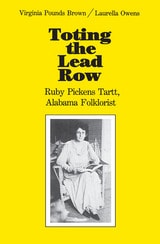
Toting the Lead Row
Ruby Pickens Tartt, Alabama FolkloristVirginia Pounds Brown
University of Alabama Press, 1981
Preserving voices from the back roads—Ruby Pickens Tartt and the folklore of Alabama’s Black Belt.
“You recall the expression ‘toting the lead row’, don’t you? In chopping cotton or corn there is always a leader, one who can chop the fastest of them all. When he finishes his row, he goes back and helps the other choppers finish theirs. The one who totes the lead row takes the lead place in the next row.”—Ruby Pickens Tartt
Toting the Lead Row is a powerful biographical and cultural tribute to Ruby Pickens Tartt, a white woman from Alabama’s Black Belt who devoted her life to preserving the oral traditions of rural Black communities. Born in 1880 in Livingston, Alabama, Tartt witnessed nearly a century of social transformation and made it her mission to document the songs, stories, and life histories of her African American neighbors. She believed that the soul of Sumter County resided not in its institutions, but in its cabins, fields, and voices.
During the Great Depression, Tartt worked with the Federal Writers’ Project, collaborating with renowned folklorists such as Carl Carmer and John Lomax. Her home became a hub for cultural preservation, attracting scholars and artists who recognized the depth of her fieldwork. The book’s title refers to a Southern agricultural phrase—“toting the lead row”—symbolizing leadership and support, a role Tartt embodied in her efforts to elevate the voices of those often overlooked.
This volume is divided into two parts: the first offers a detailed biography of Tartt and her work with the WPA, while the second presents a curated selection of her collected writings, including 18 life histories and 12 slave narratives. Through these stories, Tartt preserved a vital piece of Southern history and gave voice to generations whose experiences might otherwise have been lost.
Toting the Lead Row is both a celebration of a remarkable woman and a vital contribution to the study of folklore, race, and Southern identity.