Results by title
2 books match the query 'Brush'
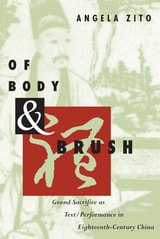
Of Body and Brush
Grand Sacrifice as Text/Performance in Eighteenth-Century ChinaAngela Zito
University of Chicago Press, 1997
The Qianlong emperor, who dominated the religious and political life of eighteenth-century China, was in turn dominated by elaborate ritual prescriptions. These texts determined what he wore and ate, how he moved, and above all how he performed the yearly Grand Sacrifices. In Of Body and Brush, Angela Zito offers a stunningly original analysis of the way ritualizing power was produced jointly by the throne and the official literati who dictated these prescriptions.
Forging a critical cultural historical method that challenges traditional categories of Chinese studies, Zito shows for the first time that in their performance, the ritual texts embodied, literally, the metaphysics upon which imperial power rested. By combining rule through the brush (the production of ritual texts) with rule through the body (mandated performance), the throne both exhibited its power and attempted to control resistance to it. Bridging Chinese history, anthropology, religion, and performance and cultural studies, Zito brings an important new perspective to the human sciences in general.
Forging a critical cultural historical method that challenges traditional categories of Chinese studies, Zito shows for the first time that in their performance, the ritual texts embodied, literally, the metaphysics upon which imperial power rested. By combining rule through the brush (the production of ritual texts) with rule through the body (mandated performance), the throne both exhibited its power and attempted to control resistance to it. Bridging Chinese history, anthropology, religion, and performance and cultural studies, Zito brings an important new perspective to the human sciences in general.
[more]
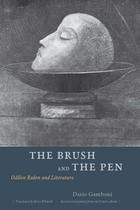
The Brush and the Pen
Odilon Redon and LiteratureDario Gamboni
University of Chicago Press, 2011
French symbolist artist Odilon Redon (1840–1916) seemed to thrive at the intersection of literature and art. Known as “the painter-writer,” he drew on the works of Poe, Baudelaire, Flaubert, and Mallarmé for his subject matter. And yet he concluded that visual art has nothing to do with literature. Examining this apparent contradiction, The Brush and the Pen transforms the way we understand Redon’s career and brings to life the interaction between writers and artists in fin-de-siècle Paris.
Dario Gamboni tracks Redon’s evolution from collaboration with the writers of symbolism and decadence to a defense of the autonomy of the visual arts. He argues that Redon’s conversion was the symptom of a mounting crisis in the relationship between artists and writers, provoked at the turn of the century by the growing power of art criticism that foreshadowed the modernist separation of the arts into intractable fields. In addition to being a distinguished study of this provocative artist, The Brush and the Pen offers a critical reappraisal of the interaction of art, writing, criticism, and government institutions in late nineteenth-century France.
[more]