Results by title
7 books match the query 'Buchanan, James M.'
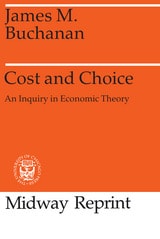
Cost and Choice
An Inquiry in Economic TheoryJames M. Buchanan
University of Chicago Press, 1979
"As he usually does, Professor Buchanan has produced an interesting and provocative piece of work. [Cost and Choice] starts off as an essay in the history of cost theory; the central ideas of the book are traced to Davenport and Knight in the United States, and to a series of distinguished writers associated at various times with the London School of Economics. The author emerges from this discussion with what can be described as the ultimate in subjectivist cost doctrines. . . . Economists should learn the lessons offered to us in this little book—and learn them well. It can save them from serious errors."—William J. Baumol, Journal of Economic Literature
[more]
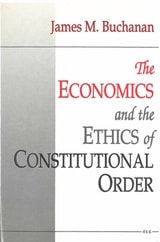
The Economics and the Ethics of Constitutional Order
James M. Buchanan
University of Michigan Press, 1991
The Ecosystem Approach in Anthropology remains a seminal resource for scholars seeking to bridge the divide between biological and cultural systems. Edited by Emilio F. Moran, this comprehensive volume re-examines the utility of the ecosystem concept in light of past criticisms, transforming it from a rigid model of stability into a dynamic, flexible framework for modern research. By integrating traditional ethnography with cutting-edge methodologies like satellite remote sensing, GIS, and multi-scale analysis, the collected essays demonstrate how human behavioral choices, political economies, and historical contexts actively interact with changing biophysical environments. This essential text provides anthropologists, ecologists, and geographers with the conceptual and empirical tools necessary to address complex, contemporary global environmental challenges.
[more]

The Economics and the Ethics of Constitutional Order
James M. Buchanan
University of Michigan Press, 1991
How do persons live together in peace, prosperity, liberty, and justice? This ancient question requires continuing analysis, discussion, and attention – by economists, by philosophers, by political leaders, and by members of the body politic. Buchanan's interests have always centered on the issues relevant to this question, and his most recent essays reflect a new broadening of perspective. In this collection of twenty distinctly but closely related essays, written over the period 1986-89 following the author's receipt of the Nobel Prize in Economic Science, Professor Buchanan records his increasing interest in and developing ideas on the constitutional order of a free society, especially in its ethical foundations. The essays in this collection extend beyond the boundaries of economics into moral philosophy, political philosophy, methodology, and epistemology Many of the separate essays were initially delivered by special invitation as lectures to general audiences throughout the world. The linking theme of the essays in The Economics and the Ethics of Constitutional Order is the continuing relevance of Adam Smith's ideas to issues emerging in the 1990s – issues that have gained a new immediacy since the revolutionary events of 1989. How can societies organize their economies so as to produce goods and services efficiently while at the same time allowing individuals the liberties to make their own choices? Buchanan's contributions here are directly addressed to this question.
[more]

The Limits of Liberty
Between Anarchy and LeviathanJames M. Buchanan
University of Chicago Press, 1977
"The Limits of Liberty is concerned mainly with two topics. One is an attempt to construct a new contractarian theory of the state, and the other deals with its legitimate limits. The latter is a matter of great practical importance and is of no small significance from the standpoint of political philosophy."—Scott Gordon, Journal of Political Economy
James Buchanan offers a strikingly innovative approach to a pervasive problem of social philosophy. The problem is one of the classic paradoxes concerning man's freedom in society: in order to protect individual freedom, the state must restrict each person's right to act. Employing the techniques of modern economic analysis, Professor Buchanan reveals the conceptual basis of an individual's social rights by examining the evolution and development of these rights out of presocial conditions.
James Buchanan offers a strikingly innovative approach to a pervasive problem of social philosophy. The problem is one of the classic paradoxes concerning man's freedom in society: in order to protect individual freedom, the state must restrict each person's right to act. Employing the techniques of modern economic analysis, Professor Buchanan reveals the conceptual basis of an individual's social rights by examining the evolution and development of these rights out of presocial conditions.
[more]
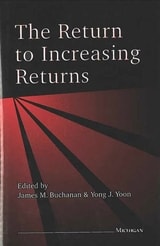
The Return to Increasing Returns
James M. Buchanan and Yong J. Yoon, Editors
University of Michigan Press, 1994
The wealth of a nation depends on the division of labor, and the division of labor depends on the extent of the market. Adam Smith advanced this proposition in 1776, but neoclassical economists, in particular, have had difficulty incorporating it into conversational models. Increasing returns, as related to the size of the market nexus, have never found a secure place in economic theory, despite early efforts by Adam Smith, Alfred Marshall, and Allyn Young.
The neoclassical theory of distribution, developed in the last decades of the nineteenth century, relies on the postulate that in equilibrium there exist constant returns to scale, not only in particular firms and industries, but in the economy as a whole. As general equilibrium theory developed, emphasis was sifted to the properties of equilibrium, to the proofs of its existence, and to the attributes of welfare. The possibility of increasing returns represented an analytical “monkey wrench” thrown in the whole neoclassical structure. Thus, the neglect of increasing returns may have been methodologically understandable – if scientifically scandalous. Only in recent years has the increasing returns postulate returned to the mainstream through analyses of endogenous growth, international trade, unemployment, and the economics of ethics.
The neoclassical theory of distribution, developed in the last decades of the nineteenth century, relies on the postulate that in equilibrium there exist constant returns to scale, not only in particular firms and industries, but in the economy as a whole. As general equilibrium theory developed, emphasis was sifted to the properties of equilibrium, to the proofs of its existence, and to the attributes of welfare. The possibility of increasing returns represented an analytical “monkey wrench” thrown in the whole neoclassical structure. Thus, the neglect of increasing returns may have been methodologically understandable – if scientifically scandalous. Only in recent years has the increasing returns postulate returned to the mainstream through analyses of endogenous growth, international trade, unemployment, and the economics of ethics.
[more]
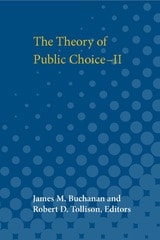
The Theory of Public Choice-II
James M. Buchanan and Robert D. Tollison, Editors
University of Michigan Press, 1984
The Theory of Public Choice is a landmark volume that brings together key essays and articles charting the rapid evolution of public choice theory during its most formative decade. Edited by James M. Buchanan and Robert D. Tollison—leading figures in the “Virginian School” of political economy—this collection synthesizes the major advances of public choice as it applies the tools of economic analysis to the workings of democratic and political institutions.The volume begins with overviews of the field’s development, highlighting public choice’s foundational challenge to “romantic” notions of government and its turn toward a more realistic, empirical understanding of collective decision-making. Renowned contributors—including Buchanan, Dennis Mueller, Gordon Tullock, and many others—explore subjects from voting theory and constitutional economics to rent-seeking, bureaucracy, and the political economy of welfare and regulation.Organized into topical sections covering theoretical advances, applications, empirical studies, and philosophical issues, The Theory of Public Choice illuminates how economics, political science, and policy analysis intersect. Whether addressing topics like political resource allocation, the logic of majority rule, or the emergence of tax and spending limitations, these essays demonstrate how public choice theory has reshaped the way scholars, policymakers, and citizens think about government.Accessible yet rigorous, this collection is essential for anyone seeking insight into the mechanisms of collective action, constitutional design, and the ongoing challenge of ensuring accountability and efficiency in public institutions. It stands as a vital resource for students and scholars in economics, political science, public policy, and related fields.
[more]
Theory of Public Choice
Political Applications of EconomicsJames M. Buchanan and Robert D. Tollison, Editors
University of Michigan Press, 1981
The Theory of Public Choice, edited by Nobel Laureate James M. Buchanan and Robert D. Tollison, serves as a landmark volume synthesizing the foundational principles of the "Virginia School" of political economy. The collection famously strips away the "romantic" assumption that politicians and bureaucrats act solely as benevolent public servants, analyzing political behavior instead through the lens of economic self-interest and utility maximization. Across its collected essays, the book demonstrates how the analytical tools of marketplace economics can be systematically applied to collective decision-making, exploring critical concepts such as voting rules, bureaucracy, special interest groups, and the mechanics of rent-seeking. Ultimately, this essential text provides a realistic, empirical framework for understanding institutional design and government limitations, making it a foundational resource for students and scholars of political science, public policy, and constitutional economics
[more]