Results by title

3 books match the query 'Buddhist legends'
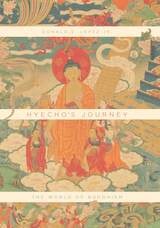
cover of Hyecho's Journey: The World of Buddhism

Hyecho's Journey

The World of Buddhism

Donald S. Lopez Jr.

University of Chicago Press, 2017

In the year 721, a young Buddhist monk named Hyecho set out from the kingdom of Silla, on the Korean peninsula, on what would become one of the most extraordinary journeys in history. Sailing first to China, Hyecho continued to what is today Vietnam, Indonesia, Myanmar, India, Pakistan, Afghanistan, and Iran, before taking the Silk Road and heading back east, where he ended his days on the sacred mountain of Wutaishan in China.
            With Hyecho’s Journey, eminent scholar of Buddhism Donald S. Lopez Jr. re-creates Hyecho’s trek. Using the surviving fragments of Hyecho’s travel memoir, along with numerous other textual and visual sources, Lopez imagines the thriving Buddhist world the monk explored. Along the way, Lopez introduces key elements of Buddhism, including its basic doctrines, monastic institutions, works of art, and the many stories that have inspired Buddhist pilgrimage. Through the eyes of one remarkable Korean monk, we discover a vibrant tradition flourishing across a vast stretch of Asia. Hyecho’s Journey is simultaneously a rediscovery of a forgotten pilgrim, an accessible primer on Buddhist history and doctrine, and a gripping, beautifully illustrated account of travel in a world long lost.
 
[more]
cover of Tales of Times Now Past: Sixty-Two Stories from a Medieval Japanese Collection

Tales of Times Now Past

Sixty-Two Stories from a Medieval Japanese Collection

Marian Ury

University of Michigan Press, 1993
Tales of Times Now Past is a translation of 62 outstanding tales freshly selected from Konjaku monogatari shu, a Japanese anthology dating from the early twelfth century. The original work, unique in world literature, contains more than one thousand systematically arranged tales from India, China, and Japan. It is the most important example of a genre of collections of brief tales which, because of their informality and unpretentious style, were neglected by Japanese critics until recent years but which are now acknowledged to be among the most significant prose literature of premodern Japan. “Konjaku” in particular has aroused the enthusiasm of such leading 20th-century writers as Akutagawa Ryunosuke and Tanizaki Jun’ichiro.
The stories, with sources in both traditional lore and contemporary gossip, cover an astonishing range—homiletic, sentimental, terrifying, practical-minded, humorous, ribald. Their topics include the life of the Buddha, descriptions of Heaven and Hell, feats of warriors, craftsmen, and musicians, unsuspected vice, virtue, and ingenuity, and the ways and wiles of bandits, ogres, and proverbially greedy provincial governors, to name just a few. Composed perhaps a century after the refined, allusive, aristocratic Tale of Genji, Konjaku represents a masculine outlook and comparatively plebeian social orientation, standing in piquant contrast to the earlier masterpiece. The unknown compiler was interested less in exploring psychological subtleties than in presenting vivid portraits of human foibles and eccentricities. The stories in the present selection have been chosen to provide an idea of the scope and structure of the book as a whole, and also for their appeal to the modern reader. And the translation is based on the premise that the most faithful rendering is also the liveliest.
[more]
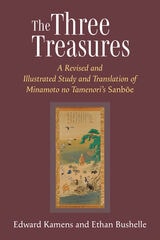
cover of The Three Treasures: A Revised and Illustrated Study and Translation of  Minamoto no Tamenori's Sanboe

The Three Treasures

A Revised and Illustrated Study and Translation of Minamoto no Tamenori's Sanboe

Edward Kamens and Ethan Bushelle

University of Michigan Press, 2023

When the young Princess Sonshi became a Buddhist nun in the year 984, a scholar-official of the royal court was commissioned to create a guide to the Buddhist religion that would be accessible for her. He did so in the form of the illustrated works of fiction (monogatari) that appealed to women readers of her time and class. The text has survived in later manuscripts; the illustrations, if they ever existed, have not. This revised translation recreates Sonshi’s experience of receiving this multimedia presentation, with illustrations selected to help contemporary readers visualize its content and essays that provide context on the religious and cultural experience of the author. The Three Jewels is a unique document that opens a window onto the world of Buddhist religious experience—especially for women—in high classical Japan, the time of Sei Shōnagon’s Pillow Book and Murasaki Shikibu’s Tale of Genji.

[more]