Results by title
3 books match the query 'Buddhists'
Locations of Buddhism
Colonialism and Modernity in Sri LankaAnne M. Blackburn
University of Chicago Press, 2010
Modernizing and colonizing forces brought nineteenth-century Sri Lankan Buddhists both challenges and opportunities. How did Buddhists deal with social and economic change; new forms of political, religious, and educational discourse; and Christianity? And how did Sri Lankan Buddhists, collaborating with other Asian Buddhists, respond to colonial rule? To answer these questions, Anne M. Blackburn focuses on the life of leading monk and educator Hikkaduve Sumangala (1827–1911) to examine more broadly Buddhist life under foreign rule.
In Locations of Buddhism, Blackburn reveals that during Sri Lanka’s crucial decades of deepening colonial control and modernization, there was a surprising stability in the central religious activities of Hikkaduve and the Buddhists among whom he worked. At the same time, they developed new institutions and forms of association, drawing on pre-colonial intellectual heritage as well as colonial-period technologies and discourse. Advocating a new way of studying the impact of colonialism on colonized societies, Blackburn is particularly attuned here to human experience, paying attention to the habits of thought and modes of affiliation that characterized individuals and smaller scale groups. Locations of Buddhism is a wholly original contribution to the study of Sri Lanka and the history of Buddhism more generally.
Seeking Sakyamuni
South Asia in the Formation of Modern Japanese BuddhismRichard M. Jaffe
University of Chicago Press, 2019
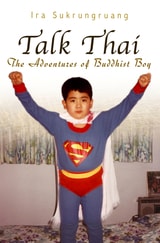
Talk Thai
The Adventures of Buddhist BoyIra Sukrungruang
University of Missouri Press, 2011
When Ira Sukrungruang was born to Thai parents newly arrived in the U.S., they picked his Jewish moniker out of a book of “American” names. In this lively, entertaining, and often hilarious memoir, he relates the early life of a first-generation Thai-American and his constant, often bumbling attempts to reconcile cultural and familial expectations with the trials of growing up in 1980s America.
Young Ira may have lived in Oak Lawn, Illinois, but inside the family’s bi-level home was “Thailand with American conveniences.” They ate Thai food, spoke the Thai language, and observed Thai customs. His bedtime stories were tales of Buddha and monkey-faced demons. On the first day of school his mother reminded him that he had a Siamese warrior’s eyes—despite his thick glasses—as Aunty Sue packed his Muppets lunch box with fried rice. But when his schoolmates played tag he was always It, and as he grew, he faced the constant challenge of reconciling American life with a cardinal family rule: “Remember, you are Thai.”
Inside the Thai Buddhist temple of Chicago, another “simulated Thailand,” are more rules, rules different from those of the Southside streets, and we see mainstream Western religion—“god people”—through the Sukrungruang family’s eyes. Within the family circle, we meet a mother who started packing for her return to Thailand the moment she arrived; her best friend, Aunty Sue, Ira’s second mother, who lives with and cooks for the family; and a wayward father whose dreams never quite pan out.
Talk Thai is a richly told account that takes us into an immigrant’s world. Here is a story imbued with Thai spices and the sensibilities of an American upbringing, a story in which Ira practices English by reciting lines from TV sitcoms and struggles with the feeling of not belonging in either of his two worlds. For readers who delight in the writings of Amy Tan, Gish Jen, and other Asian-Americans, Talk Thai provides generous portions of a still-mysterious culture while telling the story of an American boyhood with humor, playfulness, and uncompromising honesty.