Results by title
11 books match the query 'Built Environment'
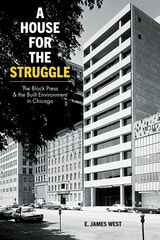
A House for the Struggle
The Black Press and the Built Environment in ChicagoE. James West
University of Illinois Press, 2022
- Winner of the 2023 Michael Nelson Prize of International Association for Media and History (IAMHIST)
- Recipient of the 2022 Jane Jacobs Urban Communication Book Award
- Winner of the 2023 American Journalism Historians Association Book of the Year
- Winner of the 2023 ULCC’s (Union League Club of Chicago) Outstanding Book on the History of Chicago Award
- Recipient of a 2023 Best of Illinois History Superior Achievement award from the Illinois State Historical Society
- Winner of the 2023 BAAS Book Prize (British Association for American Studies)
- Winner of a 2023 The Brinck Book Award and Lecture series (University of New Mexico School of Architecture + Planning)
- Honorable Mention for the 2021-22 RSAP Book Prize (Research Society for American Periodicals)
Buildings once symbolized Chicago's place as the business capital of Black America and a thriving hub for Black media. In this groundbreaking work, E. James West examines the city's Black press through its relationship with the built environment. As a house for the struggle, the buildings of publications like Ebony and the Chicago Defender embodied narratives of racial uplift and community resistance. As political hubs, gallery spaces, and public squares, they served as key sites in the ongoing Black quest for self-respect, independence, and civic identity. At the same time, factors ranging from discriminatory business practices to editorial and corporate ideology prescribed their location, use, and appearance, positioning Black press buildings as sites of both Black possibility and racial constraint.
Engaging and innovative, A House for the Struggle reconsiders the Black press's place at the crossroads where aspiration collided with life in one of America's most segregated cities.
Architecture as a Way of Seeing and Learning
The Built Environment as an Added Educator in East African Refugee CampsNerea Amorós Elorduy
University College London, 2021
Displaced before they were born, children living in long-term refugee camps along the East African Rift grow and learn surrounded by ready-made structures. Architecture as a Way of Seeing and Learning explores what these built environments teach us about both childhood development and refugee assistance. With an eye toward architecture, Nerea Amorós Elorduy models how a more empathetic approach to refugee relief might both decolonize humanitarian aid and nurture the learning of young children.
Blockchain, Smart Contracts and Distributed Ledger Technologies in the Built Environment
Key concepts, technologies, and applicationsMohamad Kassem
The Institution of Engineering and Technology, 2025

Code of Practice for Cyber Security in the Built Environment
The Institution of Engineering and Technology
The Institution of Engineering and Technology, 2014
Guide to Energy Management in the Built Environment
The Institution of Engineering and Technology
The Institution of Engineering and Technology, 2017
Handbook of Ventilation Technology for the Built Environment
Design, control and testingShi-Jie Cao
The Institution of Engineering and Technology, 2022
Opera and the Built Environment
Laura Vasilyeva
University of Chicago Press, 2025
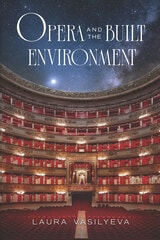
In Opera and the Built Environment, music scholar Laura Vasilyeva considers the remarkable mass construction of opera houses around the world since the 1800s and the no-less-remarkable bids to standardize the architectural features of their interiors across this vast theatrical infrastructure. Now known as the teatro all’italiana, this style of architecture—made most famous by Milan’s Teatro alla Scala—is characterized by auditoria with tiers of stacked boxes and a dominant red hue.
With attention to the sensuous dimensions of their auditoria, from their surfaces to their atmospheres to their acoustics and thresholds, Vasilyeva reveals the calculated reasons these theaters took on the form they did. The result is a book that reveals unknown associations between the Italian opera house and matters of environmental destruction, empire, and belonging, showing us new and unexpected patterns in how opera connects to the world we know.
Postcolonial Dublin
Imperial Legacies And The Built EnvironmentAndrew Kincaid
University of Minnesota Press, 2006
The Meaning of the Built Environment
A Nonverbal Communication ApproachAmos Rapoport
University of Arizona Press, 1990
"Fills a significant gap: it introduces the notion of environmental meaning so clearly that no reader will doubt the basic premise that the environment holds meaning as part of a cultural system of symbols, and influences our actions and our determinations of social order." —Design Book Review
"This is the second edition of a book first published in 1982. . . . Enthusiastic and inquiring as the reader is brought into the writer's thought processes." —Progress in Human Geography (England)
"It has merits not to be found in any other book in this much-discussed and little understood subject, to wit: it is short, it is simple, and it is useful. It is even, in parts, entertaining....a book which will help architects to do their job better." —Architecture Australia
Urban Informality and the Built Environment
Infrastructure, Exchange and ImageEdited by Nerea Amorós Elorduy, Nikhilesh Sinha, and Colin Marx
University College London, 2024
Urban Informality and the Built Environment demonstrates the value of greater and more diverse forms of engagement of built-environment disciplines with what constitutes urban informality and its politics. This collection lays forth a range of new methodologies to the study of urban informality, by exploring case studies from multiple geographies, including the creative place-making of street artists in Accra, the morphological evolution of urban Tirana, urban agriculture in la Habana, and social reproduction in Greece. Together these case studies offer ways to promote cross-fertilization between disciplines, lenses, geographies, and methodologies. Drawing on recent research by architects, planners, political scientists, geographers, and urban theorists, this book brings a multi-disciplinary approach to the study of informality and the built environment in diverse contexts.
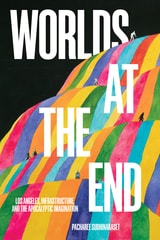
Worlds at the End
Los Angeles, Infrastructure, and the Apocalyptic ImaginationPacharee Sudhinaraset
Temple University Press, 2024
Worlds at the End analyzes destruction, rupture, and continuance through texts ranging from Karen Tei Yamashita’s Tropic of Orange, which considers racial colonial infrastructure, to the work of Diné poet Esther Belin, which illuminates how the separation between the Indian reservation and LA is part of a broader infrastructural network of termination. And she unpacks Octavia Butler’s post-apocalyptic novel, Parable of the Sower, where LA’s freeways and roadways are routes of forced migration, colonization, and flight.
Tearing down existing institutions that marginalize people of color and moving past them, Worlds at the End highlights the imaginaries of those subjugated, racialized, and made other, for whom modernity, freedom, and progress meant violence, brutality, and relegation to the status of devalued surplus populations. As Sudhinaraset deftly shows, the apocalypse marks moments of historical and spatial transition, offering stories of doomsdays that will give rise to resurgence and regeneration.