Results by title
6 books match the query 'Bullets'

Barbs, Bullets, and Blood
The 1880s Texas barbed Wire WarsHarold D. Jobes
University of North Texas Press, 2025
[more]
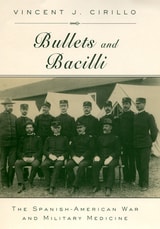
Bullets and Bacilli
The Spanish-American War and Military MedicineCirillo, Vincent J.
Rutgers University Press, 2003
For each soldier killed in combat during the Spanish-American War, more than seven died from diseases such as typhoid fever and malaria - a rate higher than that of the Civil War. During a time of rapid medical innovation and discovery, why did these soldiers die so needlessly? This work focuses primarily on military medicine during this conflict. Historian Vincent J. Cirillo argues that there is a universal element of military culture that stifles medical progress. This war gave army medical officers an opportunity to introduce to the battlefield new medical technology, including the X-ray, aseptic surgery and sanitary systems derived from the germ theory. With few exceptions, however, their recommendations were ignored almost completely. Scientific knowledge was not sufficient; putting these ideas into military practice required the co-peration of line officers and volunteer soldiers as well as a restructuring of military education. The influence of military experiences on the history of American medicine is often overlooked. Cirillo shows how preventable deaths during the Spanish-American War led to reforms that continue to save the lives of both soldiers and civilians to the present day.
[more]
Bullets and Fire
Lynching and Authority in Arkansas, 1840-1950Guy Lancaster
University of Arkansas Press, 2017
Bullets and Fire is the first collection on lynching in Arkansas, exploring all corners of the state from the time of slavery up to the mid-twentieth century and covering stories of the perpetrators, victims, and those who fought against vigilante violence.
Among the topics discussed are the lynching of slaves, the Arkansas Council of the Association of Southern Women for the Prevention of Lynching, the 1927 lynching of John Carter in Little Rock, and the state’s long opposition to a federal anti-lynching law.
Throughout, the work reveals how the phenomenon of lynching—as the means by which a system of white supremacy reified itself, with its perpetrators rarely punished and its defenders never condemned—served to construct authority in Arkansas. Bullets and Fire will add depth to the growing body of literature on American lynching and integrate a deeper understanding of this violence into Arkansas history.
[more]
Bullets in Envelopes
Iraqi Academics in ExileLouis Yako
Pluto Press, 2021
Following the U.S. invasion of Iraq in 2003, many Iraqi academics were assassinated. Countless others received bullets in envelopes and instructions to leave their institutions (and in many cases the country) or get killed. Many heeded the warning and fled into exile. Having played such a pivotal role in shaping post-independence Iraqi society, the exile and internal displacement of its academics has had a profound impact. Tracing the academic, political, and social lives of more than 60 academics, Bullets in Envelopes offers a 'genealogy of loss', and a groundbreaking appraisal of the dismantling and restructuring of Iraqi institutions, culture and society. Through extensive fieldwork in the UK, Jordan and Iraqi Kurdistan, Louis Yako shows the human side of the destructive 2003 occupation, how things are today, and how they came to be.
[more]
Bullets, Ballots, and Rhetoric
Confederate States Policy for the United States Presidential ContestLarry E. Nelson
University of Alabama Press, 1980
A fascinating study of Confederate perceptions of and attempts to manipulate the 1864 US presidential election
The Confederacy's hopes for independence were founded less on the belief that the South could defeat the North than on a strategy of staving off defeat long enough for the North to weary of the fight. The South’s single biggest opportunity to effect political change in the North was the presidential contest of 1864. If Lincoln’s support foundered and the North elected a president with a more flexible vision of peace on the continent, the South might realize its dream of independence.
Praised as an important contribution to understanding the Davis administration, in Bullets, Ballots, and Rhetoric, Larry Nelson vividly brings to life the complex state of Northern and Southern internal politics during the election year of 1863. He recounts fluctuations in the value of the dollar, draft resistance and riots, protests against emancipation, political defeats suffered by the Republicans in the elections of 1862, and growing discontent in the border states and Midwest. This gripping account explores a mission Davis sent to Canada in 1864 seeking to influence the election of a new US president, a strategy Nelson's persuasive analysis shows to have been intelligent and reasonable. Nevertheless, Davis's haphazard leadership contributed to its failure. Nelson hypothesizes that had Davis drawn the North into negotiations before the Democratic convention for the upcoming elections, a temporary armistice might well have proved permanent.
Nelson offers an insider’s look at the administration of Jefferson Davis as it searched for cracks in Northern unity and electoral opportunities to exploit—and yet also as it overlooked war-weariness in the South itself. Bullets, Ballots, and Rhetoric is an engrossing account of a little-known but critical aspect of Civil War statecraft and politics.
[more]
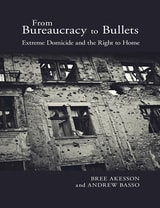
From Bureaucracy to Bullets
Extreme Domicide and the Right to HomeBree Akesson
Rutgers University Press, 2022
There are currently a record-setting number of forcibly displaced persons in the world. This number continues to rise as solutions to alleviate humanitarian catastrophes of large-scale violence and displacement continue to fail. The likelihood of the displaced returning to their homes is becoming increasingly unlikely. In many cases, their homes have been destroyed as the result of violence. Why are the homes of certain populations targeted for destruction? What are the impacts of loss of home upon children, adults, families, communities, and societies? If having a home is a fundamental human right, then why is the destruction of home not viewed as a rights violation and punished accordingly? From Bureaucracy to Bullets answers these questions and more by focusing on the violent practice of extreme domicide, or the intentional destruction of the home, as a central and overlooked human rights issue.
[more]