Results by title
6 books match the query 'Burdens'
Polished
College, Class, and the Burdens of Social MobilityMelissa Osborne
University of Chicago Press, 2024
While college initiates a major transition in all students’ lives, low-income and first-generation students attending elite schools are often entering entirely new worlds. Amid the financial and academic challenges of adapting to college, their emotional lives, too, undergo a transformation. Surrounded by peers from different classes and cultural backgrounds, they are faced with an impossible choice: turn away from their former lives to blend in or stay true to themselves and remain on the outside.
An ethnography that draws on in-depth interviews with one hundred and fifty first-generation and low-income students across eighteen elite institutions, Polished uncovers the hidden consequences of the promise of social mobility in today’s educational landscape. Sociologist Melissa Osborne reveals how the very support designed to propel first-generation students forward can unexpectedly reshape their identities, often putting them at odds with their peers and families. Without direct institutional support, this emotional journey can lead to alienation, mental health challenges, poor academic outcomes, and difficult choices between upward mobility or maintaining authenticity and community. Whether you're an educator, advocate, or student, Polished provides a powerful perspective on the uncharted challenges of social mobility and personal identity during college.
Polished
College, Class, and the Burdens of Social MobilityMelissa Osborne
University of Chicago Press, 2024
An illuminating look at the emotional costs of mobility faced by first-generation and low-income college students.
While college initiates a major transition in all students’ lives, low-income and first-generation students attending elite schools are often entering entirely new worlds. Amid the financial and academic challenges of adapting to college, their emotional lives, too, undergo a transformation. Surrounded by peers from different classes and cultural backgrounds, they are faced with an impossible choice: turn away from their former lives to blend in or stay true to themselves and remain on the outside.
An ethnography that draws on in-depth interviews with one hundred and fifty first-generation and low-income students across eighteen elite institutions, Polished uncovers the hidden consequences of the promise of social mobility in today’s educational landscape. Sociologist Melissa Osborne reveals how the very support designed to propel first-generation students forward can unexpectedly reshape their identities, often putting them at odds with their peers and families. Without direct institutional support, this emotional journey can lead to alienation, mental health challenges, poor academic outcomes, and difficult choices between upward mobility or maintaining authenticity and community. Whether you're an educator, advocate, or student, Polished provides a powerful perspective on the uncharted challenges of social mobility and personal identity during college.
Presumptions and Burdens of Proof
An Anthology of Argumentation and the LawEdited by Hans V. Hansen, Fred J. Kauffeld, James B. Freeman, and Lilian Bermejo-Luque
University of Alabama Press, 2019
An anthology of the most important historical sources, classical and modern, on the subjects of presumptions and burdens of proof
In the last fifty years, the study of argumentation has become one of the most exciting intellectual crossroads in the modern academy. Two of the most central concepts of argumentation theory are presumptions and burdens of proof. Their functions have been explicitly recognized in legal theory since the middle ages, but their pervasive presence in all forms of argumentation and in inquiries beyond the law—including politics, science, religion, philosophy, and interpersonal communication—have been the object of study since the nineteenth century.
However, the documents and essays central to any discussion of presumptions and burdens of proof as devices of argumentation are scattered across a variety of remote sources in rhetoric, law, and philosophy. Presumptions and Burdens of Proof: An Anthology of Argumentation and the Law brings together for the first time key texts relating to the history of the theory of presumptions along with contemporary studies that identify and give insight into the issues facing students and scholars today.
The collection’s first half contains historical sources and begins with excerpts from Aristotle’s Topics and goes on to include the locus classicus chapter from Bishop Whately’s crucial Elements of Rhetoric as well as later reactions to Whately’s views. The second half of the collection contains contemporary essays by contributors from the fields of law, philosophy, rhetoric, and argumentation and communication theory. These essays explore contemporary understandings of presumptions and burdens of proof and their role in numerous contexts today. This anthology is the definitive resource on the subject of these crucial rhetorical modes and will be a vital resource to all scholars of communication and rhetoric, as well as legal scholars and practicing jurists.
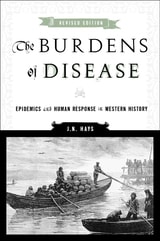
The Burdens of Disease
Epidemics and Human Response in Western HistoryJ.N. Hays
Rutgers University Press, 2009
In this updated volume, with revisions and additions to the original content, including the evolution of drug-resistant diseases and expanded coverage of HIV/AIDS, along with recent data on mortality figures and other relevant statistics, J. N. Hays chronicles perceptions and responses to plague and pestilence over two thousand years of western history. Disease is framed as a multidimensional construct, situated at the intersection of history, politics, culture, and medicine, and rooted in mentalities and social relations as much as in biological conditions of pathology. This revised edition of The Burdens of Disease also studies the victims of epidemics, paying close attention to the relationships among poverty, power, and disease.

The Burdens of Disease
Epidemics and Human Response in Western HistoryHays, J. N
Rutgers University Press, 1998
In this sweeping approach to the history of disease, historian J. N. Hays chronicles perceptions and responses to plague and pestilence over two thousand years of western history. Hays frames disease as a multi-dimensional construct, situated at the intersection of history, politics, culture, and medicine, and rooted in mentalities and social relations as much as in biological conditions of pathology. He shows how diseases affect social and political change, reveal social tensions, and are mediated both within and outside the realm of scientific medicine.
Beginning with the legacy of Greek, Roman, and early Christian ideas about disease, the book then discusses many of the dramatic epidemics from the fourteenth through the twentieth centuries, moving from leprosy and bubonic plague through syphilis, smallpox, cholera, tuberculosis, influenza, and poliomyelitis to AIDS. Hays examines the devastating exchange of diseases between cultures and continents that ensued during the age of exploration. He also describes disease through the lenses of medical theory, public health, folk traditions, and government response. The history of epidemics is also the history of their victims. Hays pays close attention to the relationships between poverty and power and disease, using contemporary case studies to support his argument that diseases concentrate their pathological effects on the poor, while elites associate the cause of disease with the culture and habits of the poor.

The Burdens of Intimacy
Psychoanalysis and Victorian MasculinityChristopher Lane
University of Chicago Press, 1998
Lane discredits the conservative notion that Victorian literature expresses only a demand for repression and moral restraint. But he also refutes historicist and Foucauldian approaches, arguing that they dismiss the very idea of repression and end up denouncing psychoanalysis as complicit in various kinds of oppression. These approaches, Lane argues, reduce Victorian literature to a drama about politics, power, and the ego. Striving instead to reinvigorate discussions of fantasy and the unconscious, Lane offers a clear, often startling account of writers who grapple with the genuine complexities of love, desire, and friendship.