Results by title
7 books match the query 'Burgess, Ernest W.'
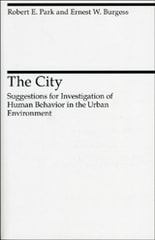
The City
Robert E. Park and Ernest W. Burgess
University of Chicago Press, 1984
The City, first published in 1925 and reprinted here in its entirety, is a cross-section of concerns of the Chicago urban school during the period of its most intense activity. Park and Burgess realized that ecological and economic factors were converted into a social organization by the traditions and aspirations of city dwellers. In their efforts to achieve objectivity, these sociologists never lost sight of the values that propel human beings.
"It is a classic which remains relevant largely because it poses questions still unresolved."—Choice
"It is a classic which remains relevant largely because it poses questions still unresolved."—Choice
[more]
The City
Robert E. Park and Ernest W. Burgess
University of Chicago Press, 2019
First published in 1925, The City is a trailblazing text in urban history, urban sociology, and urban studies. Its innovative combination of ethnographic observation and social science theory epitomized the Chicago school of sociology. Robert E. Park, Ernest W. Burgess, and their collaborators were among the first to document the interplay between urban individuals and larger social structures and institutions, seeking patterns within the city’s riot of people, events, and influences. As sociologist Robert J. Sampson notes in his new foreword, though much has changed since The City was first published, we can still benefit from its charge to explain where and why individuals and social groups live as they do.
[more]
The City
Robert E. Park and Ernest W. Burgess
University of Chicago Press, 2019
This is an auto-narrated audiobook version of this book.
First published in 1925, The City is a trailblazing text in urban history, urban sociology, and urban studies. Its innovative combination of ethnographic observation and social science theory epitomized the Chicago school of sociology. Robert E. Park, Ernest W. Burgess, and their collaborators were among the first to document the interplay between urban individuals and larger social structures and institutions, seeking patterns within the city’s riot of people, events, and influences. As sociologist Robert J. Sampson notes in his new foreword, though much has changed since The City was first published, we can still benefit from its charge to explain where and why individuals and social groups live as they do.
First published in 1925, The City is a trailblazing text in urban history, urban sociology, and urban studies. Its innovative combination of ethnographic observation and social science theory epitomized the Chicago school of sociology. Robert E. Park, Ernest W. Burgess, and their collaborators were among the first to document the interplay between urban individuals and larger social structures and institutions, seeking patterns within the city’s riot of people, events, and influences. As sociologist Robert J. Sampson notes in his new foreword, though much has changed since The City was first published, we can still benefit from its charge to explain where and why individuals and social groups live as they do.
[more]
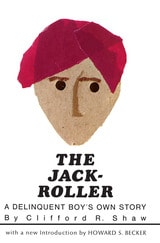
The Jack-Roller
A Delinquent Boy's Own StoryClifford R. Shaw
University of Chicago Press, 1966
The Jack-Roller tells the story of Stanley, a pseudonym Clifford Shaw gave to his informant and co-author, Michael Peter Majer. Stanley was sixteen years old when Shaw met him in 1923 and had recently been released from the Illinois State Reformatory at Pontiac, after serving a one-year sentence for burglary and jack-rolling (mugging),
Vivid, authentic, this is the autobiography of a delinquent—his experiences, influences, attitudes, and values. The Jack-Roller helped to establish the life-history or "own story" as an important instrument of sociological research. The book remains as relevant today to the study and treatment of juvenile delinquency and maladjustment as it was when originally published in 1930.
Vivid, authentic, this is the autobiography of a delinquent—his experiences, influences, attitudes, and values. The Jack-Roller helped to establish the life-history or "own story" as an important instrument of sociological research. The book remains as relevant today to the study and treatment of juvenile delinquency and maladjustment as it was when originally published in 1930.
[more]
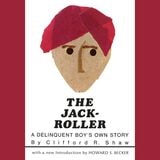
The Jack-Roller
A Delinquent Boy's Own StoryClifford R. Shaw
University of Chicago Press, 1966
This is an auto-narrated audiobook version of this book.
The Jack-Roller tells the story of Stanley, a pseudonym Clifford Shaw gave to his informant and co-author, Michael Peter Majer. Stanley was sixteen years old when Shaw met him in 1923 and had recently been released from the Illinois State Reformatory at Pontiac, after serving a one-year sentence for burglary and jack-rolling (mugging),
Vivid, authentic, this is the autobiography of a delinquent—his experiences, influences, attitudes, and values. The Jack-Roller helped to establish the life-history or "own story" as an important instrument of sociological research. The book remains as relevant today to the study and treatment of juvenile delinquency and maladjustment as it was when originally published in 1930.
[more]

Urban Sociology
Edited by Ernest W. Burgess and Donald J. Boque
University of Chicago Press, 1967
[more]

Youthful Offenders at Highfields
An Evaluation of the Effects of the Short-Term Treatment of Delinquent BoysH. Ashley Weeks
University of Michigan Press, 1958
At Highfields Youthful Offenders —are kept for no longer than four months —are permitted to leave the grounds with any responsible adult —are granted three-day furloughs over weekends to visit their families —live with no more than 19 other boys in a 14-room house on a 320-acre estate —work forty hours a week at the nearby New Jersey Neuropsychiatric Institute —actively participate in guided group interaction sessions .How successful is this program? How do the results compare with those of the more traditional reformatory? At one-third the usual cost per capita, is Highfields the answer in delinquency prevention? H. Ashley Weeks, on the basis of a survey by the New York University Department of Sociology, evaluates the success of a program of crime prevention.
[more]