Results by title
15 books match the query 'Burial'
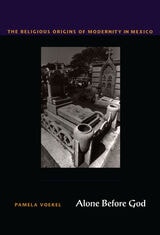
Alone Before God
The Religious Origins of Modernity in MexicoPamela Voekel
Duke University Press, 2002
Drawing on the archival research of wills, public documents, and other texts from late-colonial and early-republican Mexico, Voekel describes the marked scaling-down of the pomp and display that had characterized baroque Catholic burials and the various devices through which citizens sought to safeguard their souls in the afterlife. In lieu of these baroque practices, the new enlightened Catholics, claims Voekel, expressed a spiritually and hygienically motivated preference for extremely simple burial ceremonies, for burial outside the confines of the church building, and for leaving their earthly goods to charity. Claiming that these changes mirrored a larger shift from an external, corporate Catholicism to a more interior piety, she demonstrates how this new form of Catholicism helped to initiate a cultural and epistemic shift that placed the individual at the center of knowledge.
Breaking with the traditional historiography to argue that Mexican liberalism had deeply religious roots, Alone Before God will be of interest to specialists in Latin American history, modernity, and religion.
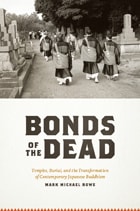
Bonds of the Dead
Temples, Burial, and the Transformation of Contemporary Japanese BuddhismMark Michael Rowe
University of Chicago Press, 2011
Despite popular images of priests seeking enlightenment in snow-covered mountain temples, the central concern of Japanese Buddhism is death. For that reason, Japanese Buddhism’s social and economic base has long been in mortuary services—a base now threatened by public debate over the status, treatment, and location of the dead. Bonds of the Dead explores the crisis brought on by this debate and investigates what changing burial forms reveal about the ways temple Buddhism is perceived and propagated in contemporary Japan.
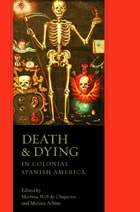
Death and Dying in Colonial Spanish America
Edited by Martina Will de Chaparro and Miruna Achim
University of Arizona Press, 2011
The variety of sources uncovered in the authors’ original archival research suggests the wide diversity of topics and approaches they employ: Nahua annals, Spanish chronicles, Inquisition case records, documents on land disputes, sermons, images, and death registers. Geographically, the range of research focuses on the viceroyalties of New Spain, Peru, and New Granada.
The resulting records—both documentary and archaeological—offer us a variety of vantage points from which to view each of these cultural groups as they came into contact with others. Much less tied to modern national boundaries or old imperial ones, the many facets of the new historical research exploring the topic of death demonstrate that no attitudes or practices can be considered either “Western” or universal.
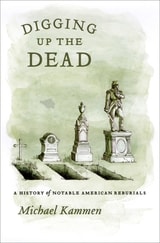
Digging Up the Dead
A History of Notable American ReburialsMichael Kammen
University of Chicago Press, 2010
With Digging Up the Dead, Pulitzer Prize–winning historian Michael Kammen reveals a treasure trove of fascinating, surprising, and occasionally gruesome stories of exhumation and reburial throughout American history. Taking us to the contested grave sites of such figures as Sitting Bull, John Paul Jones, Frank Lloyd Wright, Daniel Boone, Jefferson Davis, and even Abraham Lincoln, Kammen explores how complicated interactions of regional pride, shifting reputations, and evolving burial practices led to public and often emotional battles over the final resting places of famous figures. Grave-robbing, skull-fondling, cases of mistaken identity, and the financial lures of cemetery tourism all come into play as Kammen delves deeply into this little-known—yet surprisingly persistent—aspect of American history.
Simultaneously insightful and interesting, masterly and macabre, Digging Up the Dead reminds us that the stories of American history don’t always end when the key players pass on. Rather, the battle—over reputations, interpretations, and, last but far from least, possession of the remains themselves—is often just beginning.
Heraldry for the Dead
Memory, Identity, and the Engraved Stone Plaques of Neolithic IberiaBy Katina T. Lillios
University of Texas Press, 2008
In the late 1800s, archaeologists began discovering engraved stone plaques in Neolithic (3500-2500 BC) graves in southern Portugal and Spain. About the size of one's palm, usually made of slate, and incised with geometric or, more rarely, zoomorphic and anthropomorphic designs, these plaques have mystified generations of researchers. What do their symbols signify? How were the plaques produced? Were they worn during an individual's lifetime, or only made at the time of their death? Why, indeed, were the plaques made at all?
Employing an eclectic range of theoretical and methodological lenses, Katina Lillios surveys all that is currently known about the Iberian engraved stone plaques and advances her own carefully considered hypotheses about their manufacture and meanings. After analyzing data on the plaques' workmanship and distribution, she builds a convincing case that the majority of the Iberian plaques were genealogical records of the dead that served as durable markers of regional and local group identities. Such records, she argues, would have contributed toward legitimating and perpetuating an ideology of inherited social difference in the Iberian Late Neolithic.

Just Enough to Put Him Away Decent
Death Care, Life Extension, and the Making of a Healthier South, 1900-1955Kristine M. McCusker
University of Illinois Press, 2023
Kristine McCusker charts the dramatic transformation that took place when southerners in particular and Americans in general changed their thinking about when one should die, how that death could occur, and what decent burial really means. As she shows, death care evolved from being a community act to a commercial one where purchasing a purple coffin and hearse ride to the cemetery became a political statement and the norm. That evolution also required interactions between perfect strangers, especially during the world wars as families searched for their missing soldiers. In either case, being put away decent, as southerners called burial, came to mean something fundamentally different in 1955 than it had just fifty years earlier.
Living and Dying on the Periphery
The Archaeology and Human Remains from Two 13th-15th Century AD Villages in Southeastern New MexicoJamie L. Clark and John D. Speth
University of Utah Press, 2022
Summarizing results from eight seasons of research, Clark and Speth document human burials and associated grave offerings from the two sites. They discuss evidence for pathologies and trauma, raising questions about the nature and causes of violence that led to the demise of Henderson and Bloom Mound, and the abandonment of many other farming-hunting communities in the surrounding region.
New Jersey Cemeteries and Tombstones
History in the LandscapeVeit, Richard F
Rutgers University Press, 2008
From the earliest memorials used by Native Americans to the elaborate structures of the present day, Richard Veit and Mark Nonestied use grave markers to take an off-beat look at New Jersey’s history that is both fascinating and unique.
New Jersey Cemeteries and Tombstones presents a culturally diverse account of New Jersey’s historic burial places from High Point to Cape May and from the banks of the Delaware to the ocean-washed Shore, to explain what cemeteries tell us about people and the communities in which they lived. The evidence ranges from somber seventeenth-century decorations such as hourglasses and skulls that denoted the brevity of colonial life, to modern times where memorials, such as a life-size granite Mercedes Benz, reflect the materialism of the new millennium. Also considered are contemporary novelties such as pet cemeteries and what they reveal about today’s culture. To tell their story the authors visited more than 1,000 burial grounds and interviewed numerous monument dealers and cemetarians.
This richly illustrated book is essential reading for history buffs and indeed anyone who has ever wandered inquisitively through their local cemeteries.
Nightmare Remains
The Politics of Mourning and Epistemologies of DisappearanceEge Selin Islekel
Northwestern University Press, 2024
Offering a political epistemology of collective mourning
Focusing on forms of improper burial in Turkey and Latin America, Ege Selin Islekel argues that a political technology of mourning is fundamental to contemporary politics. This technology of necrosovereignty shapes not only individuals’ and populations’ lives but also their epistemic and political afterlives. Local practices of mourning, however, contain resistant capacities, opening alternative ways of knowing, remembering, and assembling. “Nightmare knowledges,” Islekel posits, are resistant modes of knowing tied up with grief that challenge the contemporary politics of death and those politics’ archival boundaries. Seen in mothers’ movements across the globe, from the Mothers of the Plaza de Mayo of Argentina to the Saturday Mothers of Turkey, nightmare knowledges produce counterarchives that mobilize traditionally ignored epistemic categories.
Nightmare Remains forges a new dialogue between post-Foucauldian political theory and decolonial thought and brings a fresh critical perspective to the theoretical discourse of enforced disappearances.
Skeletal Biology and Bioarchaeology of the Northwestern Plains
Edited by George W. Gill and Rick L. Weathermon
University of Utah Press, 2008
Northwestern Plains prehistory and early history as told by human bones is vivid and dramatic. The skeletal and burial record spans thousands of years, a wide geographic expanse, and contains important evidence of human existence in this vast region of North America. This book helps clarify the emerging picture.
Most of the contributions assembled here were initially presented as part of a symposium at the Plains Conference in Oklahoma City in 2003. Twenty-one preeminent scholars, working across many fields within bioarchaeology and skeletal biology—including paleopathology, dental pathology, and human osteology—bring their expertise to bear not only on prehistoric Native American burials, but on numerous other case studies. They look at specific Wyoming samples of pioneer-era burials, Indian War–era casualties, historic Chinese burials, and remains from the Benick Ranch and the Korell-Bordeaux sites. Reports on Crow Indian mummies from Montana and military burials from Missouri and Nebraska continue the exploration into recent historic times.
Human burials provide a rich source of information about people’s lives—who they were, what activities they pursued, and how they may have participated in rituals of death and mourning. This volume is an authoritative statement on both the skeletal biology and bioarchaeology of the entire Northwestern Plains.
The Burials of Cerro Azul, Peru
Joyce Marcus
University of Michigan Press, 2024
The Forge and the Funeral
The Smith in Kapsiki/Higi CultureWalter E. A. van Beek
Michigan State University Press, 2015
The Kingdom of Pylos
Warrior-Princes of Mycenaean GreeceSharon R. Stocker
J. Paul Getty Trust, The, 2025
Ancient Pylos has long captivated travelers, archaeologists, and historians familiar with Homer’s Iliad and Odyssey and his account of King Nestor, the prudent elder counselor in the Trojan War. Excavations begun in 1939 unearthed the storied Palace of Nestor in Messenia, an epicenter of Mycenaean civilization.
The Kingdom of Pylos features spectacular arts and crafts, many recently excavated at sites across Messenia, including goldwork of unparalleled artistry, masterfully carved sealstones, weapons, and wall paintings. Essays by international scholars examine the latest discoveries, including the Linear B tablets—the earliest written form of the Greek language—which document the political, religious, and economic organization of the prosperous Pylian realm. New research and cutting-edge science cast light on the 2015 find of the grave of the Griffin Warrior, an extraordinary, intact burial that held thousands of artifacts, including the celebrated Pylos Combat Agate, perhaps the finest work of art from the prehistoric Aegean. With over 300 illustrations, this is the first major publication in English to reconstruct the society of Pylos and settlements in its orbit during the Late Bronze Age (1700–1070 BCE).
This volume is published to accompany an exhibition on view at the Archaeological Museum of Messenia in Kalamata from February 15 to April 27, 2025, the J. Paul Getty Museum at the Getty Villa from June 25, 2025, to January 12, 2026, and the Hellenic National Archaeological Museum in Athens from March 1 to June 30, 2026.
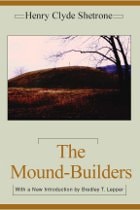
The Mound-Builders
Henry Clyde Shetrone; with a new introduction by Bradley T. Lepper
University of Alabama Press, 2004
A Dan Josselyn Memorial Publication
A classic resource on early knowledge of prehistoric mounds and the peoples who constructed them in the eastern United States
With this accessible volume, Henry Clyde Shetrone made available to general readers the archaeological research data and conclusions concerning the ancient mounds and earthworks that dot the landscape of eastern North America. Dismissing popularly held theories of mysterious giants who built these structures, he explained that their purposes were defensive and ceremonial, that they had been used for habitation, burial, and worship. Their builders were antecedents of the native peoples of present-day America and had been skilled artisans and engineers with successful agricultural practices and structured leadership.
Twenty chapters discuss aspects of mound-builder cultures: quarrying of flint and obsidian for knapping into points; mining of copper and iron and its fashioning into tools and ceremonial objects; spinning and weaving materials and methods; smoking customs; carving of calumets and their use in ceremony; freshwater pearls and other items for body ornamentation; and the use of stone burial vaults, cremation basins, and concepts of an afterlife. Data is presented from excavations ranging broadly from Massachusetts to Florida and from Texas to North Dakota.
As Bradley Lepper points out in his new introduction, "The Mound-Builders is a testament to Shetrone's success at working towards 'correlation and systematization' of data, as well as public education. . . . Shetrone was no armchair popularizer. His work was based on years of excavation and first-hand familiarity with much of the data. His popularizations [still] echo with the ring of the shovel and trowel in gravelly soil."
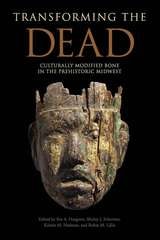
Transforming the Dead
Culturally Modified Bone in the Prehistoric MidwestEve A. Hargrave
University of Alabama Press, 2015
Revealing how the dead continued to shape the spiritual and social worlds of prehistoric North America.
Transforming the Dead is a collection of essays that examines culturally modified human bones and their roles as “cultural and ritual objects” among prehistoric Eastern Woodland cultures. Previous scholarship has explored the role of human body parts in Native American cultures as trophies of war and revered ancestors. This collection discusses new evidence that human elements were also important components of daily and ritual activities across the Eastern Woodlands. The contributors to this volume discuss each case study within the unique regional and temporal contexts of the material, rather than seeking universal answers to how these objects were used.
Most research addressing modified human bone has focused on cut marks and trauma associated with warfare, trophy taking, and burial practices. The editors and contributors of Transforming the Dead document the varied and often overlooked ways that human bone was intentionally modified through drilling, incising, cutting, and polishing for utilitarian, ornamental, spiritual, or ritual use. Examples include bracelets and gorgets to be worn, as well as musical rasps, pipe stems, masks, and protective talismans. The form and function of these objects are not unusual; their construction from the remains of “another” sets them apart.
Through a flexible but systematic analysis of the archaeological record, the contributors bring into focus how the careful selection, modification, and retention of particular bones or body parts of an individual after death offer insights into concepts of personhood, the body, life, and death among the prehistoric Native Americans in the Midwest.