Results by title
11 books match the query 'Burke, Edmund'
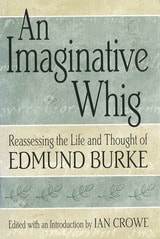
An Imaginative Whig
Reassessing the Life and Thought of Edmund BurkeEdited & Intro by Ian Crowe
University of Missouri Press, 2005
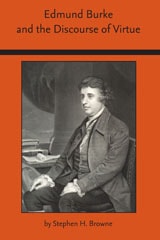
Edmund Burke and the Discourse of Virtue
Stephen Howard Browne
University of Alabama Press, 2007
"A major accomplishment in the study of Burke." —Choice
More than 200 years after his death, Edmund Burke remains among the most influential conservative writers in the Anglophone world. Burke’s relevance has only grown as the nature of what it means to be a conservative has become hotly contested.
And yet Burke is often discussed more than he is read. Worse, his rhetoric is often pressed into the service of other ideologies. In Edmund Burke and the Discourse of Virtue, Stephen Browne of Pennsylvania State University subjects Burke’s work to the close textual analysis it has never received.
The result of Browne's study is to present Burke and his work in a light that was clearly essential to Burke himself, one that illuminates the link between rhetoric and action that is key to understanding Burke, his career, his work, and his influence on contemporary conservatism.
Readers interested in the development of conversative philosophy, politics, and writing from its earliest roots will value this rare and illuminating work.
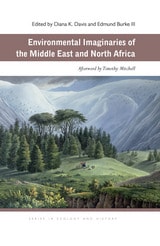
Environmental Imaginaries of the Middle East and North Africa
Diana K. Davis
Ohio University Press, 2011
The landscapes of the Middle East have captured our imaginations throughout history. Images of endless golden dunes, camel caravans, isolated desert oases, and rivers lined with palm trees have often framed written and visual representations of the region. Embedded in these portrayals is the common belief that the environment, in most places, has been deforested and desertified by centuries of misuse. It is precisely such orientalist environmental imaginaries, increasingly undermined by contemporary ecological data, that the eleven authors in this volume question. This is the first volume to critically examine culturally constructed views of the environmental history of the Middle East and suggest that they have often benefitted elites at the expense of the ecologies and the peoples of the region. The contributors expose many of the questionable policies and practices born of these environmental imaginaries and related histories that have been utilized in the region since the colonial period. They further reveal how power, in the form of development programs, notions of nationalism, and hydrological maps, for instance, relates to environmental knowledge production.
Contributors: Samer Alatout, Edmund Burke III, Shaul Cohen, Diana K. Davis, Jennifer L. Derr, Leila M. Harris, Alan Mikhail, Timothy Mitchell, Priya Satia, Jeannie Sowers, and George R. Trumbull IV
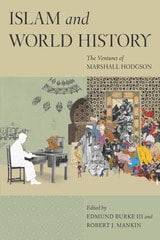
Islam and World History
The Ventures of Marshall HodgsonEdited by Edmund Burke and Robert J. Mankin
University of Chicago Press, 2018
In our post-9/11 world, Hodgson’s historical vision and moral engagement have never been more relevant. A towering achievement, Islam and World History will prove to be the definitive statement on Hodgson’s relevance in the twenty-first century and will introduce his influential work to a new generation of readers.
Selected Letters of Edmund Burke
Edmund Burke
University of Chicago Press, 1984
Statesmanship and Party Government
A Study of Burke and BolingbrokeHarvey C. Mansfield
University of Chicago Press, 1965
Mansfield points out that while parties have always existed, the party government that we know today is possible only because parties are now considered respectable. In Burke’s day, however, they were thought by detractors to be a cancer in a free polity. Even many supporters of the parties viewed them as a dangerous instrument, only to be used cautiously by statesmen in dire times. Burke, however, was an early champion of the party system in Britain and made his arguments with a clear-eyed realism. In Statesmanship and Party Government, Mansfield provides a skillful evaluation of Burke’s writings and sheds light present-day party politics through a profound understanding of the historical background of the their inception.
Subversives and Mavericks in the Muslim Mediterranean
A Subaltern HistoryEdited by Odile Moreau and Stuart Schaar; preface by Edmund Burke III
University of Texas Press, 2016
Subaltern studies, the study of non-elite or underrepresented people, have revolutionized the writing of Middle Eastern history. Subversives and Mavericks in the Muslim Mediterranean represents the next step in this transformation. The book explores the lives of eleven nonconformists who became agents of political and social change, actively organizing new forms of resistance—against either colonial European regimes or the traditional societies in which they lived—that disrupted the status quo, in some cases, with dramatic results. These case studies highlight cross-border connections in the Mediterranean world, exploring how these channels were navigated.
Chapters in the book examine the lives of subversives and mavericks, such as Tawhida ben Shaykh, the first Arab woman to receive a medical degree; Mokhtar al-Ayari, a radical Tunisian labor leader; Nazli Hanem, Kmar Bayya, and Khiriya bin Ayyad, three aristocractic women who resisted the patriarchal structures of their societies by organizing and participating in intellectual salons for men and women and advocating social reform; Qaid Najim al-Akhsassi, an ex-slave and military officer, who fought against French and Spanish colonial expansion; and Boubeker al-Ghandjawi, a nearly illiterate trader who succeeded, though his diverse connections, in establishing important relations between the Moroccan sultan and the representative of the British government. Although based on individual and local perspectives, Subversives and Mavericks in the Muslim Mediterranean reveals new and unrecognized trans-local connections across the Muslim world, illuminating our understanding of these societies beyond narrow elite circles.

The Correspondence of Edmund Burke, Volume X
IndexEdmund Burke
University of Chicago Press, 1978
The Great Melody
A Thematic Biography of Edmund BurkeConor Cruise O'Brien
University of Chicago Press, 1992
"In bringing Burke to our attention, Mr. O'Brien has brought back a lost treasure. The Great Melody is a brilliant work of narrative sweep and analytical depth. Conor Cruise O'Brien on Edmund Burke is a literary gift to political thought."—John Patrick Diggins, New York Times Book Review
"Serious readers of history are in for a treat: a book by the greatest living Irishman on the greatest Irishman who ever lived. . . . O'Brien's study is not merely a reconstruction of a fascinating man and period. It is also a tract for the times. . . . I cannot remember another time when I finished a book of more than 600 pages wishing it were longer."—Paul Johnson, The Independent
"The Great Melody combines superb biography and fascinating history with a profound understanding of political philosophy."—Former President Richard Nixon
The Philosophy of Edmund Burke
A Selection from His Speeches and WritingsEdmund Burke
University of Michigan Press, 1960
The Vision of the Soul
James Matthew Wilson
Catholic University of America Press, 2017
Story-telling is foundational to the forms of the fine arts, but it is no less foundational to human reason. Human life in turn constitutes a specific kind of form—a story form. The ancient conception of human life as a pilgrimage to beauty itself is one that we can fully embrace only if we see the essential correlation between reason and story and the essential convertibility of truth, goodness and beauty in beauty. By turns a study in fundamental ontology, aesthetics, and political philosophy, Wilson’s book invites its readers to a renewal of the West’s intellectual tradition.