Results by title

9 books match the query 'Burkina Faso'

cover of A Certain Amount of Madness: The Life Politics and Legacies of Thomas Sankara

A Certain Amount of Madness

The Life Politics and Legacies of Thomas Sankara

Amber Murrey

Pluto Press, 2018

Thomas Sankara was one of Africa's most important anti-imperialist leaders of the late 20th Century. His declaration that fundamental socio-political change would require a 'certain amount of madness' drove the Burkinabe Revolution and resurfaced in the country's popular uprising in 2014.

This book looks at Sankara's political philosophies and legacies and their relevance today. Analyses of his synthesis of Pan-Africanism and humanist Marxist politics, as well as his approach to gender, development, ecology and decolonisation offer new insights to Sankarist political philosophies. Critical evaluations of the limitations of the revolution examine his relationship with labour unions and other aspects of his leadership style. His legacy is revealed by looking at contemporary activists, artists and politicians who draw inspiration from Sankarist thought in social movement struggles today, from South Africa to Burkina Faso.

In the 30th anniversary of his assassination, this book illustrates how Sankara's political praxis continues to provide lessons and hope for decolonisation struggles today.

[more]
cover of Exchange Is Not Robbery: More Stories of an African Bar Girl

Exchange Is Not Robbery

More Stories of an African Bar Girl

John M. Chernoff

University of Chicago Press, 2004

While living in West Africa in the 1970s, John Chernoff recorded the stories of "Hawa," a spirited and brilliant but uneducated woman whose insistence on being respected and treated fairly propelled her, ironically, into a life of marginality and luck as an "ashawo," or bar girl. Rejecting traditional marriage options and cut off from family support, she is like many women in Africa who come to depend on the help they receive from one another, from boyfriends, and from the men they meet in bars and nightclubs. Refusing to see herself as a victim, Hawa embraces the freedom her lifestyle permits and seeks the broadest experience available to her.

In Exchange Is Not Robbery and its predecessor, Hustling Is Not Stealing, a chronicle of exploitation is transformed by verbal art into an ebullient comedy.  In Hustling Is Not Stealing, Hawa is a playful warrior struggling against circumstances in Ghana and Togo. In Exchange Is Not Robbery, Hawa returns to her native Burkina Faso, where she achieves greater control over her life but faces new difficulties. As a woman making sacrifices to live independently, Hawa sees her own situation become more complex as she confronts an atmosphere in Burkina Faso that is in some ways more challenging than the one she left behind, and the moral ambiguities of her life begin to intensify.

Combining elements of folklore and memoir, Hawa's stories portray the diverse social landscape of West Africa. Individually the anecdotes can be funny, shocking, or poignant; assembled together they offer a sweeping critical and satirical vision.
[more]
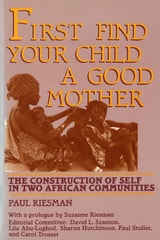
cover of First Find Your Child a Good Mother: The Construction of Self in Two African Communities

First Find Your Child a Good Mother

The Construction of Self in Two African Communities

Riesman, Paul

Rutgers University Press, 1992

Through a systematic comparison of the life circumstances, child-rearing practices, and personalities of the FulBe and their former slaves, the RiimaayBe, this book develops an alternative theory of the way personality is formed in the Fulani society of West Africa. Riesman discusses the different characters, economies, and life plans of adult men and women of both groups, focusing on their ideas about the value of relatives. He further presents detailed observations of child-rearing practices, and concludes that the FulBe and RiimaayBe do not differ in these practices. Contrasting Fulani and Western notions of parenting, he suggests that child-rearing practices are themselves irrelevant to the formation of adult personality, but that a people's ideas about the meaning of life, social relations, and the development of character are very important. Finally, Riesman outlines a sociocultural theory of personality and its formation, and uses this theory to make sense of the differences between FulBe and RiimaayBe.
[more]
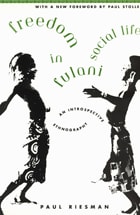
cover of Freedom in Fulani Social Life: An Introspective Ethnography

Freedom in Fulani Social Life

An Introspective Ethnography

Paul Riesman

University of Chicago Press, 1977

Paul Riesman's Freedom in Fulani Social Life is based upon his two years of residence among the Jelgobe, a group of semi-nomadic Fulani of the Sahel in Upper Volta, western Africa. Since its original publication, this classic study has profoundly influenced the field of anthropology through its re-examination of the enthnographer's personal input on his research.

"Freedom in Fulani Social Life richly documents how the ethnographer's own personal and cultural background is implicated in the research process. . . . For this reason, [Riesman's] book will be of paramount interest to all ethnographers."—Philip L. Kilbride, Reviews in Anthropology

"A remarkably well-written and insightful account of Fulani life. . . . In addition to using the conventional approaches of participating in and observing the daily activities of the Jelgobe . . . Riesman enriches his account by examining his personal feelings about particular incidents."—Library Journal

"An interesting and provocative study."—Choice

At the time of his death in 1988, Paul Riesman was an anthropologist who taught at Carleton College.
[more]
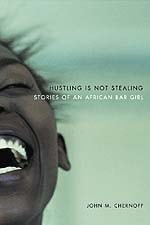
cover of Hustling Is Not Stealing: Stories of an African Bar Girl

Hustling Is Not Stealing

Stories of an African Bar Girl

John M. Chernoff

University of Chicago Press, 2003

While living in West Africa in the 1970s, John Chernoff recorded the stories of “Hawa,” a spirited and brilliant but uneducated woman whose insistence on being respected and treated fairly propelled her, ironically, into a life of marginality and luck as an “ashawo,” or bar girl. Rejecting traditional marriage options and cut off from family support, she is like many women in Africa who come to depend on the help they receive from one another, from boyfriends, and from the men they meet in bars and nightclubs. Refusing to see herself as a victim, Hawa embraces the freedom her lifestyle permits and seeks the broadest experience available to her.

In Hustling Is Not Stealing and its follow-up, Exchange Is Not Robbery, a chronicle of exploitation is transformed by verbal art into an ebullient comedy.  In Hustling Is Not Stealing, Hawa is a playful warrior struggling against circumstances in Ghana and Togo. In Exchange Is Not Robbery, Hawa returns to her native Burkina Faso, where she achieves greater control over her life but faces new difficulties. As a woman making sacrifices to live independently, Hawa sees her own situation become more complex as she confronts an atmosphere in Burkina Faso that is in some ways more challenging than the one she left behind, and the moral ambiguities of her life begin to intensify.

Combining elements of folklore and memoir, Hawa’s stories portray the diverse social landscape of West Africa. Individually the anecdotes can be funny, shocking, or poignant; assembled together they offer a sweeping critical and satirical vision.
[more]
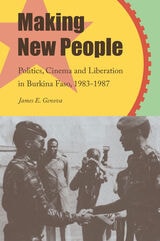
cover of Making New People: Politics, Cinema, and Liberation in Burkina Faso, 1983–1987

Making New People

Politics, Cinema, and Liberation in Burkina Faso, 1983–1987

James Genova

Michigan State University Press, 2022
On August 4, 1983, Captain Thomas Sankara led a coalition of radical military officers, communist activists, labor leaders, and militant students to overtake the government of the Republic of Upper Volta. Almost immediately following the coup’s success, the small West African country—renamed Burkina Faso, or Land of the Dignified People—gained international attention as it charted a new path toward social, economic, cultural, and political development based on its people’s needs rather than external pressures and Cold War politics. James E. Genova’s Making New People: Politics, Cinema, and Liberation in Burkina Faso, 1983–1987 recounts in detail the revolutionary government’s rise and fall, demonstrating how it embodied the critical transition period in modern African history between the era of decolonization and the dawning of neoliberal capitalism. It also uncovers one of the revolution’s most enduring and significant aspects: its promotion of film as a vehicle for raising the people’s consciousness, inspiring their efforts at social transformation, and articulating a new self-generated image of Africa and Africans. Foregrounding film and drawing evocative connections between Sankara’s political philosophy and Frantz Fanon, Making New People provides a deeply nuanced explanation for the revolution’s lasting influence throughout Africa and the world.
[more]
cover of Sahel Visions: Planned Settlement and River Blindness Control in Burkina Faso

Sahel Visions

Planned Settlement and River Blindness Control in Burkina Faso

Della E. McMillan

University of Arizona Press, 1994
When an international health initiative succeeded in wiping out river blindness in Burkina Faso, it allowed the settlement of the sparsely populated Volta Valley by the Mossi people--a development plan by which the Burkinabe government sought to relieve population pressure, establish communities, and increase cotton production. Anthropologist Della McMillan followed this visionary plan over twelve years as people relocated communities, founded farms, dealt with officials, entered the market, and in some instances moved on. Her study examines the question of how development occurs or fails to occur and offers unusual insight into how visions of progress--held by developers, settlers, and even researchers--originate and are revised.
[more]
cover of The Upright Farmer: Racial Capitalism and Agricultural Modernization in Burkina Faso

The Upright Farmer

Racial Capitalism and Agricultural Modernization in Burkina Faso

Jessie K. Luna

Duke University Press, 2026
Debates over African agricultural development have been deeply polarized between those who see capitalism and modern technology as saving African farmers and those who see those forces as destroying them. The Upright Farmer reframes this debate through a flagship case of agricultural modernization: the cotton sector of Burkina Faso, where farmers have rapidly adopted pesticides and genetically modified seeds. This process has produced inequality, debt, and social and ecological harm, yet many farmers embrace these technologies. Through rich, multi-sited ethnographic data, Jessie K. Luna untangles this puzzle by arguing that the material and ideological dynamics of colonial capitalist expansion have been interwoven with racialized hierarchies. The lens of racial capitalism reveals how agricultural modernization creates and justifies structural inequalities. At the same time, people throughout this system, from farmers to extension agents to scientists, actively navigate what W. E. B. Du Bois called “the global color line,” using agricultural technologies as pathways for status and tools of resistance. Invoking Thomas Sankara’s anticolonial vision of Burkina Faso as “the land of upright people,” Luna reveals how Burkinabè strive to stand upright as modern subjects, even as they participate in a process that compounds ecological and social splintering.
[more]
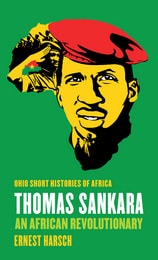
cover of Thomas Sankara: An African Revolutionary

Thomas Sankara

An African Revolutionary

Ernest Harsch

Ohio University Press, 2014

Thomas Sankara, often called the African Che Guevara, was president of Burkina Faso, one of the poorest countries in Africa, until his assassination during the military coup that brought down his government. Although his tenure in office was relatively short, Sankara left an indelible mark on his country’s history and development. An avowed Marxist, he outspokenly asserted his country’s independence from France and other Western powers while at the same time seeking to build a genuine pan-African unity. Ernest Harsch traces Sankara’s life from his student days to his recruitment into the military, early political awakening, and increasing dismay with his country’s extreme poverty and political corruption. As he rose to higher leadership positions, he used those offices to mobilize people for change and to counter the influence of the old, corrupt elites. Sankara and his colleagues initiated economic and social policies that shifted away from dependence on foreign aid and toward a greater use of the country’s own resources to build schools, health clinics, and public works. Although Sankara’s sweeping vision and practical reforms won him admirers both in Burkina Faso and across Africa, a combination of domestic opposition groups and factions within his own government and the army finally led to his assassination in 1987. This is the first English-language book to tell the story of Sankara’s life and struggles, drawing on the author’s extensive firsthand research and reporting on Burkina Faso, including interviews with the late leader. Decades after his death, Sankara remains an inspiration to young people throughout Africa for his integrity, idealism, and dedication to independence and self-determination.
[more]