Results by title

4 books match the query 'Business and education'
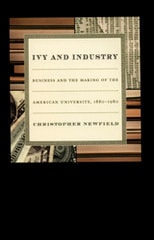
cover of Ivy and Industry: Business and the Making of the American University, 1880-1980

Ivy and Industry

Business and the Making of the American University, 1880-1980

Christopher Newfield

Duke University Press, 2003

Emphasizing how profoundly the American research university has been shaped by business and the humanities alike, Ivy and Industry is a vital contribution to debates about the corporatization of higher education in the United States. Christopher Newfield traces major trends in the intellectual and institutional history of the research university from 1880 to 1980. He pays particular attention to the connections between the changing forms and demands of American business and the cultivation of a university-trained middle class. He contends that by imbuing its staff and students with seemingly opposed ideas—of self-development on the one hand and of an economic system existing prior to and inviolate of their own activity on the other—the university has created a deeply conflicted middle class.

Newfield views management as neither inherently good nor bad, but rather as a challenge to and tool for negotiating modern life. In Ivy and Industry he integrates business and managerial philosophies from Taylorism through Tom Peters’s “culture of excellence” with the speeches and writings of leading university administrators and federal and state education and science policies. He discusses the financial dependence on industry and government that was established in the university’s early years and the equal influence of liberal arts traditions on faculty and administrators. He describes the arrival of a managerial ethos on campus well before World War II, showing how managerial strategies shaped even fields seemingly isolated from commerce, like literary studies. Demonstrating that business and the humanities have each had a far stronger impact on higher education in the United States than is commonly thought, Ivy and Industry is the dramatic story of how universities have approached their dual mission of expanding the mind of the individual while stimulating economic growth.
[more]
cover of Recommended Principles to Guide Academy-Industry Relationships

Recommended Principles to Guide Academy-Industry Relationships

American Association of University Professors

University of Illinois Press, 2014

The reputation of a college or institution depends upon the integrity of its faculty and administration. Though budgets are important, ethics are vital, and a host of new ethical problems now beset higher education. From MOOCS and intellectual property rights to drug industry payments and conflicts of interest, this book offers AAUP policy language and best practices to deal with all the campus-wide challenges of today's corporate university:
 
• Preserving the integrity of research and public respect for higher education
• Eliminating and managing individual and institutional financial conflicts of interest
• Maintaining unbiased hiring and recruitment policies
• Establishing grievance procedures and due process rights for faculty, graduate students, and academic professionals
• Mastering the complications of negotiations over patents and copyright
• Assuring the ethics of research involving human subjects.
 
In a time of dynamic change Recommended Principles to Guide Academy-Industry Relationships offers an indispensable and authoritative guide to sustaining integrity and tradition while achieving great things in twenty-first century academia.
[more]
cover of The Fantasy Economy: Neoliberalism, Inequality, and the Education Reform Movement

The Fantasy Economy

Neoliberalism, Inequality, and the Education Reform Movement

Kraus, Neil

Temple University Press, 2023

Wage stagnation, growing inequality, and even poverty itself have resulted from decades of neoliberal decision making, not the education system, writes Neil Kraus in his urgent call to action, The Fantasy Economy. Kraus claims the idea that both the education system and labor force are chronically deficient was aggressively and incorrectly promoted starting in the Reagan era, when corporate interests and education reformers emphasized education as the exclusive mechanism providing the citizenry with economic opportunity. However, as this critical book reveals, that is a misleading articulation of the economy and education system rooted in the economic self-interests of corporations and the wealthy.

The Fantasy Economy challenges the basic assumptions of the education reform movement of the last few decades. Kraus insists that education cannot control the labor market and unreliable corporate narratives fuel this misinformation. Moreover, misguided public policies, such as accountability and school choice, along with an emphasis on workforce development and STEM over broad-based liberal arts education, have only produced greater inequality.

Ultimately, The Fantasy Economy argues that education should be understood as a social necessity, not an engine of the neoliberal agenda. Kraus’ book advocates for a change in conventional thinking about economic opportunity and the purpose of education in a democracy.
[more]
cover of Universities in the Age of Corporate Science: The UC Berkeley-Novartis Controversy

Universities in the Age of Corporate Science

The UC Berkeley-Novartis Controversy

Alan P. Rudy, Dawn Coppin, Jason Konefal, Bradley T. Shaw, Toby Ten Eyck, Craig Harris and Lawrence Busch

Temple University Press, 2007

As a result of widespread financial pressures, U.S. research universities increasingly stress the pursuit of funding beyond that available from government grants and contracts. Concomitantly, recent legal changes have encouraged universities to develop closer ties to the private business sector.This book represents the most thorough review ever undertaken of a major collaboration between industry and academe. A professional evaluation team obtained authorization for unprecedented access to those associated with the landmark $25 million contract entered into by the Plant and Microbial Biology Department at the University of California, Berkeley, and the Novartis Agricultural Discovery Institute, a subsidiary of Novartis, an international pharmaceutical and agribusiness conglomerate.This model study presents the inside story of the partnership itself, places it in the context of contemporary university-industry relationships, and provides a larger theoretical framework for evaluating such collaborations in the future.
[more]