Results by title
8 books match the query 'Business intelligence'

Computer Control of Real-Time Processes
S. Bennett
The Institution of Engineering and Technology, 1990
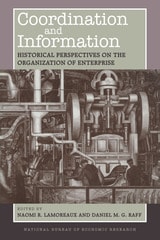
Coordination and Information
Historical Perspectives on the Organization of EnterpriseEdited by Naomi R. Lamoreaux and Daniel M. G. Raff
University of Chicago Press, 1995
In an ideal world, the market would be the optimal provider of coordination, but in the real world of incomplete information, some activities are better coordinated in other ways. Divided into three parts, this book addresses coordination within firms, at the borders of firms, and outside firms, providing a picture of the overall incidence and logic of economic coordination. The case studies—drawn from the late nineteenth and early twentieth century, when the modern business enterprise was evolving, address such issues as the relationship between coordination mechanisms and production techniques, the logic of coordination in industrial districts, and the consequences of regulation for coordination.
Continuing the work on information and organization presented in the influential Inside the Business Enterprise, this book provides material for business historians and economists who want to study the development of the dissemination of information and the coordination of economic activity within and between firms.
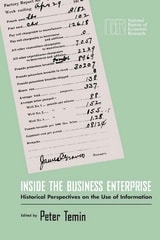
Inside the Business Enterprise
Historical Perspectives on the Use of InformationEdited by Peter Temin
University of Chicago Press, 1991
Because business enterprises are complex institutions, these questions can prove difficult to address. All too often, firms are treated as the atoms of economics, the irreducible unit of analysis. This accessible volume, suitable for course use, looks more closely at the American firm—into its internal workings and its genesis in the Gilded Age. Focusing on the crucial role of imperfect and asymmetric information in the operation of enterprises, Inside the Business Enterprise forges an innovative link between modern economic theory and recent business history.
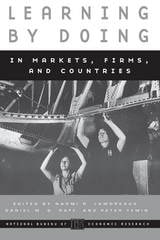
Learning by Doing in Markets, Firms, and Countries
Edited by Naomi R. Lamoreaux, Daniel M. G. Raff, and Peter Temin
University of Chicago Press, 1998
The first three essays in this volume explore techniques firms have used to both manage information to create valuable asymmetries and to otherwise suppress unwelcome competition. The next three focus on the ways in which firms have built special capabilities over time, capabilities that have been both sources of competitive advantage and resistance to new opportunities. The last two extend the notion of learning from the level of firms to that of nations. The collection as a whole builds on the previous two volumes to make the connection between information structure and product market outcomes in business history.
Modelling Enterprise Architectures
Jon Holt
The Institution of Engineering and Technology, 2010
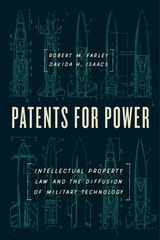
Patents for Power
Intellectual Property Law and the Diffusion of Military TechnologyRobert M. Farley and Davida H. Isaacs
University of Chicago Press, 2020
The book probes two major issues: the effect of IP law on innovation itself and the effect of IP law on the international diffusion, or sharing, of technology. Discussing a range of inventions, from the AK-47 rifle to the B-29 Superfortress bomber to the MQ-1 Predator drone, the authors show how IP systems (or their lack) have impacted domestic and international relations across a number of countries, including the United States, Russia, China, and South Korea. The study finds, among other results, that while the open nature of the IP system may encourage industrial espionage like cyberwarfare, increased state uptake of IP law is helping to establish international standards for IP protection. This clear-eyed approach to law and national security is thus essential for anyone interested in history, political science, and legal studies.

Secret Manoeuvres in the Dark
Corporate and Police Spying on ActivistsEveline Lubbers
Pluto Press, 2012
The exposure of undercover policeman Mark Kennedy in the eco-activist movement revealed how the state monitors and undermines political activism. This book shows the other grave threat to our political freedoms - undercover activities by corporations.
Secret Manoeuvres in the Dark documents how corporations are halting legitimate action and investigation by activists. Using exclusive access to previously confidential sources, Eveline Lubbers shows how companies such as Nestlé, Shell and McDonalds use covert methods to evade accountability. She argues that corporate intelligence gathering has shifted from being reactive to pro-active, with important implications for democracy itself.
Secret Manoeuvres in the Dark will be vital reading for activists, investigative and citizen journalists, and all who care about freedom and democracy in the 21st century.
Thinker, Faker, Spinner, Spy
Corporate PR and the Assault on DemocracyEdited by David Miller and William Dinan
Pluto Press, 2007
Written by leading activists and writers, this book reveals the secrets of the PR trade including deception, the use of fake 'institutes', spying and dirty tricks. The impact can be devastating -- when the public is denied access to the truth, the results are rising inequality and environmental catastrophe.
Exposing the misdeeds of famous companies including Coca Cola, British Aerospace, Exxon and Monsanto, and revealing information about the covert funding of various apparently independent thinks tanks and institutes, the authors offer a guide to campaigns that can help us roll back corporate power and resist deceptive PR.