Results by title
2 books match the query 'Business logistics'
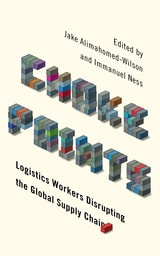
Choke Points
Logistics Workers Disrupting the Global Supply ChainEdited by Jake Alimahomed-Wilson and Immanuel Ness
Pluto Press, 2017
Global capitalism is a precarious system. Relying on the steady flow of goods across the world, trans-national companies such as Wal-Mart and Amazon depend on the work of millions in docks, warehouses and logistics centres to keep their goods moving.
This is the global supply chain, and, if the chain is broken, capitalism grinds to a halt. This book looks at case studies across the world to uncover a network of resistance by these workers who, despite their importance, often face vast exploitation and economic violence.
Experiencing first hand wildcat strikes, organised blockades and boycotts, the authors explore a diverse range of case studies, from South China dockworkers to the transformation of the port of Piraeus in Greece, and from the Southern California logistics sector, to dock and logistical workers in Chile and unions in Turkey.
[more]
Fragmenting Globalization
The Politics of Preferential Trade Liberalization in China and the United StatesKa Zeng and Xiaojun Li
University of Michigan Press, 2021
Global supply chain integration is not only a rapidly growing feature of international trade, it is responsible for fundamentally changing trade policy at international and domestic levels. Given that final goods are produced with both domestic and foreign suppliers, Ka Zeng and Xiaojun Li argue that global supply chain integration pits firms and industries that are more heavily dependent on foreign supply chains against those that are less dependent on intermediate goods for domestic production. Hence, businesses whose supply chain would be disrupted as a result of increased trade barriers should lobby for preferential trade liberalization to maintain access to those foreign markets. Moreover, businesses whose products are used in the production of goods in foreign countries should also support preferential trade liberalization to compete with suppliers from other parts of the world.
Fragmenting Globalization uses multiple methods, including time series, cross-sectional analysis of the pattern of Preferential Trade Alliance formation by existing World Trade Organization members, a firm-level survey, and case studies of the pattern of corporate support for regional trade liberalization in both China and the United States. Zeng and Li show that the growing fragmentation of global production, trade, and investment is altering trade policy away from the traditional divide between export-oriented and import-competing industries.
Fragmenting Globalization uses multiple methods, including time series, cross-sectional analysis of the pattern of Preferential Trade Alliance formation by existing World Trade Organization members, a firm-level survey, and case studies of the pattern of corporate support for regional trade liberalization in both China and the United States. Zeng and Li show that the growing fragmentation of global production, trade, and investment is altering trade policy away from the traditional divide between export-oriented and import-competing industries.
[more]