Results by title
15 books match the query 'Butterflies & Moths'

Butterflies in Your Pocket
A Guide to the Butterflies of the Upper MidwestSteve & Diane Hendrix & Debinski
University of Iowa Press, 2003
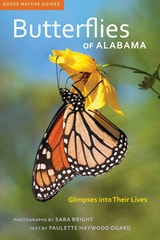
Butterflies of Alabama
Glimpses into Their LivesPaulette H. Ogard, Sara C. Bright
University of Alabama Press, 2010
Capture Every Stage of Alabama’s Butterfly Wonder.
Butterflies of Alabama is a full-color, richly illustrated guide to the 84 known species of “true” butterflies (Papilionoidea) found within the state’s borders. For more than 14 years, the authors have made a close study of these showy, winged stars of the insect world, pursuing them in a great variety of habitats, rearing them, and photographing their remarkable life cycle stages—egg, larva (caterpillar), pupa (chrysalid or “cocoon”), and adult.
Each species account is accompanied by color photographs of live subjects in their natural habitats. Close-ups reveal fascinating details of camouflage, mimicry, coloration, and warning devices. The engaging text explains the highly evolved relationships between butterflies and the plants upon which they depend as well as the specialized adaptations that enable their survival within specific environmental niches. Included are range maps, flight times, caterpillar host plants, adult nectar sources, and identification tips—abundant information to tantalize budding as well as experienced butterfly watchers. In addition, pertinent conservation issues are addressed and appendices provide an annotated checklist of the state’s butterflies, a list of accidentals and strays, information on butterfly organizations, and recommended further reading.
With its non-technical language, simple format, and beautiful images, Butterflies of Alabama is accessible and appealing to anyone who appreciates Alabama’s amazing natural wealth.
Publication is supported in part by the Citizens of the City of Selma, Alabama's Butterfly Capital.
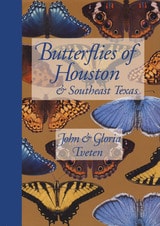
Butterflies of Houston and Southeast Texas
By John and Gloria Tveten
University of Texas Press, 1996
All across the country, butterflies are becoming as popular as birds and wildflowers, especially among people seeking to enjoy the rich natural resources that Texas possesses. John and Gloria Tveten have been studying butterflies in Southeast Texas for thirty-five years, and here they offer their considerable knowledge to everyone who shares their passion for butterflies.
In this easy-to-use field guide, the Tvetens describe and illustrate more than 100 species of butterflies that live in Southeast Texas and can often be found across the state. Striking color photographs of living butterflies and caterpillars (a unique addition) show the key marks and characteristics necessary for field identification. The Tvetens' enjoyable and authoritative text describes each species' life history, habits, flight patterns, and characteristic markings.
An account of the different butterfly families, from swallowtails to longwings to skippers, precedes the descriptions of the species within each family. The Tvetens also include an interesting discussion of butterfly biology, a complete checklist of area butterflies, an index of butterfly-attracting plants, and pointers to other butterfly resources.
This field guide is the first to focus exclusively on Southeast Texas butterflies. It will be the essential reference for everyone seeking a reliable way to identify these butterflies, from field observers to apartment dwellers who wonder what is fluttering around the pot plants on the balcony.
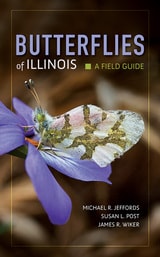
Butterflies of Illinois
A Field GuideMichael R. Jeffords, Susan L. Post, and James R. Wiker
University of Illinois Press, 2019
- identification quick guides depicting the tops and undersides of all butterfly species
- scientific information and photos that explain life cycles, habitats, and ecology
- range maps
- flight period charts
- key characteristics relevant to field identification
- descriptions of rarely seen butterflies and irregular visitors from nearby states
- supplemental information on various species, including collection records and unusual sightings
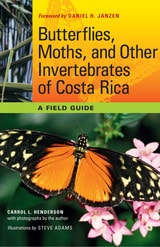
Butterflies, Moths, and Other Invertebrates of Costa Rica
A Field GuideBy Carrol L. Henderson, with photographs by the author
University of Texas Press, 2010
At the biological crossroads of the Americas, Costa Rica hosts an astonishing array of plants and animals—over half a million species! Ecotourists, birders, and biologists come from around the world, drawn by the likelihood of seeing more than three or four hundred species of birds and other animals during even a short stay. To help all these visitors, as well as local residents, identify and enjoy the wildlife of Costa Rica, Carrol Henderson published Field Guide to the Wildlife of Costa Rica in 2002, and it instantly became the indispensable guide.
Now Henderson has created a dedicated field guide to more than one hundred tropical butterflies, moths, and other invertebrates that travelers are most likely to see while exploring the wild lands of Costa Rica. He includes fascinating information on their natural history, ecology, identification, and behavior gleaned from his forty years of travels and wildlife viewing, as well as details on where to see these remarkable and beautiful creatures. The butterflies, moths, and other invertebrates are illustrated by over 180 stunning and colorful photographs—most of which were taken in the wild by Henderson. A detailed and invaluable appendix that identifies many of Costa Rica's best wildlife-watching destinations, lodges, and contact information for trip-planning purposes completes the volume.
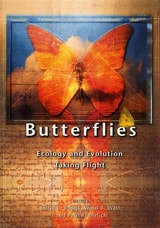
Butterflies
Ecology and Evolution Taking FlightEdited by Carol L. Boggs, Ward B. Watt, and Paul R. Ehrlich
University of Chicago Press, 2003
The first international synthesis of butterfly biology in two decades, Butterflies: Ecology and Evolution Taking Flight offers students, scientists, and amateur naturalists a concise overview of the latest developments in the field. Furthermore, it articulates an exciting new perspective of the whole group of approximately 15,000 species of butterflies as a comprehensive model system for all the sciences concerned with biodiversity and its preservation.
Contributors:
Carol L. Boggs, Paul M. Brakefield, Adriana D. Briscoe, Dana L. Campbell, Elizabeth E. Crone, Mark Deering, Henri Descimon, Erika I. Deinert, Paul R. Ehrlich, John P. Fay, Richard ffrench-Constant, Sherri Fownes, Lawrence E. Gilbert, André Gilles, Ilkka Hanski, Jane K. Hill, Brian Huntley, Niklas Janz, Greg Kareofelas, Nusha Keyghobadi, P. Bernhard Koch, Claire Kremen, David C. Lees, Jean-François Martin, Antónia Monteiro, Paulo César Motta, Camille Parmesan, William D. Patterson, Naomi E. Pierce, Robert A. Raguso, Charles Lee Remington, Jens Roland, Ronald L. Rutowski, Cheryl B. Schultz, J. Mark Scriber, Arthur M. Shapiro, Michael C. Singer, Felix Sperling, Curtis Strobeck, Aram Stump, Chris D. Thomas, Richard VanBuskirk, Hans Van Dyck, Richard I. Vane-Wright, Ward B. Watt, Christer Wiklund, and Mark A. Willis
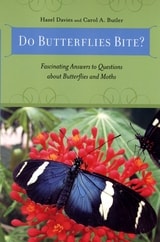
Do Butterflies Bite?
Fascinating Answers to Questions about Butterflies and MothsDavies, Hazel
Rutgers University Press, 2008
Every year, thousands of people visit butterfly conservatories to stand in quiet awe of the simple beauty displayed by these magical creatures. Hazel Davies and Carol A. Butler capture the sense of wonderment and curiosity experienced by adults and children alike in this book about butterflies and their taxonomic cousins, the moths and the skippers. Beautifully illustrated with color and black and white photographs, and drawings by renowned artist William Howe, this book is an essential resource for parents, teachers, students, or anyone who has ever been entranced by these fascinating, fluttering creatures.
Covering everything from their basic biology to their complex behaviors at every stage of life to issues in butterfly conservation, Davies and Butler explore wide-ranging topics and supply a trove of intriguing facts. You'll find tips on how to attract more butterflies to your garden, how to photograph them, and even how to raise them in your own home. Arranged in a question and answer format, the book provides detailed information written in an accessible style that brings to life the science and natural history of these insects. In addition, sidebars throughout the book detail an assortment of butterfly trivia, while extensive appendices direct you to organizations, web sites, and more than 200 indoor and outdoor public exhibits, where you can learn more or connect with other lepidopterophiles (butterfly lovers).
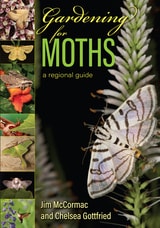
Gardening for Moths
A Regional GuideJim McCormac
Ohio University Press, 2023
This guide to moths, native plants, and their environmental roles is an indispensable resource for gardeners, conservationists, and nature enthusiasts across the midwestern United States.
Gardening for Moths is the first book to show midwestern gardeners and naturalists why they should attract specific moth species to their properties and how to do it. The book’s stunning color photographs and intriguing facts reveal the fascinating world of these insects, inspiring readers to incorporate moth-loving native plants into their landscapes. The authors emphasize the importance of moths and their caterpillars to ecological food webs, widening the book’s appeal to birders and bat lovers as well.
The book consists of three main sections, beginning with a thorough overview of moths, including their
- population decline and conservation,
- importance in ecosystems,
- relationship with native plants, and
- predators and defenses
In the next section the authors profile about 140 plant species, providing brief background, natural history, habitat, and growing notes for each along with lists of potential moths the plants may attract.
The third section highlights approximately 150 moth species, ordered taxonomically. These accounts include interesting facts about the life history of both the caterpillar and adult moth of each species. Each account also features a list of the species’ common host plants.
Throughout the volume, inset text boxes provide additional fascinating moth facts. Beautiful photographs (most by the authors) illustrate every included plant and moth species. Select references, online resources, and quick reference tables round out this valuable resource.
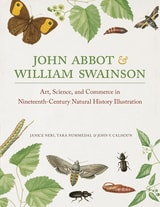
John Abbot and William Swainson
Art, Science, and Commerce in Nineteenth-Century Natural History IllustrationJanice Neri, Tara Nummedal, and John V. Calhoun
University of Alabama Press, 2019
During his lifetime (1751–ca. 1840), English-born naturalist and artist John Abbot rendered more than 4,000 natural history illustrations and profoundly influenced North American entomology, as he documented many species in the New World long before they were scientifically described. For sixty-five years, Abbot worked in Georgia to advance knowledge of the flora and fauna of the American South by sending superbly mounted specimens and exquisitely detailed illustrations of insects, birds, butterflies, and moths, on commission, to collectors and scientists all over the world.
Between 1816 and 1818, Abbot completed 104 drawings of insects on their native plants for English naturalist and patron William Swainson (1789–1855). Both Abbot and Swainson were artists, naturalists, and collectors during a time when natural history and the sciences flourished. Separated by nearly forty years in age, Abbot and Swainson were members of the same international communities and correspondence networks upon which the study of nature was based during this period.
The relationship between these two men—who never met in person—is explored in John Abbot and William Swainson: Art, Science, and Commerce in Nineteenth-Century Natural History Illustration. This volume also showcases, for the first time, the complete set of original, full-color illustrations discovered in 1977 in the Alexander Turnbull Library in Wellington, New Zealand. Originally intended as a companion to an earlier survey of insects from Georgia, the newly rediscovered Turnbull manuscript presents beetles, grasshoppers, butterflies, moths, and a wasp. Most of the insects are pictured with the flowering plants upon which Abbot thought them to feed. Abbot’s journal annotations about the habits and biology of each species are also included, as are nomenclature updates for the insect taxa.
Today, the Turnbull drawings illuminate the complex array of personal and professional concerns that informed the field of natural history in the eighteenth and nineteenth centuries. These illustrations are also treasured artifacts from times past, their far-flung travels revealing a world being reshaped by the forces of global commerce and information exchange even then. The shared project of John Abbot and William Swainson is now brought to completion, signaling the beginning of a new phase of its significance for modern readers and scholars.
Life Histories of Cascadia Butterflies
David G. James
Oregon State University Press, 2011
Moth Catcher
An Evolutionist's Journey Through Canyon And PassMichael M. Collins
University of Nevada Press, 2007
The memoir of a scientist and the wild silk moths he studies
Biologist Michael Collins has been studying wild silk moths since he was a boy. This family — which includes the largest and most colorful of the North American moths — led Collins into a long career as a scientist, and has provided him with significant insights into the process by which new species evolve. Moth Catcher is Collins’s engaging account of his development as a scientist and of his groundbreaking research. The canyon and pass environments of the American West offer a setting in which, since the last Ice Age, organisms have adapted to new surroundings and where many have formed new species. Collins has discovered in the Sierra Nevada that geneticists call a “hybrid zone” where two species interbreed. This hybrid zone is unusual because both sexes are fertile, unlike lab-bred hybrids between the same silk moth species. Collins explains how such hybrid populations serve as laboratories in nature where the process of speciation can be observed and studied. This book offers a fascinating view into the work of a field scientist and the ways that evolution continues to operate around us. Collins’s colorful accounts of his fieldwork will delight any reader who loves the outdoors and is captivated by the diversity and interrelations of the life forms found there. And his passion for his research and the fragile, exquisite creatures that he studies will inspire a new appreciation of the wonders of the natural world and the myriad life forms that occupy it.
Moths in Your Pocket
A Guide to the Saturn and Sphinx Moths of the Upper MidwestJim Durbin, Frank Olsen, and Tom Jantscher
University of Iowa Press, 2014
The Saturniid, or Giant Silk moths, are well named. Their large size—up to 6.5 inches for the cecropia moth—and the soft silky browns, greens, and oranges of their wings are unforgettable when they appear at a lighted window at night. Equally well named are the Sphinx or Hawk moths, important pollinators that hover like hummingbirds when nectar-feeding at dusk and even in daylight. The caterpillars of both families can be just as distinctive as the adults, as anyone who has ever come upon a tobacco or a tomato hornworm can attest.
For each species the authors have included common and scientific names, wingspan, and time of flight for the adults at this final stage in their life cycle. Striking photographs of the adult moths and of their larval stages make this guide as beautiful as it is useful.
For all naturalists captivated by the clear window eyespots of a Swallow-tailed Luna moth, the dark eyespots and bright yellow “pupils” of an Io moth, or the extendable proboscis of a White-lined Sphinx moth flitting from one moss rose to another, the photographs and descriptions in Moths in Your Pocket will be an invaluable reference.
Rainbow Dust
Three Centuries of Butterfly DelightPeter Marren
University of Chicago Press, 2016
At the age of five, Marren had his “Nabokov Moment,” catching his first butterfly and feeling the dust of its colored scales between his fingers. It was a moment that would launch a lifetime’s fascination rivaling that of the famed novelist—a fascination that put both in good company. From the butterfly collecting and rearing craze that consumed North America and Europe for more than two hundred years (a hobby that in some cases bordered on madness), to the potent allure of butterfly iconography in contemporary advertisements and their use in spearheading calls to conserve and restore habitats (even though butterflies are essentially economically worthless), Marren unveils the many ways in which butterflies inspire us as objects of beauty and as symbols both transient and transcendent.
Floating around the globe and through the whole gamut of human thought, from art and literature to religion and science, Rainbow Dust is a cultural history rather than merely a natural one, a tribute to butterflies’ power to surprise, entertain, and obsess us. With a sway that far surpasses their fragile anatomy and gentle beat, butterfly wings draw us into the prismatic wonders of the natural world—and, in the words of Marren, these wonders take flight.
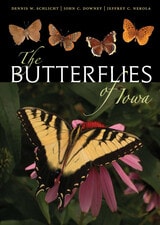
The Butterflies of Iowa
Dennis W. Schlicht
University of Iowa Press, 2007
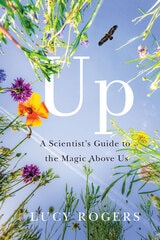
UP
A Scientist's Guide to the Magic Above UsLucy Rogers
Michigan State University Press, 2027
Engineer and bubble scientist Lucy Rogers invites us to explore the wonders of the air, sky, and space; understand the science; and appreciate the insights this offers about life on Earth. The sky is a world of endless wonder. From the intricate dance of clouds and the vibrant hues of the aurora borealis to the marvel of effortless soaring birds and the silent majesty of the stars, it is a living storybook. Join Rogers on a marvelous adventure through a kite market in India, creep through the Borneo jungle to witness millions of bats pour out of a cave at dusk, venture to Tornado Alley to chase the raw power of storms, and journey to Mexico to stand in awe of a total solar eclipse. Up is for anyone who has ever looked up at the sky in awe and needs to know the science behind its never-ending phenomena.